How Many Christmas Lights Can You Plug Into One Outlet?
Key Takeaways
- There is no universal number of Christmas light strands that is safe for every outlet; the answer depends on each strand’s electrical load, the outlet’s circuit, and other devices sharing it.
- Add the wattage or amperage shown on the light labels, then compare the combined load with the ratings for the circuit and any extension cord or power strip.
- Follow the manufacturer’s limit for how many strands can connect end to end; an outlet’s capacity does not override that limit.
- Use outdoor-rated lights and cords outside, plug outdoor lights into GFCI-protected outlets, and avoid stacking power strips and extension cords.
Table of Contents
- How many Christmas lights can you plug into one outlet?
- How to calculate the combined load from Christmas lights
- Do LED and incandescent Christmas lights change the count?
- Why the manufacturer’s strand limit still matters
- How other devices on the same circuit affect your lights
- Can you use an extension cord or power strip?
- What changes when Christmas lights are outdoors?
- Warning signs and common mistakes to avoid
- Which approach makes sense for your setup?
- Frequently Asked Questions
- Key points before you plug in
Short answer: You can plug in as many Christmas lights as the electrical circuit and equipment ratings safely allow, but there is no reliable strand count that applies to every home or product. Check the light labels and manufacturer instructions, add up the load of the lights and other devices on the same circuit, and stay within the ratings of the outlet circuit, cords, and power strips.
How many Christmas lights can you plug into one outlet?
The number is determined by electrical load, not by how many open receptacle slots you see. A single wall outlet can share a circuit with other outlets and devices, so an unused slot does not necessarily mean the circuit has spare capacity.
Consumers Credit Union recommends adding the power drawn by devices already connected to a power strip and comparing the total with the strip’s rating. Apply the same careful thinking to a holiday setup: count all the loads involved, not just the light strands plugged directly into the outlet.
| What to check | Why it affects the answer |
|---|---|
| Light labels and instructions | They show the product’s electrical load and the manufacturer’s strand-connection limit. |
| Other devices on the circuit | Those devices use capacity that is not available for the holiday lights. |
| Extension cord or power strip rating | The connected equipment must stay within the rating of the equipment carrying the load. |
| Indoor or outdoor use | Outdoor lights, cords, and outlet protection must be appropriate for outdoor conditions. |
A strand count alone can mislead. Two products that look similar may list different electrical requirements, so use the information printed on the actual lights rather than a rule of thumb based on “one outlet” or “one tree.”
How to calculate the combined load from Christmas lights
Start with the electrical information printed on each strand, then add the loads for everything that will operate on the same circuit at the same time. If a product lists watts, add the wattage figures; if it lists amps, add the amperage figures. Compare the result with the applicable circuit and equipment ratings.
- Read each light label. Look for the electrical load, such as watts or amps, and any stated limit on connected strands. Use the figures for the exact product you plan to install.
- List every strand that will be on together. Include lights on the tree, windows, porch, and other displays if they share the circuit.
- Add other operating devices. Include devices plugged into other outlets on that same circuit, not only the lights and equipment visible at the decorating location.
- Check every rating in the path. Compare the total against the circuit and against the rating printed on each extension cord or power strip you use.
- Follow the lowest applicable limit. The strand-connection limit, circuit capacity, or cord and strip rating can each restrict the setup. Stay within all of them.
For example, if three strands each list a wattage, add those three figures before considering other devices. The available capacity is not simply the outlet’s total rating: other loads on the circuit and the ratings of any intermediate equipment also matter.
If the circuit rating or which outlets share a circuit is unclear, do not guess at a maximum strand count. Use the electrical information available at the panel and on the products; if the remaining capacity cannot be established, have a qualified electrician assess the setup.
Do LED and incandescent Christmas lights change the count?
The product label—not the bulb category—is the useful basis for calculating how many strands you can run. LED and incandescent lights may have different electrical requirements, but the exact load depends on the particular product, so do not assume a fixed number of strands for either type.
Compare the labels for the specific strands you own. If one set lists a lower load than another, that label can help you understand how each set contributes to the combined total. Still, a lower-load strand does not cancel the manufacturer’s limit on how many strands may connect end to end.
- Shopping for new lights: Compare the electrical load and connection instructions on the packages before choosing how many sets to use.
- Mixing old and new lights: Add the load for every set and follow the instructions for each product. Do not assume different strands are interchangeable just because their plugs fit.
- Using lights without a readable label: Look for the manufacturer’s instructions for that product. If you cannot establish the load or connection limit, do not use guesswork to build a large connected run.
Safe Electricity advises connecting only the number of light strands recommended by the manufacturer. That instruction is separate from the outlet calculation: even when the circuit has capacity, the product’s own connection limit still applies.
Why the manufacturer’s strand limit still matters
The “maximum connected strands” instruction applies to a line of lights joined end to end. It is not a universal allowance for every strand in the room, and it does not tell you how much capacity remains on the home circuit.
Read the product instructions for each set and keep connected runs within the stated limit. If you have more lights than one run permits, do not extend that run beyond its instructions simply because the final plug fits. Plan separate connections only where the circuit and all cord or power-strip ratings allow them.
This distinction prevents a common planning error: treating the manufacturer’s strand count as the maximum number for an entire outlet, or treating the outlet as permission to exceed the strand limit. They answer different questions. The first concerns the connected light run; the second concerns the total electrical load and the equipment serving it.
How other devices on the same circuit affect your lights
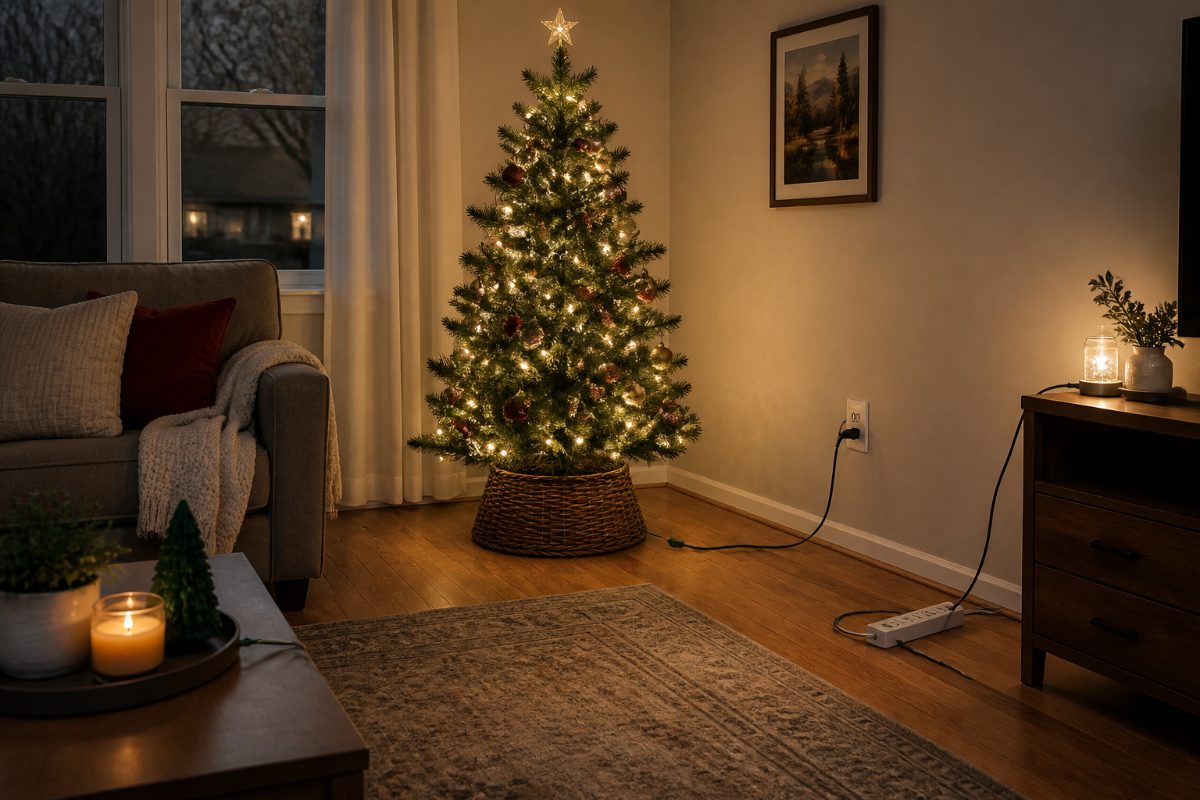
Christmas lights plugged into different wall receptacles can still draw power from the same circuit. That means a lamp, television, or another device on a nearby outlet can affect the capacity available to a holiday display if both outlets are on the same circuit.
Before adding lights, identify which other devices will be operating at the same time. A practical way to organize the check is to note the outlets and devices in the decorating area, use the circuit labels at the electrical panel as a starting point, and confirm the circuit assignment without opening electrical equipment or touching wiring. If the labels do not clearly identify the circuit, do not treat an unknown load as spare capacity.
| Setup | What to include in the load check |
|---|---|
| Tree lights in a living room | Tree strands plus other devices on the same circuit that will run at the same time. |
| Several window displays | All the strands, even if they plug into separate receptacles, when those receptacles share a circuit. |
| Lights and a power strip | Every device connected to the strip, plus any other loads on the circuit. |
| Outdoor display supplied from indoors | The lights and any devices sharing the supplying circuit, as well as the outdoor cord’s rating and intended use. |
Consumers Credit Union specifically cautions that an empty slot on a power strip does not prove that the strip can handle another device. The same logic applies to an apparently unused wall receptacle: availability of a plug is not a load calculation.
Can you use an extension cord or power strip?
Use an extension cord or power strip only when the setup requires it, and make sure its rating accommodates the combined load. Consumers Credit Union advises plugging decorations directly into an outlet when possible and warns against connecting a power strip to an extension cord, or combining those devices in a chain.
Before using a strip, add the load of everything already connected to it and compare the sum with the strip’s rating. Do not fill an unused socket just because it is open. If you need a cord for an outdoor display, choose one rated for outdoor use; keep the cord and connections arranged so they are not routed through a doorway or window, where the cord could be damaged.
- Plug a power strip directly into a wall outlet rather than into another power strip.
- Avoid using a power strip and an extension cord together in a series.
- Check the cord or strip rating and the connected products’ instructions before powering the display.
- Do not run cords through doorways or under rugs or carpets.
For more on choosing and placing cords for a seasonal display, see Outdoor Extension Cord Safety for Christmas Lights. A cord can provide reach, but it does not increase the capacity of the circuit supplying it.
What changes when Christmas lights are outdoors?
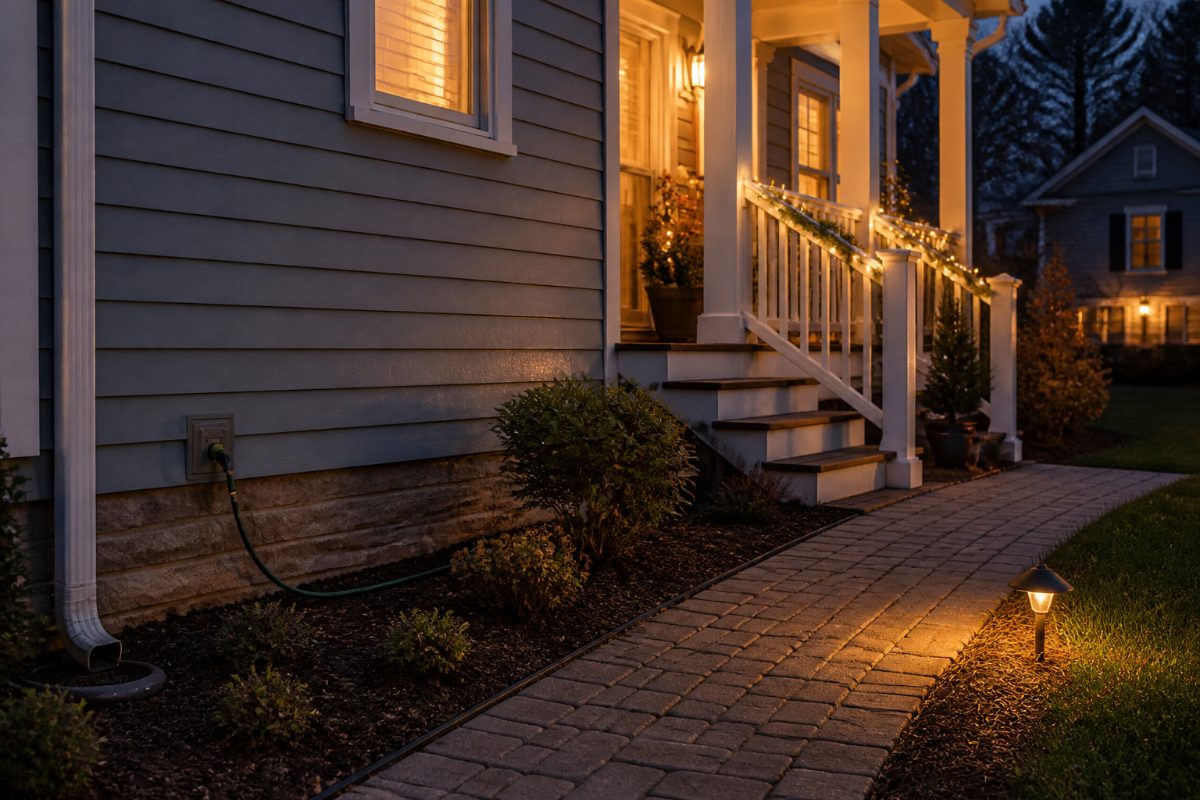
Outdoor lights need equipment and outlet protection intended for outdoor use. Safe Electricity says to use only outdoor-rated lights outside and to plug outdoor lights into GFCI-protected outlets. GFCI protection is designed to interrupt power when it detects a ground-fault condition.
Check the light strand and extension cord for an outdoor-use rating before setting up the display. Safe Electricity also recommends inspecting strands for frayed cords, broken sockets, or damaged plugs, and using plastic clips or hooks rather than nails or staples to secure lights. Keep cords out of walkways and do not route them beneath rugs or carpets.
Do not solve a reach problem by feeding an outdoor cord through a door or window. Americord cautions that this can damage the cord’s insulation. If the available cord will not reach without being pinched or exposed to damage, reposition the display or use an appropriately rated cord arrangement instead.
Warning signs and common mistakes to avoid
Damaged wiring, broken sockets, and damaged plugs are reasons to set a strand aside rather than connect it. Safe Electricity recommends checking for these defects before installation, which makes the inspection easier before lights are hung or hidden behind a tree.
- Counting plugs instead of load: An empty receptacle does not show how much circuit capacity remains.
- Ignoring other devices: Add the loads that will run on the same circuit, including devices plugged in elsewhere.
- Exceeding the strand limit: Follow the manufacturer’s connected-strand instructions even when the calculated circuit load appears low.
- Stacking cords and strips: Do not create a chain of power strips or combine a strip with an extension cord in series.
- Using indoor products outside: Use outdoor-rated lights and cords for outdoor displays, and use a GFCI-protected outlet.
- Leaving lights on unattended: Safe Electricity advises turning holiday lights off before leaving home or going to bed.
Which approach makes sense for your setup?
A small indoor display and a large outdoor arrangement call for different checks, but both depend on product labels, shared circuit load, and equipment ratings. Choose the simplest setup that stays within every stated limit.
| Your situation | Practical next step |
|---|---|
| You are setting up lights for the first time | Start with the labels and instructions. Record each strand’s load and connected-strand limit before plugging anything in. |
| You already have several displays | List the strands and other devices by circuit, not just by room or receptacle, and total the loads that will run together. |
| You need a longer reach | Use a properly rated cord for the setting, avoid cord-and-strip chains, and keep the cord away from doors, windows, rugs, and walkways. |
| You cannot find a product rating or circuit information | Do not estimate a safe strand count. Find the manufacturer’s instructions or get the circuit assessed before expanding the setup. |
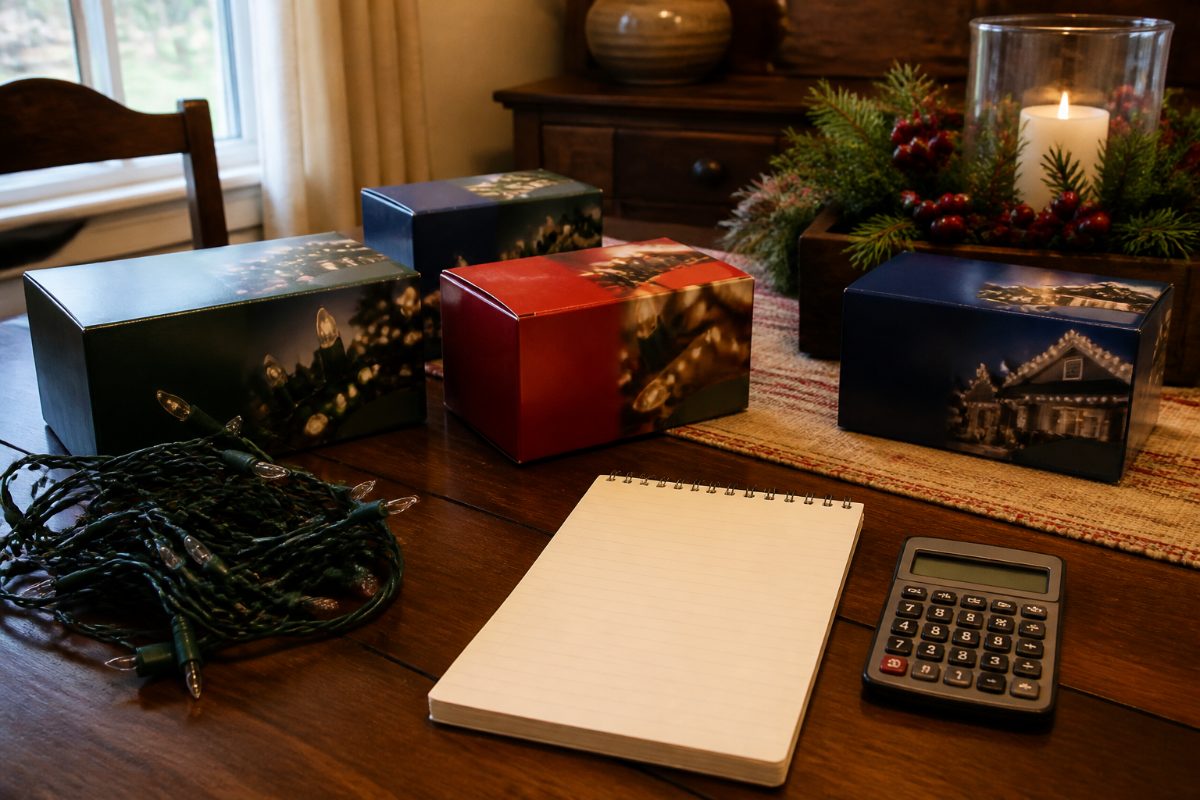
Before you plug in the display, make a short written list: strand load, strand-connection limit, other devices on the circuit, and the rating of each cord or strip. If any one of those checks leaves the total uncertain, reduce the setup or resolve the missing rating before adding more lights.
Frequently Asked Questions
Is there a standard number of Christmas light strands per outlet?
No single strand count works for every outlet and product. The count depends on the light labels, manufacturer instructions, other devices on the same circuit, and the ratings of any cords or power strips.
Can I connect more strands if they are LED?
Use the load printed on the specific LED product rather than assuming a set number based on bulb type. Follow the manufacturer’s limit for connected strands and include other circuit loads in your calculation.
Can I plug a power strip into an extension cord for Christmas lights?
Consumers Credit Union advises against combining a power strip and extension cord in that arrangement. Plug decorations directly into an outlet when possible, and make sure any cord or strip used is rated for the connected load.
Do lights in different outlets count toward the same limit?
They do if those outlets share the same electrical circuit. Count the lights and other devices that will operate on that circuit, not just the equipment plugged into one receptacle.
What should I do if a light strand has no readable rating?
Look for the product’s manufacturer instructions and use the listed load and connection limit. If you cannot establish them, do not guess at a maximum number of strands.
Key points before you plug in
There is no outlet-based Christmas-light count that is safe to assume without checking the actual products and circuit. Read each strand’s electrical label, respect the connected-strand limit, include other devices on the same circuit, and compare the total with every cord and power-strip rating.
For the next step, gather the light labels and instructions, identify the other devices that will run on the same circuit, and write down the combined load. Then inspect the strands and plugs before installation; use outdoor-rated equipment and GFCI protection for outdoor displays.
References
- Read this before plugging in holiday lights - Articles | Consumers Credit Union
- Best Practices for Using Holiday Light Extension Cords
- Holiday Lights: Your Guide to Decorating Safely - Safe Electricity
Information in this post was checked as of October 2026. Policies and prices may change, so please verify important details with official sources.


Comments
Post a Comment