Outdoor Extension Cord Safety for Christmas Lights
Key Takeaways
- Choose an extension cord marked for outdoor use and lights labeled for outdoor use; an indoor cord is not a substitute.
- Inspect the cord and light strings before plugging them in, and replace damaged equipment instead of taping or routing around the damage.
- Use one cord that reaches the outlet without strain, keep it away from sharp edges and pinch points, and follow the product’s load instructions.
- Use a GFCI-protected receptacle for outdoor holiday lights, and switch the lights off before leaving home or going to bed.
Table of Contents
- How do you choose an outdoor extension cord for Christmas lights?
- Are indoor Christmas lights or cords safe to use outside?
- How should you inspect cords and light strings before plugging them in?
- How do you route and connect an outdoor extension cord safely?
- How many light strings can go on one extension cord?
- Which outlet and operating habits make an outdoor display safer?
- What should first-time decorators and experienced homeowners do differently?
- What should you do after the holiday display comes down?
- Frequently Asked Questions
- Key points to remember
Outdoor extension cord safety for Christmas lights starts with matching the cord, light strings, outlet, and route to outdoor use. A cord that reaches the display is not automatically suitable: its markings, condition, connected load, and exposure all matter.
How do you choose an outdoor extension cord for Christmas lights?
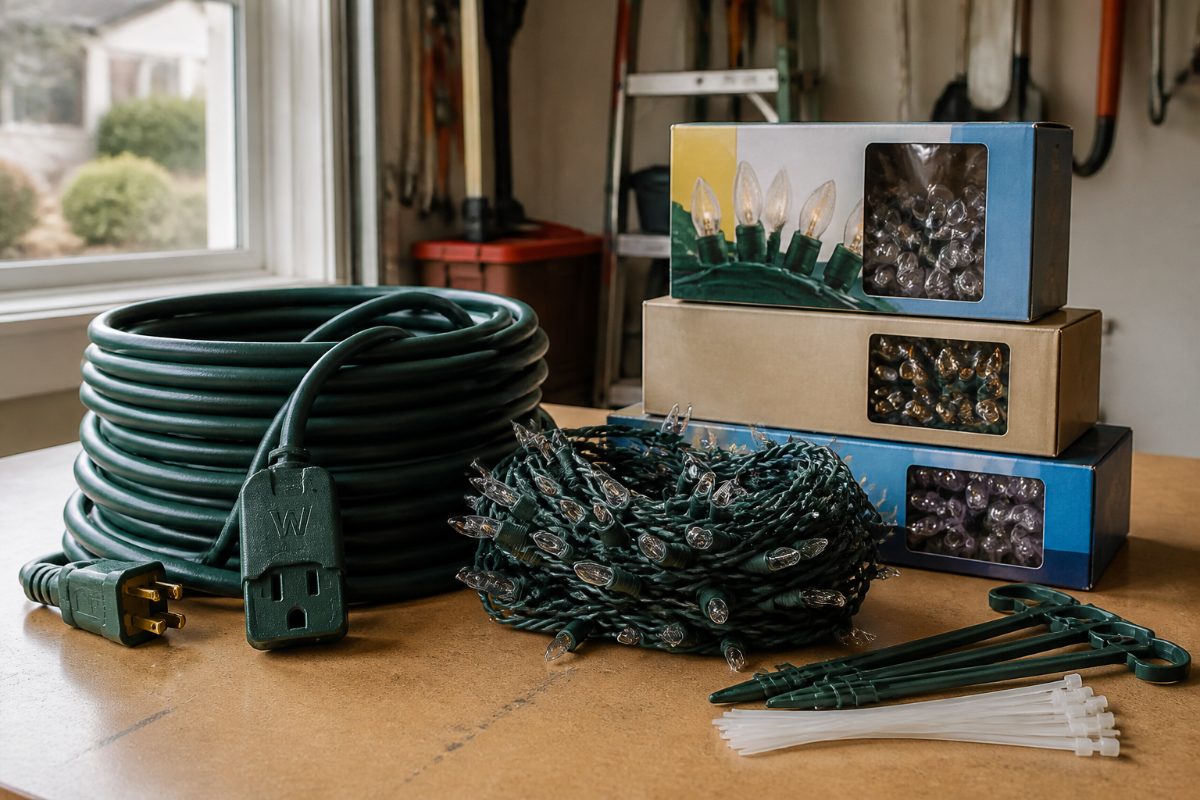
Choose a cord specifically marked for outdoor use, then compare its product instructions and electrical rating with the lights you plan to connect. MEMIC explains that the letter marking “W” or “W-A” identifies a weather-approved cord for outdoor use; a cord without that outdoor marking should stay indoors.
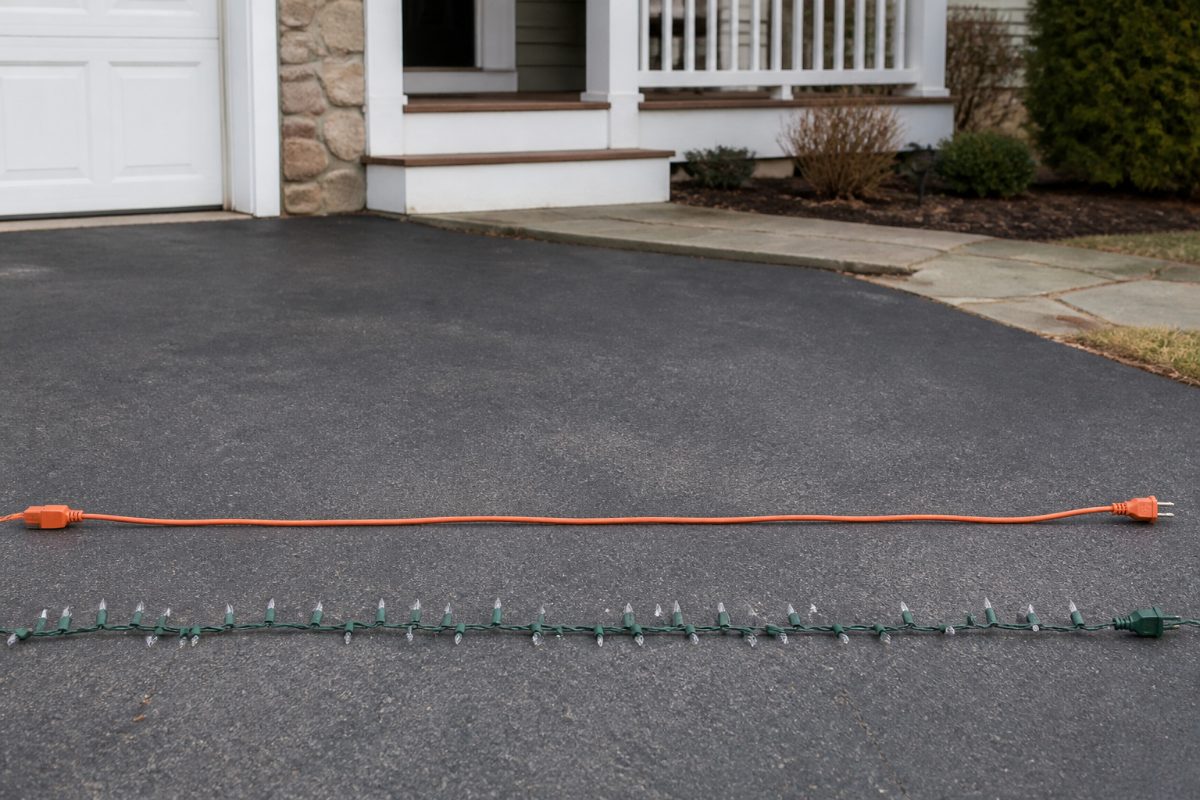
Start with the route from the receptacle to the display. Measure the path rather than the straight-line distance, including the turns needed to keep the cord away from walkways, doors, and sharp edges. Selecting a cord long enough for that route helps avoid a stretched connection or the temptation to join several cords end to end.
| What to inspect | What to look for | Why it matters |
|---|---|---|
| Outdoor marking | “W” or “W-A” on the cord marking | MEMIC identifies these markings with weather-approved outdoor use. |
| Electrical rating | The cord and light instructions show ratings compatible with the planned setup | The connected lights must remain within the cord’s stated capacity. |
| Light labels | Outdoor-use labeling and the manufacturer’s directions | The University of Texas Fire Prevention Services warns that some light strings are for indoor use only, while others are rated for outdoor or both uses. |
| Safety testing label | A label naming an independent testing laboratory | The University of Texas Fire Prevention Services advises looking for this label on lights and electrical decorations. |
Do not use “heavy-duty” as a substitute for checking the actual markings and rating. Cord construction and ratings differ, and the words on the packaging need to match the job; if the cord or light instructions do not clearly support the planned connection, choose a product that does.
Are indoor Christmas lights or cords safe to use outside?
No. Use outdoor-rated light strings and an outdoor-rated extension cord for an outdoor display. The University of Texas Fire Prevention Services says some lights are designed for indoor use, some for outdoor use, and some for both, so the label and manufacturer’s instructions determine where a particular set belongs.
Before decorating, read the product labels on both the light string and the cord. Do not assume that a covered porch makes indoor-only equipment suitable: the product must be labeled for the environment where it will be used. OPPD also advises checking that lights planned for outdoor use are certified for outdoor use and plugging them into GFCI-protected receptacles.
A common mistake is to judge suitability by appearance. A thick-looking cord or a familiar-looking light string does not tell you whether the product is approved for outdoor use. Use the markings, not color, thickness, or last year’s setup, to make that decision.
How should you inspect cords and light strings before plugging them in?
Unplug the equipment and inspect it along its full length before installation. Look for fraying, broken insulation, cracked or crushed sections, loose bulb connections, and damaged plugs; the University of Texas Fire Prevention Services specifically advises against using light strings with worn, frayed, broken cords, or loose bulb connections.
- Lay out each cord and light string where you can see its full length.
- Check the jacket, plug ends, and light connections for visible damage or looseness.
- Separate damaged items from the equipment you plan to install; replace faulty parts or the affected string rather than covering damage with tape.
- Read the product instructions and labels before reconnecting the equipment.
- After installation, switch the lights on and look for an abnormal change such as flickering or a connection that feels unusually warm; if something seems wrong, unplug the setup and stop using it.
Inspection matters because insulation protects the conductors inside a flexible cord. OSHA’s temporary-wiring rule says flexible cords and cables must be protected from damage and that sharp corners and projections should be avoided. That rule is written for construction settings, but the underlying lesson for a home display is practical: do not put a cord where its jacket can be cut, crushed, or abraded.
How do you route and connect an outdoor extension cord safely?
Plan the route so the cord is protected from foot traffic, sharp corners, moving doors, and other pinch points. OSHA’s temporary-wiring standard allows flexible cords to pass through doorways or pinch points only when protection is provided to prevent damage; for a home display, routing around the door is usually the simplest way to avoid that pinch point.
Use one appropriately rated cord that reaches the display whenever possible. Avoid joining cords end to end as a way to make a short cord reach; each additional connection creates another point that must remain compatible, protected, and secure. If a single cord cannot reach, rethink the outlet or display layout rather than stretching a cord or leaving connections where they can be walked on or damaged.
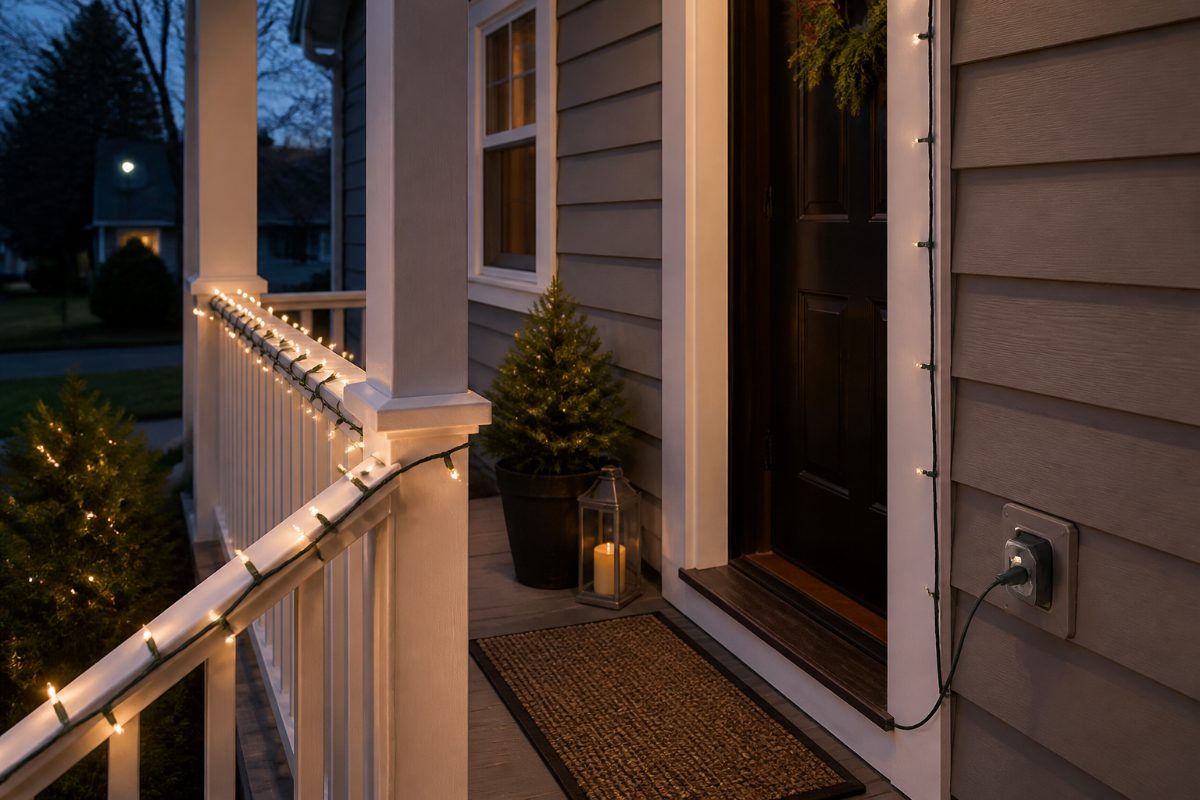
Keep the cord away from places where a door can shut on it or where furniture, decorations, or other objects can crush it. Do not secure Christmas-light wiring with nails, staples, or tacks: the University of Texas Fire Prevention Services warns that these fasteners can damage wire insulation and recommends clips instead. Use a clip suited to the installation and avoid fastening through the cord itself.
Connections and equipment should be used as their manufacturers direct. Do not treat an outdoor-rated cord as permission to leave a connection sitting in water or exposed in a way the product instructions do not allow. If you cannot route the setup without damage risk or unsuitable exposure, move the display or use a different approved arrangement.
How many light strings can go on one extension cord?
There is no single safe string count for every combination of lights and cord; follow the manufacturers’ load instructions and do not overload the cord. The University of Texas Fire Prevention Services advises avoiding more than three connected light strands, while Mississippi State University Extension says not to use more than three strings for each extension cord and to make sure the cord is rated for multiple-cord use.
Those recommendations are a useful ceiling, not a guarantee that three strings are acceptable for every product. Light strings differ, and the cord’s rating still controls what it can carry. The Sedona Rural Fire District’s December 2025 fire-safety guidance likewise says to use no more than three standard-size sets of lights per single extension cord; read that as a limit, not a target.
- One string: Check the cord and light instructions, then confirm the cord is suitable for the outdoor location and the connected load.
- Several strings: Follow the product’s stated connection limit and electrical rating; do not rely on a general “three strings” rule to override either label.
- Unclear rating or instructions: Do not guess. Reduce the number of connected sets or use products whose labels clearly support the setup.
Another common mistake is counting plugs instead of checking the rated load. A connector that physically accepts several plugs does not establish that the cord can carry the combined load. Keep the number and type of connected sets within the instructions for both the lights and the extension cord.
Which outlet and operating habits make an outdoor display safer?
Plug outdoor holiday lights into a GFCI-protected receptacle. OPPD gives this specific guidance for outdoor lights, alongside using lights labeled for outdoor use. A GFCI receptacle is the outlet protection named in that advice; it does not replace outdoor-rated products, sound cords, or correct installation.
Switch the display off before leaving home or going to sleep. The University of Texas Fire Prevention Services recommends turning off light strings and electrical decorations before either event. This routine also makes the display easier to manage: choose a clear shutoff point, such as a switch or outlet you can access without moving decorations or stepping over cords.
Use manufacturer instructions for the cord, lights, and any connection accessories. Avoid overloading the cord, and do not add another set simply because the lights still turn on. A working display can still exceed a product’s stated limit.
What should first-time decorators and experienced homeowners do differently?
First-time decorators should simplify the setup: one outdoor-rated cord, one clearly planned route, and only as many light strings as the product instructions permit. Experienced homeowners should not assume last year’s arrangement is still suitable; inspect every cord and string again, since the University of Texas Fire Prevention Services calls for checking light strands and fixing or replacing faulty parts before use.
| Your situation | Best next step | Common trap to avoid |
|---|---|---|
| First outdoor display | Confirm outdoor-use labels on both cord and lights, map the route, then inspect each item. | Using an indoor cord because the display is under a roof. |
| Reusing stored lights | Uncoil and inspect the entire string and cord before mounting them. | Plugging in first and checking only if something fails. |
| Display needs multiple strings | Compare the number of sets with the manufacturers’ connection and load directions. | Treating three strings as universally safe. |
| Door or walkway is in the route | Reroute the display or cord, and use clips to mount lights. | Pinching the cord in a door or fastening through its insulation. |
If the route requires a cord to cross a frequently used path, consider changing the display location so the cord is not exposed to routine foot traffic. The safe choice is the arrangement that avoids damage rather than one that depends on people stepping over the cord carefully.
What should you do after the holiday display comes down?
Remove outdoor lights after the holiday season and bring them inside for storage. The University of Texas Fire Prevention Services recommends bringing outdoor lights indoors after the season to reduce fire hazards and extend the life of the lights.
Unplug equipment before taking it down, then inspect it again as you coil it. Keep damaged items out of next season’s usable supplies, and store cords and lights according to the manufacturers’ instructions. Neat storage makes it easier to spot damage during the next pre-installation inspection instead of discovering it after the display is mounted.
Keep the cord and light instructions with the products if possible. That way, next season’s setup can start with the actual outdoor-use and load directions rather than memory or assumptions about what worked before.
Frequently Asked Questions
Can I use an indoor extension cord on a covered porch?
Use a cord marked for outdoor use for an outdoor Christmas-light setup. MEMIC identifies “W” and “W-A” as weather-approved outdoor-use markings, while the University of Texas Fire Prevention Services advises matching lights to their indoor or outdoor rating.
Is it safe to connect three Christmas-light strings to one extension cord?
Three strings is not a universal safe allowance. University of Texas Fire Prevention Services and Mississippi State University Extension provide guidance around three strings, but the cord and light manufacturers’ load and connection instructions still determine whether your specific setup is suitable.
Can I use staples or nails to hold the cord in place?
No. The University of Texas Fire Prevention Services warns that nails, staples, or tacks can damage wire insulation and recommends clips for mounting lights. Choose a clip that holds the installation without piercing or crushing the cord.
Should outdoor Christmas lights be plugged into a GFCI outlet?
Yes. OPPD advises plugging outdoor lights into GFCI-protected receptacles. GFCI protection does not make an indoor-rated cord suitable for outdoor use, so check the cord and light labels as well.
Key points to remember
- Use outdoor-rated cords and outdoor-rated lights, following the labels and manufacturer instructions.
- Inspect cords and light strings before installation; do not use damaged insulation, plugs, or loose connections.
- Route cords away from doors, sharp edges, and foot traffic, and use clips rather than nails or staples.
- Use a GFCI-protected receptacle, stay within the equipment’s load instructions, and turn lights off before leaving or sleeping.
- Bring outdoor lights indoors after the season and store them according to their instructions.
References
- 1926.405 - Wiring methods, components, and equipment for general use. | Occupational Safety and Health Adminis
- Deck the Halls with Fire Safety | Fire Prevention Services
- December - Holiday Safety Tips | Mississippi State University Extension Service
- Tips to keep your holidays bright and safe - OPPD - The Wire
- Extension Attention! Avoiding Extension Cord Hazards
Information in this post was checked as of October 2026. Policies and prices may change, so please verify important details with official sources.


Comments
Post a Comment