Using AI Safely for Home Maintenance: A Practical Guide

AI assistants can be useful home-maintenance tools when you use them to organize symptoms, identify questions to investigate, explain unfamiliar terms, and prepare a safe troubleshooting checklist. They should not be treated as the final authority on electrical faults, gas or combustion systems, hazardous materials, structural problems, or other situations where a wrong answer could put people or property at risk.
- What AI Assistants Can Safely Do for Home Maintenance
- Why a Confident AI Answer Still Needs Verification
- A Safer Workflow for AI-Assisted Troubleshooting
- Do Not Use a Photo to Rule Out Asbestos or Lead Hazards
- Electrical, HVAC, Gas, and Carbon Monoxide Boundaries
- Using AI for Water Damage and Mold Questions
- Dryer Troubleshooting: A Good Example of AI Used Correctly
- Ladder and Exterior Maintenance Questions
- How to Verify an AI Answer Before Acting
- Using AI to Find a Contractor Without Trusting the Recommendation
- Better Prompts for Safer Home-Maintenance Help
- A Practical Stop-or-Proceed Checklist
- Common AI Home-Maintenance Mistakes to Avoid
- Frequently Asked Questions
- Key Takeaways
- Sources
The safest approach is simple: use AI to investigate and organize, then verify important advice against manufacturer instructions and reliable official guidance. When the next step requires testing, specialized equipment, hazardous-material identification, or professional expertise, stop the DIY process and hand the problem to a qualified professional.
Quick Navigation:
- Diagnosing Maintenance Issues with AI Tools
- Utilizing Camera and Security Features
- Common Mistakes and Safety Boundaries
- When to Call a Professional Technician
- Sources
What AI Assistants Can Safely Do for Home Maintenance
AI is most useful before you pick up a tool. A homeowner can describe what is happening, organize observations, turn a long appliance manual into questions to check, or ask for possible causes that can then be verified. This makes the assistant a planning tool rather than a substitute for inspection.
For example, suppose a clothes dryer suddenly takes longer than usual to dry a load. Instead of asking, “Tell me exactly what is broken,” ask the assistant to list safe observations that could help narrow the problem. You can then compare those suggestions with manufacturer instructions and official dryer-safety guidance.
The U.S. Consumer Product Safety Commission says unusually long drying times or clothes remaining damp after a normal cycle can indicate restricted airflow involving the lint screen or exhaust duct. It also recommends checking whether exhaust is actually leaving the outside vent while the dryer is operating.
An AI assistant can help organize those observations, but it cannot physically confirm airflow inside hidden ductwork or determine the condition of inaccessible components. That distinction is the foundation of safe AI-assisted troubleshooting.
Good jobs to give an AI assistant
- Organize symptoms you have already observed.
- Generate questions to compare with an owner's manual.
- Explain unfamiliar maintenance terminology in simpler language.
- Create a checklist of items you can inspect without opening hazardous equipment.
- Help distinguish basic maintenance questions from issues that may require professional service.
- Summarize information you provide so that you can describe the problem clearly to a technician.
AI is much less suitable for declaring that an unseen component is safe, identifying hazardous materials from appearance alone, or deciding that a warning sign can be ignored.
Why a Confident AI Answer Still Needs Verification
Generative AI can produce incorrect information in convincing language. NIST describes this problem as confabulation: generated content can contain erroneous or false information while presenting it confidently. The risk matters more when a question requires specialized knowledge or when acting on the answer could create a safety hazard.
OpenAI likewise warns that ChatGPT can produce incorrect facts, definitions, and dates and can even generate citations, studies, or sources that do not exist. Its guidance recommends verifying important information through reliable sources and maintaining human review for consequential work.
This means confidence, detail, and professional-sounding terminology are not proof. A long step-by-step answer can still contain a bad step.
| AI Output | Useful Response | What Not to Assume |
|---|---|---|
| Possible cause of an appliance problem | Compare it with the manufacturer manual and observed symptoms | That AI has diagnosed the failed component |
| Photo interpretation | Use it to identify questions or areas needing closer inspection | That appearance proves a material or component is safe |
| Repair instructions | Check official instructions and evaluate whether the work is within your DIY ability | That every generated step is correct or safe |
| Source or citation | Find and read the actual source | That the cited source necessarily exists |
| Contractor suggestion | Use it as a starting point for your own verification | That the contractor's credentials have been verified |
A useful habit is to ask AI what information would change its answer. If it lists model numbers, symptoms, installation conditions, moisture history, or previous repairs, you immediately see how much context was missing from the original response.
A Safer Workflow for AI-Assisted Troubleshooting
A home-maintenance conversation works better when diagnosis is separated from observation. Start with what you can actually see, hear, or otherwise establish without exposing yourself to a hazard. Do not begin by telling the AI what you think the cause is.
- Describe the symptom. Explain what changed and what you observed without claiming a cause.
- Add relevant context. Include information you already know, such as the type of equipment, visible condition, whether moisture is present, and what happened immediately before the problem appeared.
- Ask for possible causes rather than a definitive diagnosis. This keeps uncertainty visible.
- Ask which observations can be made safely. Avoid instructions that require opening hazardous equipment or bypassing protective devices.
- Verify the proposed next step. Check manufacturer documentation or appropriate official safety guidance before acting.
- Decide whether the task remains DIY-appropriate. If confirming the cause requires specialized testing, hazardous-material disturbance, electrical work, combustion-system work, or another high-risk procedure, stop and use a qualified professional.
For electrical troubleshooting, this distinction is especially useful. Repeated breaker trips should not simply be explained away by an AI-generated theory. The Electrical Safety Foundation International identifies frequently tripped circuit breakers as a warning sign associated with an overloaded electrical system. For a broader look at panel warning signs, see signs your electrical panel may need professional attention.
The same approach works for visible wall damage. AI may help you organize observations about an ordinary small drywall defect, but the age and materials of the home can change what is safe to disturb. For uncomplicated modern drywall damage after hazardous-material concerns have been ruled out, the small drywall hole inspection and patching guide covers the repair process in more detail.
Do Not Use a Photo to Rule Out Asbestos or Lead Hazards
Photos can provide useful context, but some hazards cannot be cleared visually. This is one of the clearest boundaries for AI-assisted home maintenance.
The U.S. Environmental Protection Agency states that you generally cannot determine whether a material contains asbestos simply by looking at it. Proper testing is needed for a definitive determination. If suspected material is damaged or will be disturbed during remodeling, EPA guidance recommends having sampling performed by an appropriately trained and accredited asbestos professional.
Material that is in good condition and will not be disturbed is a different situation from material that will be cut, drilled, sanded, scraped, or otherwise damaged. EPA guidance explains that disturbing asbestos-containing material can release fibers. Therefore, an AI response such as “That flooring does not look like asbestos, so it is safe to sand” should never be treated as clearance to proceed.
Older painted surfaces require similar caution for a different hazard. EPA warns that renovation, repair, and painting activities in homes built before 1978 can disturb lead-based paint and create hazardous lead dust. DIY work in that setting should follow EPA lead-safe practices rather than relying on an image-based AI judgment.
A safer question is: “What information should I verify before disturbing this older material?” That asks AI to help with planning while leaving material identification and safety clearance to appropriate testing and official guidance.
Electrical, HVAC, Gas, and Carbon Monoxide Boundaries
Some home systems deserve a much lower threshold for professional involvement because the consequence of a mistaken diagnosis can be serious. AI can still explain terminology and help prepare questions, but it should not override safety procedures or professional inspection.
Electrical problems
If a breaker repeatedly trips, do not keep resetting it merely because an AI assistant proposes an innocent explanation. Repeated trips are a warning sign identified by ESFI. Older electrical systems and the installation of new circuits for high-power equipment are examples of situations ESFI directs toward qualified electricians.
AI can help you document which appliances were operating when the trip occurred, whether the problem repeats, and what information to give an electrician. It should not be used as justification for dismantling a panel or ignoring repeated protective-device operation.
HVAC maintenance
ENERGY STAR distinguishes routine homeowner maintenance from professional HVAC service. Its maintenance checklist advises checking central air conditioner, furnace, and heat-pump filters monthly and cleaning or replacing them when they are dirty.
Other HVAC items belong on the professional side of the boundary. ENERGY STAR includes checking and correcting refrigerant charge, inspecting gas or oil connections, gas pressure, burner combustion, and the heat exchanger among professional maintenance tasks. It also warns that improper gas or oil connections can create fire and health risks.
So an AI assistant can help you understand a filter-maintenance procedure or prepare a symptom list. It should not persuade you that a refrigerant, combustion, or gas-system problem is safe to repair simply because it produced detailed instructions.
Carbon monoxide is not an AI diagnosis problem
The Centers for Disease Control and Prevention describes carbon monoxide, or CO, as a colorless and odorless poisonous gas that can cause sudden illness and death at sufficient concentrations. You cannot use smell to determine whether CO is present.
CDC guidance says gasoline-, propane-, natural-gas-, or charcoal-burning equipment such as generators, grills, and camping stoves should not be used inside a home, basement, garage, or camper, or near an open window or window air conditioner. A chatbot should never be used to reinterpret these safety boundaries based on a photograph or description.
If your question involves a suspected combustion or CO hazard, the goal is not to make AI more certain. The goal is to follow established safety guidance rather than experiment with AI-generated troubleshooting.
Using AI for Water Damage and Mold Questions
Moisture problems illustrate why context matters. A photo of a wet wall cannot tell an AI assistant the complete history of the leak, how long materials have remained wet, what is happening inside the wall, or whether the moisture source has actually been stopped.
EPA identifies moisture control as central to mold control. Its guidance says wet areas and items should be dried within 24 to 48 hours to help prevent mold growth. EPA also recommends keeping indoor relative humidity below 60% when possible, ideally around 30% to 50%.
Instead of asking only, “Is this mold?”, organize the problem around actionable facts:
- Where is the water coming from?
- Has the source of moisture been stopped?
- When was the wet area first noticed?
- Which visible materials became wet?
- Are materials still wet or damp?
- Is visible mold already present?
EPA guidance also notes that when mold is visible, sampling is generally unnecessary in many situations; controlling moisture and addressing the affected area are the central issues. AI can help organize the response, but it cannot establish what is hidden behind a finished wall from a surface photograph.
Dryer Troubleshooting: A Good Example of AI Used Correctly
A dryer problem shows the difference between asking AI for a diagnosis and asking it to support a verified inspection process. Suppose clothes are taking longer to dry than they normally do.
The CPSC recommends cleaning the lint screen or filter before or after drying each load and periodically cleaning the dryer vent and exhaust duct. It also identifies longer drying times or clothes remaining damp after a normal cycle as possible signs of lint-screen or exhaust-duct blockage.
The CPSC further recommends checking the outside dryer vent while the dryer is operating to make sure exhaust air is escaping. If exhaust is not coming out, the vent or duct may be blocked.
An AI assistant can turn these established checks into a convenient list, explain what an exhaust duct is, or help you record the symptoms. The safety information itself should remain anchored to the manufacturer and official guidance rather than whatever explanation the model happens to generate.
Ladder and Exterior Maintenance Questions
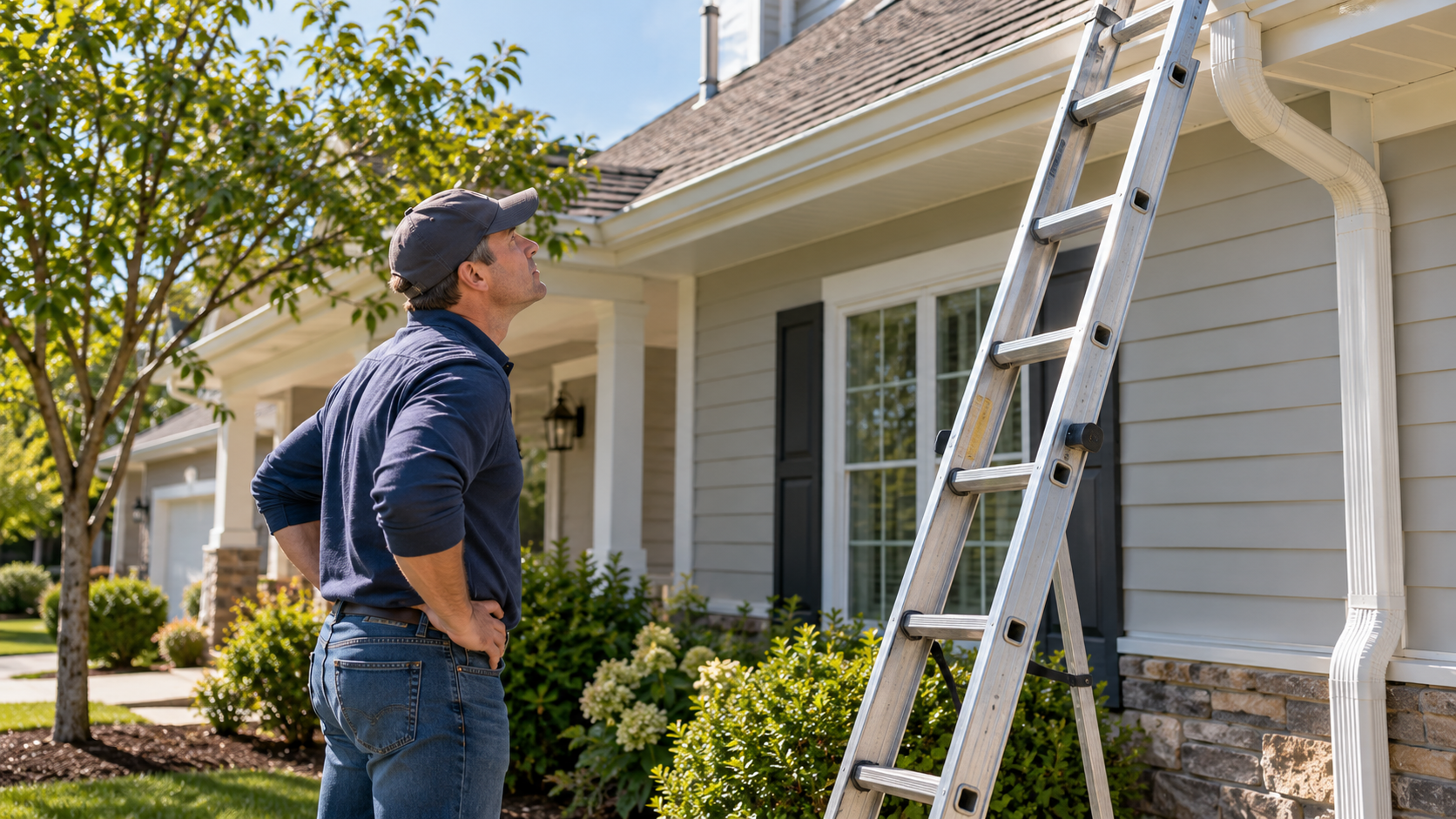
AI can easily underestimate physical conditions it cannot observe: unstable soil, a damaged ladder, wind, slippery surfaces, poor footwear, or an awkward reach. Exterior maintenance therefore requires judgment beyond a generated checklist.
OSHA ladder materials provide useful safety references, although OSHA standards are workplace safety requirements and should not be presented as universal legal DIY requirements for every U.S. homeowner. OSHA guidance uses the 4-to-1 setup principle for non-self-supporting ladders: the base is placed about one-quarter of the ladder's working length away from the wall or vertical surface.
For portable ladders used to access an upper landing, OSHA standards specify that the side rails extend at least 3 ft (0.9 m) above the landing. OSHA guidance also calls for inspecting components such as rungs, steps, side rails, feet, and locking parts before use.
If the AI gives you a gutter-cleaning procedure, those instructions do not establish that your particular ladder setup, roof edge, ground surface, or weather conditions are safe. The exterior drainage itself is also worth evaluating as a system; gutter maintenance for protecting your foundation explains how gutters and downspouts relate to water management around the home.
How to Verify an AI Answer Before Acting
The most useful safety habit is verification. You do not need to distrust every AI response; you need to separate low-consequence organizational help from claims that affect physical safety.
| Question to Ask Yourself | If the Answer Is Yes |
|---|---|
| Could a wrong answer cause fire, shock, poisoning, serious exposure, or major property damage? | Verify before acting and favor professional evaluation where appropriate. |
| Does the advice conflict with the manufacturer manual? | Do not let the AI override the manufacturer's safety instructions. |
| Does the answer depend on identifying a material from appearance? | Do not treat visual AI identification as definitive testing. |
| Did AI provide a study, citation, or source? | Locate the real source and confirm that it actually supports the claim. |
| Does the next step require opening or altering a hazardous system? | Reassess whether the task belongs with a qualified professional. |
| Is the AI unusually certain despite missing information? | Ask what assumptions it made and what evidence would change its answer. |
Manufacturer documentation is particularly valuable because the safe procedure can depend on the specific equipment. Official agencies are useful for broader hazards such as asbestos, lead, mold, dryer fire prevention, ladder practices, and carbon monoxide.
Local requirements can also differ. When a repair involves permits, licensing, building requirements, or other location-specific rules, do not ask AI to guess. Check the applicable local authority or other official source for the current requirements.
Using AI to Find a Contractor Without Trusting the Recommendation
AI can help you create a shortlist of questions for contractors or organize estimates, but an AI-generated recommendation is not evidence that a contractor is licensed, insured, or trustworthy.
The Federal Trade Commission advises consumers considering home-improvement contractors to check licensing with state or county government where applicable, request proof of insurance, and obtain written estimates from multiple contractors. These verification steps remain necessary even when AI helped you discover the business.
The FTC also identifies warning signs associated with home-improvement scams. Examples include contractors who unexpectedly arrive at your home seeking work, pressure you to decide immediately, or demand the entire payment upfront or insist on cash.
A practical AI-assisted process is to have the assistant create a neutral comparison checklist, then fill that checklist with information you independently verify. Do not ask the model to make trustworthiness claims that it cannot substantiate.
Better Prompts for Safer Home-Maintenance Help
There is no official government-mandated prompt format for AI home-maintenance questions in the research reviewed for this guide. The following examples are therefore practical ways to structure a conversation, not official safety rules.
For an appliance symptom:
I observed this symptom. Give me possible causes without claiming a definitive diagnosis. Separate checks that can be made without opening or altering hazardous components from issues that may require professional service. Tell me which claims I should verify in the manufacturer's instructions.
For an older building material:
I do not want to disturb this material until hazards are considered. Explain what information I should verify and what cannot be determined safely from a photograph alone.
For repeated electrical symptoms:
Help me organize the symptoms and identify warning signs that indicate professional electrical evaluation. Do not give instructions for opening or modifying the electrical panel.
For a wet wall:
Help me organize what I know about the moisture source, when the area became wet, whether the source has stopped, and which materials are affected. Separate observations from assumptions.
For contractor selection:
Create a checklist I can use to compare contractors. Keep AI recommendations separate from credentials, insurance, estimates, and other information that I need to verify independently.
These prompts make uncertainty visible. They also encourage AI to help with the part it handles well—organization—without quietly turning a suggestion into a safety decision.
A Practical Stop-or-Proceed Checklist
Before following AI-generated maintenance instructions, run through this checklist. A single unresolved high-risk question may be enough to stop and seek better information.
- Symptom: Have I described what I actually observed rather than assuming the cause?
- Source: Have I checked important claims against manufacturer or official guidance?
- Equipment: Do I know which specific appliance or home system I am dealing with?
- Hazardous materials: Could the work disturb suspected asbestos or lead-based paint?
- Electrical: Does the problem involve repeated breaker trips or work inside electrical equipment?
- HVAC: Does the task involve refrigerant, combustion, gas or oil connections, or a heat exchanger?
- CO: Could combustion equipment create a carbon-monoxide hazard?
- Moisture: Have I identified and stopped the water source rather than focusing only on the visible stain?
- Physical access: Does the job require a ladder or another setup whose stability AI cannot inspect?
- Professional handoff: If specialized testing or expertise is needed, am I willing to stop rather than ask AI for a workaround?
Common AI Home-Maintenance Mistakes to Avoid
One common mistake is repeatedly rephrasing a question until the AI finally gives permission to perform the repair you already wanted to attempt. A different response does not change the physical hazard.
Another is confusing visual recognition with testing. An assistant may describe what old flooring, insulation, paint, or staining resembles, but resemblance is not laboratory confirmation or a professional inspection.
A third mistake is accepting citations without checking them. Because generative AI can invent references, open the original source independently and confirm that it exists and actually supports the statement being made.
Finally, avoid treating AI as a way around manufacturer warnings or professional boundaries. The useful question is not, “Can I persuade the assistant that this is safe?” It is, “What can I verify safely, and what evidence or expertise is required before I continue?”
Frequently Asked Questions
Can I trust an AI assistant to diagnose a home repair from a photo?
No photo-based AI answer should be treated as a definitive diagnosis. AI can generate incorrect information confidently, and some hazards cannot be identified visually. Use the image to organize questions and observations, then verify consequential conclusions through appropriate documentation, testing, or professional inspection.
Can AI tell whether old flooring or insulation contains asbestos?
No. EPA guidance says you cannot reliably determine whether a material contains asbestos simply by looking at it. Appropriate testing is required for a definitive determination, and suspected materials that may be disturbed should be handled according to EPA guidance.
Can AI help me troubleshoot a repeatedly tripping breaker?
It can help organize observations and explain general terminology, but repeated breaker trips should not be dismissed based on an AI guess. ESFI identifies frequent breaker trips as an electrical-system warning sign. Avoid repeatedly resetting the breaker merely because an assistant proposes a harmless cause.
Can AI tell me whether a wet wall will develop mold?
AI cannot establish the outcome from a photograph alone. EPA guidance emphasizes moisture control and drying wet areas and items within 24 to 48 hours. Focus on stopping the moisture source, drying affected materials, and assessing conditions rather than asking AI for a visual prediction.
Should I hire a contractor because an AI assistant recommended one?
No. Treat an AI recommendation only as a possible starting point. FTC guidance recommends independently checking applicable licensing, asking for proof of insurance, and obtaining written estimates from multiple contractors.
Key Takeaways
- Use AI to organize symptoms, investigate possibilities, explain terminology, and prepare better questions.
- Do not confuse a confident AI response with a verified diagnosis.
- Check consequential claims against manufacturer documentation and reliable official sources.
- Do not use photographs or AI opinions to rule out asbestos or lead hazards.
- Use a low threshold for professional help with electrical, refrigerant, combustion, gas, and other high-risk systems.
- For water damage, focus on stopping the moisture source and EPA's 24-to-48-hour drying guidance.
- Never rely on smell to detect carbon monoxide.
- Verify contractor credentials and estimates independently rather than relying on AI recommendations.
The safest role for an AI assistant in home maintenance is not to replace a technician, inspector, manufacturer, test, or safety authority. Use it to investigate, organize, and ask better questions while keeping verification and final safety decisions in human hands.
Sources
Checked: September 25, 2026
- AI Maintenance Assistant: Using Generative AI to Troubleshoot Equipment
- AI Assistant For Smart Homes
- The Complete Guide to Smart Home Automation in 2026
- Smart Home Maintenance: How AI is Changing the Way We Care for Our Homes - CleverHome Assistant
References
- Protect Your Family from Exposures to Asbestos | US EPA
- Lead-Safe Renovations for DIYers | US EPA
- Maintenance Checklist | ENERGY STAR
- ESFI Home Electrical Safety
- CPSC – Overheated Clothes Dryers Can Cause Fires
- CDC Carbon Monoxide Clinical Guidance
- CDC – Carbon Monoxide Hazard: Using a Generator
- eTool : Construction - Falls - Ladder Safety | Occupational Safety and Health Administration
Information in this post was checked as of 2026-09-25. Policies and prices may change, so please verify important details with official sources.


Comments
Post a Comment