Why Your HVAC Airflow Is Weak in One Room

Last updated: 2026-09-26 · Checked against 8 sources
Key Takeaways
Table of Contents
- Why Is HVAC Airflow Weak in Only One Room?
- What Should You Check First at the Weak Supply Vent?
- Can a Dirty HVAC Filter Cause Weak Airflow?
- Can a Kinked or Leaking Duct Make One Room Weak?
- Can a Closed Bedroom Door Affect HVAC Airflow and Comfort?
- Could the Balancing Damper Be Causing the Problem?
- Can the Duct Size or Original HVAC Design Be Wrong for the Room?
- Does Supply and Return Grille Size Matter?
- When Does Weak Airflow Point to the Blower or the Whole HVAC System?
- What Should You Avoid Doing?
- When Should You Call an HVAC Professional?
- A Step-by-Step Checklist for One Weak Room
- Frequently Asked Questions
- Key Summary
- Weak HVAC airflow in one room often points to a room-specific issue such as a blocked register, damaged branch duct, damper imbalance, or inadequate return-air path.
- A dirty HVAC filter can restrict airflow, but it usually deserves a system-wide check rather than being assumed to explain only one weak room.
- Kinked, compressed, disconnected, or leaking ductwork can prevent the expected amount of conditioned air from reaching a room.
- If simple register and filter checks do not identify the problem, airflow balancing and duct-system performance are better evaluated with professional measurements.
If your HVAC airflow is weak in one room while the rest of the house feels normal, start with that room rather than assuming the entire heating and cooling system is failing. Check the supply register, compare airflow elsewhere, inspect the HVAC filter, and pay attention to whether closing the room's door changes comfort or airflow.
A one-room problem can also come from the branch duct serving that space, a balancing damper, the return-air path, or the original duct design. Carrier, Trane, ENERGY STAR, the U.S. Department of Energy, and ACCA guidance all support looking beyond the HVAC equipment itself when airflow is uneven.
Why Is HVAC Airflow Weak in Only One Room?
When airflow is noticeably weaker in one room than at other supply registers, the cause may be located somewhere along the air path serving that particular room. A closed or obstructed register is the simplest possibility, but duct leakage, flexible-duct restrictions, balancing problems, and inadequate return airflow can also contribute.
A supply register is the room opening through which conditioned air enters from the HVAC duct system. Before considering equipment replacement or major duct work, make sure the register is fully open and is not obstructed by furniture, rugs, curtains, storage, or other objects.
Carrier's current troubleshooting guidance identifies closed or blocked vents, duct leaks or kinks, imbalanced dampers, slow blower operation, and incorrect fan speed among possible causes of weak or uneven airflow. Trane also advises checking accessible vents when airflow is weak or nearly absent.
| What You Notice | What It May Point Toward | Useful First Check |
|---|---|---|
| Only one register feels weak | Register, branch duct, damper, or room air path | Confirm the register is open and unobstructed |
| Many registers feel weak | Filter or broader system airflow problem | Check the filter and compare multiple registers |
| Room changes when its door closes | Possible return-air-path or pressure issue | Compare the room with the door open and closed |
| Accessible flex duct is visibly kinked or compressed | Branch-duct restriction | Have the duct condition evaluated |
This comparison is a troubleshooting guide, not a diagnosis. Professional HVAC testing can measure airflow and system pressure rather than relying only on how strong the air feels against your hand.
What Should You Check First at the Weak Supply Vent?
First, confirm that the weak room's supply register is fully open and has a clear path into the room. This is the quickest room-specific check and is consistent with current Carrier and Trane troubleshooting guidance.
- Locate the supply register serving the room.
- Check whether its adjustable louvers or control are open.
- Move obvious obstructions away from the register.
- Compare the situation with other accessible supply registers in the house.
- Notice whether the problem appears isolated to this room or is present throughout the home.
A weak register should not automatically lead to closing vents elsewhere in an attempt to force more air into the room. The official sources reviewed for this article did not establish that practice as a general DIY solution for a one-room airflow problem, while Carrier and Trane troubleshooting information emphasizes checking that accessible vents are open and unobstructed.
If several rooms are uncomfortable rather than just one, the problem may overlap with broader temperature-distribution issues. The troubleshooting approach in Why Your Home Has Cold Spots and How to Fix Them can help distinguish a single weak branch from a more widespread comfort problem.
Can a Dirty HVAC Filter Cause Weak Airflow?
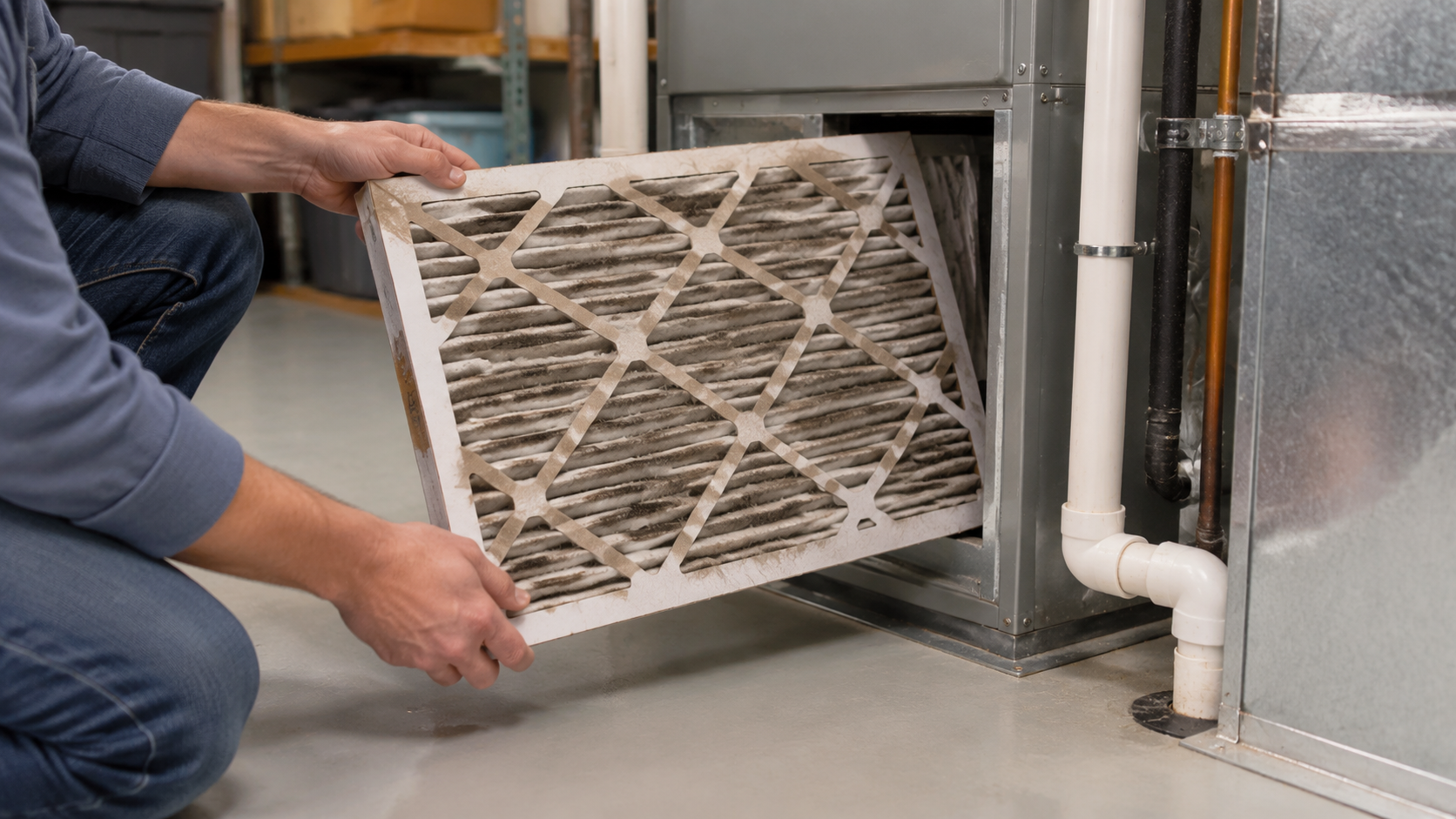
Yes. A dirty or clogged HVAC filter can restrict system airflow, but a filter problem should not automatically be blamed when only one room has weak airflow.
U.S. Department of Energy Building Science Education guidance states that a dirty or clogged filter can significantly reduce airflow and can increase furnace runtime, motor wear, and energy consumption. ENERGY STAR also advises consumers to check the filter monthly and clean or replace it when dirty.
Filter replacement timing should not be reduced to a universal fixed schedule. ENERGY STAR emphasizes monthly inspection, while EPA guidance says to follow manufacturer recommendations and notes that manufacturer replacement recommendations can vary. The practical approach is to inspect the filter regularly and follow the HVAC and filter manufacturer's requirements for replacement.
Should you install a higher-MERV filter?
A higher filtration rating is not automatically appropriate for every HVAC system. The U.S. EPA recommends MERV 13 for particle filtration, or the highest-efficiency filter that the system's fan and filter slot can accommodate, while following manufacturer requirements.
MERV is a filter-efficiency rating used to describe particle filtration performance. If you do not know what filter efficiency your equipment can accommodate, EPA guidance recommends consulting an HVAC technician rather than simply installing the highest-rated filter available.
For ongoing maintenance planning beyond this airflow problem, How Often Should You Service Your HVAC System? covers the broader question of routine HVAC service.
Can a Kinked or Leaking Duct Make One Room Weak?
Yes. A damaged or poorly performing branch duct can reduce the conditioned air that reaches one particular room, especially when the rest of the system appears to be operating normally.
ENERGY STAR identifies tangled or kinked flexible ducts as a sign of poorly performing ductwork. Its HVAC quality-installation materials also explain that turns, kinks, and compression in flexible duct can reduce airflow and contribute to comfort complaints when the required air does not reach a room.
ACCA's current Manual D information similarly identifies excess length, sag, and compression of flexible ducts as factors that matter in residential duct design. As of September 26, 2026, ACCA's standards information continues to list ANSI/ACCA 1 Manual D – 2016. ACCA conducted public reviews of proposed revisions in 2024 and 2025, but the research for this article did not find an ACCA announcement establishing those proposals as a new final Manual D edition.
What about duct leaks?
ENERGY STAR states that in a typical house, about 20–30% of the air moving through the duct system can be lost through leaks, holes, and poorly connected ducts. That figure describes typical-house duct losses and should not be interpreted as the exact leakage rate in every home.
A branch duct with a leak or poor connection may deliver less conditioned air to the room it serves. ENERGY STAR also identifies rooms that are difficult to heat or cool as one sign of poorly performing ductwork.
If accessible duct leakage is found, ENERGY STAR recommends appropriate duct-sealing materials such as mastic sealant or metal tape and specifically warns that ordinary household duct tape does not provide a durable duct-sealing solution. Ducts that are difficult or unsafe to access are better left to a qualified contractor.
A room can have a completely open register and still receive weak airflow if the air is being restricted or lost before it reaches that register.
Can a Closed Bedroom Door Affect HVAC Airflow and Comfort?
Yes, a closed bedroom door can contribute to comfort problems when the supplied air does not have an adequate path back to the central air handler. The effect depends on how the home's return-air system is configured.
A return-air path is the route that allows air supplied to a room to travel back toward the HVAC system. DOE Building Science Education explains that homes using a central return can develop room-to-room pressure imbalances when adequate return pathways are not provided.
DOE describes several return-path strategies, including dedicated returns, transfer grilles, jump ducts, and door undercuts. Which arrangement is appropriate depends on the home and system, so a homeowner should not assume that one specific modification is suitable without evaluation.
A useful observation is to compare the room with its door open and closed. If comfort or apparent airflow changes noticeably when the door is closed, that observation can give an HVAC professional a useful clue about the return-air path, although it does not by itself prove the cause.
Could the Balancing Damper Be Causing the Problem?
Yes. If the register is open but the room remains weak, a branch balancing damper may need to be checked or adjusted as part of an airflow-balancing evaluation.
A balancing damper is a duct-system component used to help distribute air among branches. ACCA's current Manual D description addresses balancing air dampers as part of residential duct-system design, and Carrier lists imbalanced dampers among possible causes of weak or uneven airflow.
Changing one branch can influence airflow elsewhere in the system, so randomly moving every accessible damper is not the same as properly balancing a system. When damper position is suspected, professional airflow measurements provide more useful information than repeatedly adjusting dampers by feel.
Can the Duct Size or Original HVAC Design Be Wrong for the Room?
Yes. A room can receive inadequate airflow because of duct sizing, duct resistance, air-distribution design, or the relationship between the room's heating and cooling load and the HVAC blower's performance.
ACCA explains that Manual D uses heating and cooling load information to determine the air delivery needed for individual spaces and matches duct-system resistance with manufacturer blower performance. This means there is no reliable universal airflow number that every bedroom or every supply vent should produce.
ENERGY STAR's HVAC quality-installation guidance also emphasizes selecting equipment for the characteristics of the home and ensuring that system airflow meets manufacturer specifications. Replacing the HVAC unit with a larger one is therefore not an evidence-based first response to one weak room.
Oversizing is not a harmless shortcut. ENERGY STAR notes that oversized HVAC equipment can cycle too frequently, reduce comfort, and shorten equipment life. A room-specific airflow complaint should be diagnosed before equipment size is blamed.
Does Supply and Return Grille Size Matter?
Yes. Supply and return grilles need to be appropriately sized and located for the air-distribution system they serve.
DOE Building Science Education explains that properly sized supply and return grilles contribute to appropriate airflow throughout a home. Incorrect grille sizing or placement can contribute to drafts, stagnant air, noise, and comfort problems.
This is another reason not to judge the entire HVAC system from a single vent opening. The register, branch duct, return path, grille selection, duct resistance, and blower all function as parts of the same air-distribution system.

When Does Weak Airflow Point to the Blower or the Whole HVAC System?
If airflow is weak at several registers rather than one isolated room, broaden the investigation beyond that room's branch duct. Filter restriction, blower performance, fan-speed settings, and other system-level conditions become more relevant when weak airflow is widespread.
Carrier identifies a slow or failing blower motor and incorrect fan speed as possible causes of weak airflow. ENERGY STAR's maintenance guidance also includes professional cleaning and adjustment of blower components to maintain proper system airflow.
ENERGY STAR states that airflow problems can reduce system efficiency by as much as 15%. That makes widespread weak airflow more than a room-comfort issue and provides a reason to have persistent system-level airflow problems properly evaluated.
| Pattern | Reasonable Next Step |
|---|---|
| One room, blocked register | Clear the obstruction and confirm the register is open |
| One room, register open | Consider branch duct, damper, return path, or distribution issues |
| Several rooms have weak airflow | Check the filter and consider system-level diagnosis |
| Problem changes with bedroom door position | Have the return-air pathway considered during diagnosis |
| Visible kink, damage, or disconnected accessible duct | Arrange appropriate duct inspection or repair |
| Basic checks reveal nothing | Request measured HVAC airflow and duct-system evaluation |
What Should You Avoid Doing?
Avoid turning a one-room airflow problem into a series of unverified fixes. Several common shortcuts skip the actual cause and may change system performance without showing why the room is weak.
- Do not assume the HVAC unit is too small. Register obstruction, filter restriction, duct leakage, flexible-duct problems, dampers, return pathways, and blower issues are all documented possibilities.
- Do not automatically buy a larger HVAC system. Equipment and ductwork should be matched to the home's loads and system requirements.
- Do not install the highest-MERV filter without checking compatibility. EPA recommends MERV 13 or the highest efficiency the system can accommodate according to manufacturer requirements.
- Do not assume duct cleaning is the solution. EPA does not present routine duct cleaning as the automatic response to weak airflow and notes limitations in knowledge about its health benefits.
- Do not use ordinary household duct tape as a long-term duct seal. ENERGY STAR recommends mastic sealant or metal tape for accessible duct leaks.
- Do not treat a hand-over-the-register test as a precise airflow measurement. Professional diagnosis can evaluate airflow, pressure, and balancing with measurements.
When Should You Call an HVAC Professional?
Call a qualified HVAC professional when the register and filter checks do not solve the problem or when the likely cause involves duct leakage, damaged flex duct, balancing, blower operation, fan speed, or overall duct-system performance. These conditions benefit from inspection and measurement rather than guesswork.
ENERGY STAR recommends that professional duct work include inspection of the whole duct system, consideration of supply and return balance, identification of damaged or disconnected ducts, appropriate repairs, and evaluation of airflow after the work.
ACCA also emphasized measurement-based duct performance in its September 23, 2026 discussion of duct systems. The practical lesson for homeowners is that duct appearance alone does not establish whether the system is delivering the intended airflow to each space.
If repair costs are competing with other household needs, How to Prioritize Home Repairs When Money Is Tight can help organize the decision without assuming that equipment replacement is the first step.
A Step-by-Step Checklist for One Weak Room
The most efficient troubleshooting order starts with simple observations and moves toward issues that require system knowledge or measurements. This keeps a blocked register from being mistaken for a major equipment problem while still recognizing when professional diagnosis is justified.
- Check the room's supply register. Make sure it is fully open and unobstructed.
- Compare other accessible registers. Determine whether weak airflow is isolated or widespread.
- Inspect the HVAC filter. If it is dirty, clean a reusable filter or replace a disposable filter as appropriate, and follow manufacturer requirements.
- Look only at safely accessible ductwork. Visible kinks, compression, damage, or disconnected sections are useful clues.
- Compare the room with the door open and closed. A noticeable change can suggest that the return-air pathway deserves evaluation.
- Consider balancing. If the branch register is open but airflow remains weak, a balancing damper may need professional checking or adjustment.
- Consider duct design and system performance. Persistent problems may require evaluation of duct resistance, air delivery, blower performance, and room requirements.
Frequently Asked Questions
Why is airflow weak in only one room?
Possible causes include a closed or blocked supply register, leaking or restricted branch duct, kinked or compressed flexible duct, damper imbalance, inadequate return-air pathway, or duct-distribution design. If other registers are also weak, check for broader problems such as a dirty filter or system-level airflow issue.
Can a dirty filter cause weak HVAC airflow?
Yes. DOE and ENERGY STAR guidance confirms that dirty or clogged filters can restrict HVAC airflow and make the system work harder. Because a filter affects the central system, compare several rooms before assuming it explains a problem isolated to one register.
Should I close vents in other rooms to push more air into the weak room?
The official sources reviewed for this article did not support closing other vents as a general DIY fix for one weak room. Carrier and Trane troubleshooting guidance instead recommends checking that accessible vents are open and unobstructed.
Can a closed bedroom door cause an HVAC comfort problem?
It can when the room lacks an adequate return-air pathway. DOE guidance explains that pressure imbalances can occur in homes with central returns, so a noticeable difference between door-open and door-closed conditions is worth reporting during an HVAC evaluation.
Does one weak vent mean my ducts need cleaning?
No. Weak airflow has several possible causes, and EPA guidance does not establish routine duct cleaning as the automatic solution. Check the register, filter, branch-duct condition, return path, balancing, and broader system performance before drawing that conclusion.
Key Summary
Weak HVAC airflow in one room is best treated as an air-distribution problem until the evidence points elsewhere. Start with the room's open and unobstructed supply register, determine whether other rooms are affected, inspect the filter, and note whether the room behaves differently with its door closed.
If those checks do not explain the problem, branch-duct leakage or restriction, flexible-duct kinks or compression, return-air limitations, balancing dampers, duct sizing, and blower performance are reasonable areas for further diagnosis. As of September 26, 2026, current ENERGY STAR, DOE, EPA, Carrier, Trane, and ACCA guidance supports a measured, system-aware approach rather than automatically replacing equipment, closing other vents, installing the highest-MERV filter, or ordering duct cleaning.
Related Posts
- Wall-Mounted AC Leaking Water: What to Check First
- Why Your Circuit Breaker Trips and When to Call a Pro
References
- Furnace Repair Service | Signs, Costs & Troubleshooting | Carrier
- HVAC Troubleshooting - Schedule an Online Appointment - Trane®
- HVAC Proper Installation of Filters | Building Science Education
- Clean Heating and Cooling | ENERGY STAR
- Do ducted air source heat pumps filter fine particles out of indoor air? | US EPA
- Standards 62.1 & 62.2
- Duct Sealing | ENERGY STAR
- Home Upgrades | Department of Energy
Information in this post was checked as of 2026-09-26. Policies and prices may change, so please verify important details with official sources.


Comments
Post a Comment