How to Replace a Ceiling Light Safely: Step-by-Step Guide
Editorial Team
Last updated: September 24, 2026
- 1. Decide Whether This Is Really a Simple Fixture Replacement
- 2. Prepare the Work Area Before Touching the Fixture
- 3. Isolate the Circuit and Verify Before Handling Wiring
- 4. Remove the Existing Ceiling Light Without Letting It Hang
- 5. Inspect the Ceiling Support Before Installing the New Light
- 6. Do Not Identify Ceiling Wires by Color Alone
- 7. Install the New Fixture in a Controlled Sequence
- 8. What to Do When You Find Damaged or Unfamiliar Wiring
- 9. Common Ceiling-Light Replacement Mistakes
- 10. LED Fixtures and Dimmer Switches Need a Compatibility Check
- 11. A Simple Go-or-Stop Decision Guide
- 12. Frequently Asked Questions
- 13. Key Takeaways
- 14. Editorial and Safety Note
Replacing a ceiling light starts with electrical safety, not with removing screws. Isolate the circuit, verify that the wiring is not energized with an appropriate tester, support the fixture during removal, and follow the new fixture manufacturer's instructions rather than guessing how unfamiliar wiring should be connected.
If the existing wiring is damaged, its function cannot be identified, the ceiling support appears unsuitable, or the job requires changing fixed wiring, stop the installation. This guide provides general safety information for a straightforward fixture replacement; it is not a substitute for an inspection of the actual electrical installation.
What this guide covers
- Direct Answer: Can You Do It Yourself?
- Safety Preparation and Tools
- Step-by-Step Replacement Process
- Common Mistakes to Avoid
- Frequently Asked Questions
1. Decide Whether This Is Really a Simple Fixture Replacement
Before reaching for a screwdriver, define the job. Replacing a fixture that is already mounted at an existing lighting point is different from moving the light, extending wiring, creating a new connection point, repairing damaged conductors, or altering fixed wiring inside the ceiling.
A useful DIY boundary is whether you can complete the planned replacement using the existing, clearly identifiable installation and the instructions supplied with the new fixture. If opening the old fixture reveals something substantially different from what you expected, do not expand the job simply because the ceiling is already open.
| What you find | What to check | Practical response |
|---|---|---|
| Existing mounting point appears secure | Compatibility with the new fixture and its instructions | Continue only after electrical safety checks |
| Wire functions are unclear | Whether they can be positively identified | Do not guess from appearance alone |
| Damaged insulation or loose connections | Condition of the existing installation | Stop and have the problem assessed |
| New fixture uses a different mounting arrangement | Whether the existing support is suitable | Follow the fixture instructions or seek qualified help |
| Fixed wiring must be extended or altered | Whether the work has moved beyond fixture replacement | Check applicable official requirements and use a qualified professional where required |
Electrical-work rules vary by location and by the exact work being performed. Because no supporting legal research was supplied for this revision, this article does not state that every ceiling-light replacement is legally permitted as DIY work. Check the current official requirements that apply where the property is located.
If you are deciding which household jobs are suitable for DIY and which should be left to a professional, 예산이 부족할 때 집수리 우선순위를 정하는 방법 can also help you think about the scope of the repair before starting.
2. Prepare the Work Area Before Touching the Fixture
A safer installation begins before the old light comes down. Read the new fixture's instructions while you can still see the existing installation intact. Identify how the new fixture is supported, how its cover is removed, what connection arrangement the manufacturer expects, and whether the instructions specify any conditions that your ceiling installation does not appear to meet.
Clear the floor below the light so you can work without stepping around boxes or furniture. Use a stable way to reach the fixture without stretching sideways or working at the limit of your balance. Arrange tools so that you do not have to climb down repeatedly while holding the fixture.
Pre-work checklist
- Read the fixture instructions: Check the mounting, connection, grounding, assembly, and installation requirements provided by the manufacturer.
- Identify the circuit: Make sure you know which circuit supplies the light rather than relying on an assumption.
- Prepare a suitable tester: You need a reliable method of checking whether the conductors are energized.
- Inspect the work area: Make sure you can reach the ceiling safely and keep the floor clear.
- Plan how to support the fixture: Do not rely on the electrical wires to hold its weight while you work.
- Compare the mounting arrangements: Look for obvious differences between the old and new fixtures before dismantling everything.
Safety rule: Turning off the wall switch and proving that the circuit is not energized are not the same task. Treat verification as a separate step.
3. Isolate the Circuit and Verify Before Handling Wiring
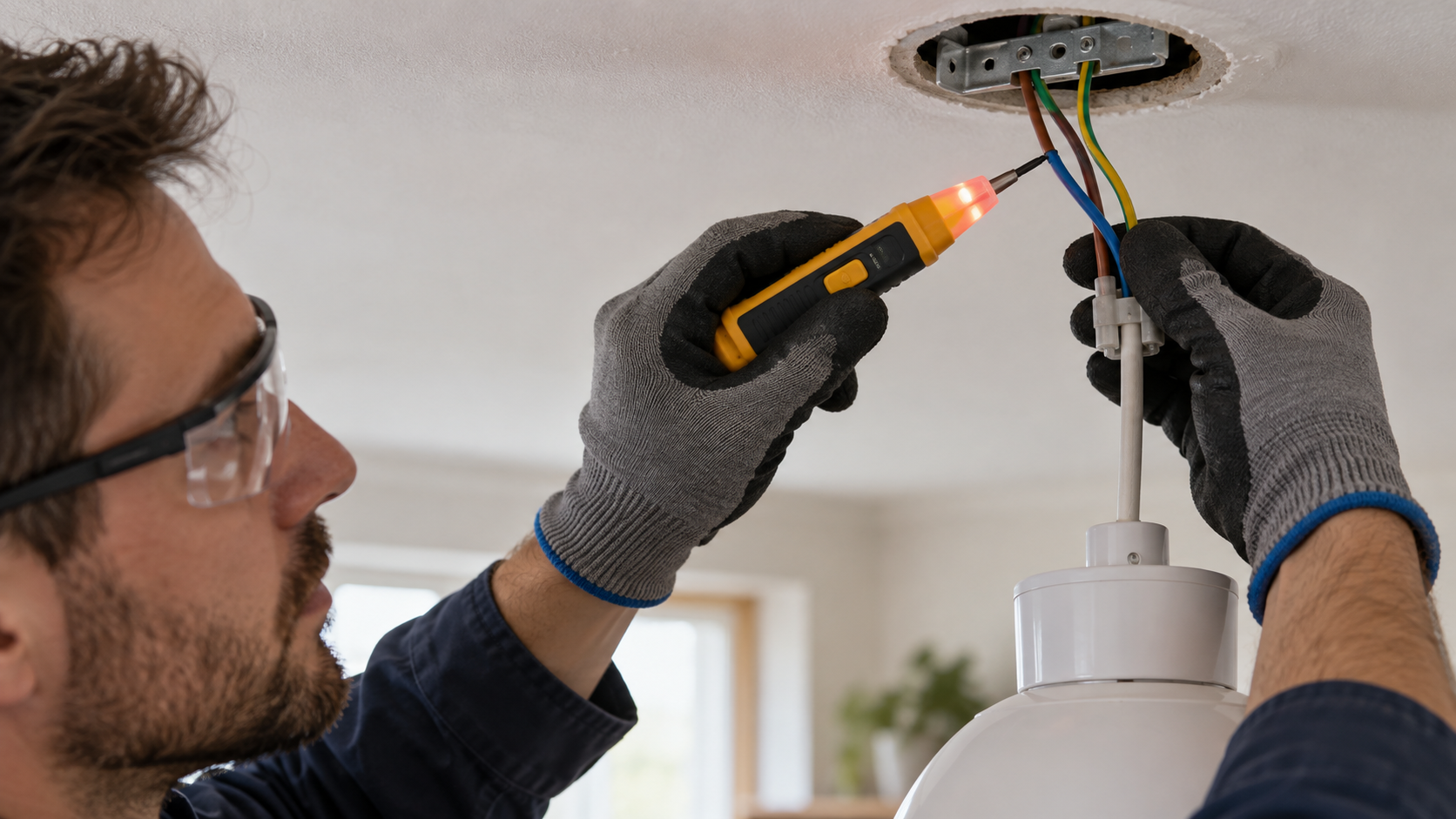
Do not treat the wall switch as your electrical isolation method. Before working on the wiring, isolate the circuit at the appropriate electrical panel or other proper isolation point for the installation.
After isolation, verify the condition at the work location with an appropriate voltage-testing device. The purpose of this step is simple: you are checking the actual wiring you are about to touch instead of assuming that operating a switch or breaker produced the expected result.
If you cannot confidently identify the correct circuit, cannot use the tester correctly, receive an unexpected indication, or cannot verify that the wiring is safe to handle, stop. Troubleshooting an uncertain electrical supply is a different task from replacing a straightforward light fixture.
Why verification matters
Labels can be unclear, an installation may have been altered in the past, and the arrangement behind a fixture may not be obvious from the room below. A safe process therefore separates two questions: did you operate the intended isolation device, and did you verify the condition of the conductors at the actual work point?
Do not defeat this process because the light no longer illuminates. A lamp being off tells you that the lamp is not operating; it does not replace a proper check of the wiring before it is handled.
4. Remove the Existing Ceiling Light Without Letting It Hang
Once the circuit has been isolated and the condition of the wiring has been verified, examine how the old fixture is attached. Covers, decorative plates, brackets, screws, and retaining hardware differ between products, so dismantle the fixture according to its construction rather than forcing parts that do not move freely.
Step 1: Support the fixture
Before removing the final mounting fastener, support the body of the light. The electrical conductors and their connections should not become an improvised hanger for the fixture. If the light is awkward to hold while accessing its connections, get assistance rather than balancing it with one hand while trying to work with the other.
Step 2: Observe the existing arrangement
Before separating anything, look carefully at the existing mounting and connection arrangement. This can help you understand what was present, but it is not proof that every existing connection is correct.
If the installation appears improvised, conductors are difficult to identify, insulation is deteriorated, connections are loose, or the wiring differs substantially from the new fixture instructions, stop. Reproducing an unexplained old connection is not a safe substitute for identifying what each conductor actually does.
Step 3: Remove the old fixture carefully
With the fixture supported and the electrical condition verified, separate the old fixture according to its connection and mounting method. Avoid pulling conductors from the ceiling or twisting them simply to create more working space.
Once the old fixture is removed, inspect what is now visible. The exposed installation should determine whether the original plan can continue or whether the job needs to be reassessed.
5. Inspect the Ceiling Support Before Installing the New Light
A ceiling light needs mechanical support as well as an electrical connection. The conductors are not structural supports. The new fixture must be secured using the mounting method specified for the product and a ceiling support arrangement suitable for that installation.
Do not assume that a bracket is suitable merely because the old light was attached to it. Compare the new fixture's mounting instructions with what is actually present. If the mounting point is loose, damaged, incomplete, or obviously incompatible with the new fixture, address that issue before proceeding.
This becomes particularly relevant when the replacement fixture differs substantially in construction from the old one. Without verified specifications for the existing support, there is no useful universal weight limit that this article can safely provide. Use the fixture instructions and confirmed information about the existing support instead of an invented rule of thumb.
If your project involves relocating the light as part of a larger renovation, 대규모 리모델링 전에 집 상태와 공사 범위를 정리하는 방법 can help separate a simple replacement from work that changes the building installation.
6. Do Not Identify Ceiling Wires by Color Alone
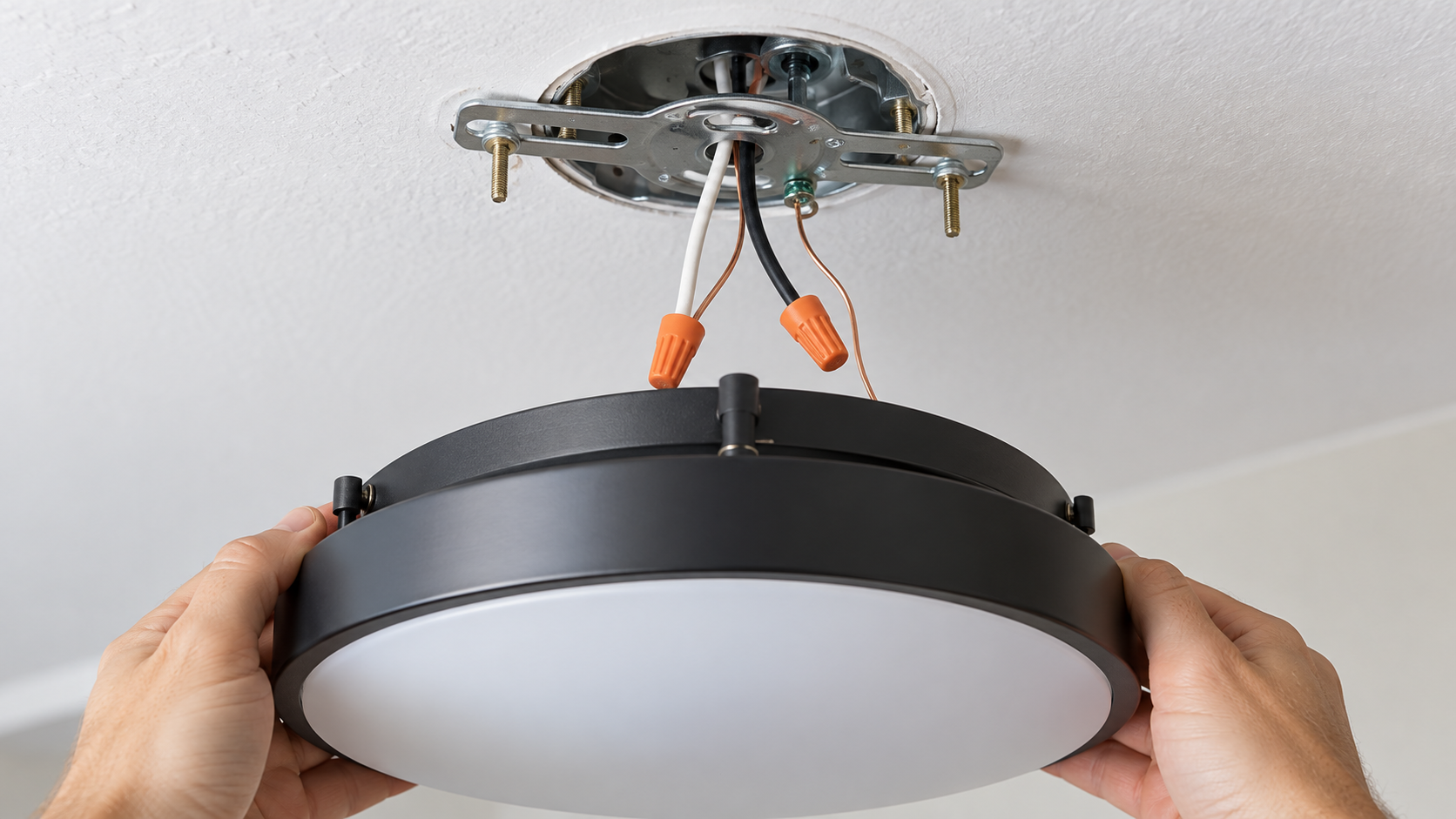
Online tutorials often show a neat set of conductors with familiar colors and then instruct the reader to match them. That may be appropriate for the exact installation covered by that tutorial, but it should not be turned into a universal rule for an unfamiliar home.
Existing wiring may reflect different installation practices, previous work, product-specific leads, or conditions that are not visible until the fixture is opened. Color can be useful information when interpreted within the applicable wiring system, but appearance alone should not be used to invent the function of an unidentified conductor.
Use three sources of information
- The new fixture instructions: Understand what connections the product requires.
- The actual installation: Determine what conductors and mounting arrangements are present rather than assuming they match an online example.
- Verified identification: If a conductor's function cannot be established confidently, stop instead of experimenting with possible combinations.
The same principle applies to grounding or protective connections. If the fixture instructions require a protective connection, do not omit it simply because the previous fixture looked different. If the required arrangement cannot be identified at the ceiling point, seek qualified assistance.
7. Install the New Fixture in a Controlled Sequence
There is no single screw-by-screw installation sequence that fits every ceiling light. Brackets, integrated LED fixtures, pendant fittings, flush-mount lights, drivers, connectors, covers, and decorative hardware can all be assembled differently. The manufacturer's instructions therefore take priority for product-specific assembly.
For planning purposes, a straightforward replacement can be organized into the following sequence:
- Read the complete installation instructions before dismantling the existing light.
- Isolate the appropriate circuit using the proper electrical isolation point.
- Verify the electrical condition at the fixture with an appropriate tester before handling conductors.
- Support the old fixture before removing its final mounting hardware.
- Inspect the existing arrangement and stop if the wiring or support is damaged or cannot be identified.
- Remove the old fixture without allowing its weight to hang from the wiring.
- Check the mounting point against the new fixture's installation requirements.
- Fit the supplied or specified mounting hardware according to the manufacturer's directions.
- Make only connections you can correctly identify and follow the product instructions for the required wiring arrangement.
- Arrange the conductors carefully so that they are not pinched, crushed, or trapped by mounting hardware.
- Secure the fixture body and covers using the intended fasteners.
- Restore power only after assembly is complete and the work area has been cleared.
This sequence is deliberately conservative. It does not provide a universal wire-to-wire connection recipe because the supplied research contains no verified information about the reader's particular electrical installation.
8. What to Do When You Find Damaged or Unfamiliar Wiring
A fixture replacement is often the first time hidden wiring has been visible for years. If removing the old light exposes cracked insulation, loose connections, heat damage, an unstable mounting point, unexplained splices, or wiring whose purpose cannot be determined, do not hide the condition behind the new fixture.
At that point, the problem has changed. Your task is no longer simply to attach a new light; an existing electrical condition needs to be assessed. Continuing because the new fixture is already unpacked is a poor reason to accept uncertainty around fixed wiring.
Stop the job when:
- You cannot positively identify the circuit being worked on.
- You cannot verify the electrical condition before touching conductors.
- The wiring arrangement cannot be understood without guessing.
- Insulation, terminals, connectors, or conductors appear damaged.
- The ceiling mounting point is loose, damaged, or unsuitable for the fixture.
- The new fixture requires a connection that is not clearly available.
- The planned work would require extending, rerouting, or otherwise altering fixed wiring.
- The manufacturer's instructions conflict with what you find at the installation point.
The useful rule is not simply to call a professional whenever a project feels difficult. It is to stop whenever completing the job would require you to substitute a guess for something that should be verified.
For other home repairs, the same caution applies when using AI-generated instructions without inspecting the real installation. AI 도우미를 집 관리에 안전하게 활용하는 방법 provides additional guidance on using such tools as references rather than as substitutes for site-specific checks.
9. Common Ceiling-Light Replacement Mistakes
| Common mistake | Why it is a problem | Better approach |
|---|---|---|
| Turning off only the wall switch | It does not replace proper circuit isolation and verification | Isolate appropriately and verify before handling wiring |
| Assuming the circuit is safe immediately after isolation | The actual condition at the work point has not been checked | Use an appropriate testing method |
| Letting the fixture hang from its wires | Fixture weight is placed on electrical conductors and connections | Support the fixture independently |
| Matching wires only by color | The actual conductor function may not match the assumption | Use verified identification and the fixture instructions |
| Copying the old connection without understanding it | An existing installation should not automatically be assumed correct | Stop if the arrangement cannot be confidently identified |
| Ignoring a loose mounting point | The fixture may not be mechanically supported as intended | Resolve the support issue before installation |
| Forcing wires behind the fixture | Conductors or insulation can be trapped or damaged | Arrange wiring carefully before tightening the fixture |
| Expanding the project into fixed-wiring alterations | The work may require different skills or legal requirements | Reassess the scope and check official guidance |

10. LED Fixtures and Dimmer Switches Need a Compatibility Check
If the existing light is controlled by a dimmer, do not assume that every replacement LED fixture will operate correctly with it. Compatibility can depend on the fixture, its electronic components, and the dimming equipment already installed.
Check the documentation supplied by the fixture manufacturer and, where applicable, the dimmer manufacturer. If compatibility is not stated, look for current official product guidance rather than relying on the fact that another LED lamp happened to work on the same switch.
Unexpected behavior after installation should not automatically be treated as proof of faulty wiring or a defective fixture. Compatibility can be one of several possible causes, so troubleshooting should begin with the product documentation and the actual installation conditions rather than random component changes.
11. A Simple Go-or-Stop Decision Guide
For a homeowner, the most useful skill is often recognizing when the planned job has changed. Use the following checklist before proceeding from inspection to installation.
- Go: The correct circuit can be identified and safely isolated.
- Go: You can verify the electrical condition using an appropriate tester.
- Go: The existing mounting point is sound and compatible with the new fixture's instructions.
- Go: The required connections can be positively identified without relying on color guesses.
- Stop: You cannot identify or verify the electrical supply.
- Stop: Wiring or insulation appears damaged.
- Stop: The ceiling support is loose or its suitability cannot be established.
- Stop: The installation requires changes to fixed wiring beyond the original replacement plan.
- Stop: The product instructions and the existing installation cannot be reconciled confidently.
Local electrical rules can also affect what work a homeowner may perform. Because those requirements can change and no current legal source material was provided with this revision, check the applicable official guidance before undertaking work that goes beyond a straightforward fixture replacement.
12. Frequently Asked Questions
Is turning off the wall switch enough before replacing a ceiling light?
No. Do not use the wall switch as a substitute for properly isolating the circuit and verifying the electrical condition at the work location. The verification step matters because you should know the condition of the conductors before handling them rather than infer it from whether the lamp is illuminated.
Can I identify ceiling wires by their colors?
Do not use color alone as universal proof of a conductor's function. Follow the new fixture instructions and work from positively identified conductors in the actual installation. If the wiring cannot be identified confidently, stop rather than trying possible combinations.
Can the old light hang from its wires while I install the bracket?
Avoid using electrical wiring to support the fixture's weight. Support the fixture independently while removing mounting hardware and connections. If the fixture is too awkward to support safely while working, get assistance.
What should I do if the new mounting bracket does not fit?
Do not improvise simply to make the fixture stay against the ceiling. Recheck the manufacturer's installation instructions and inspect the existing mounting point. If the required support arrangement is not present or cannot be confirmed as suitable, stop and obtain appropriate help.
Can I install a new LED ceiling light on an existing dimmer?
Only after checking compatibility for the actual products involved. Review the fixture and dimmer manufacturers' current documentation. If compatibility cannot be confirmed, do not assume that all LED fixtures and dimmers are interchangeable.
13. Key Takeaways
- Define the project before starting and distinguish fixture replacement from alteration of fixed wiring.
- Read the new fixture's instructions before removing the existing light.
- Do not rely on the wall switch as the only electrical safety step.
- Isolate the appropriate circuit and verify the electrical condition before handling wiring.
- Support the fixture independently instead of allowing it to hang from electrical conductors.
- Inspect the existing mounting point before attaching the replacement fixture.
- Do not identify unfamiliar conductors by color alone.
- Do not assume an existing connection is correct simply because it previously operated.
- Stop when damaged wiring, an unsuitable support, or an unexplained connection is discovered.
- Check product documentation when an LED fixture will be used with an existing dimmer.
- Check current official requirements when the work extends beyond a straightforward fixture replacement.
14. Editorial and Safety Note
This article was revised on September 24, 2026 as a general safety guide for replacing an existing ceiling-light fixture. No external research material was supplied for this revision, so specific legal provisions, universal wire-color rules, fixture weight limits, prices, electrical ratings, and other unsupported numerical requirements have deliberately not been added.
Electrical installations differ by property, product, location, and previous work. Manufacturer instructions and current official requirements applicable to the actual installation should take priority over a generic online guide. If the electrical condition cannot be verified or the project requires altering fixed wiring, seek help from an appropriately qualified professional.
Editorial Team
This guide provides general home-improvement safety information. It does not replace an inspection of the actual wiring, product-specific installation instructions, or professional advice for an installation whose condition cannot be confirmed.
Last updated: September 24, 2026
[[KEEP번호]]참고 자료
이 글은 2026-09-24 기준으로 확인한 정보입니다. 정책·가격 등은 바뀔 수 있으니 중요한 내용은 공식 안내에서 다시 확인하세요.


Comments
Post a Comment