Whole-House Humidifier Not Working When the Furnace Runs?
Key Takeaways
- A furnace running does not guarantee that a whole-house humidifier is receiving a humidity call or water.
- Start with the humidifier control, then inspect accessible parts for mineral scale, a worn water panel, or a restricted drain.
- Steam, fan-powered, and other furnace humidifiers operate differently, so use the model’s instructions for control and component checks.
- If cleaning and basic control checks do not restore moisture output, leave electrical, valve, and system repairs to an HVAC professional.
Table of Contents
- Why can the furnace run while the humidifier stays off?
- Whole-house humidifier not working: a practical first-check sequence
- Check the water panel, scale, and drain
- Could a water valve or control be the problem?
- When the humidifier runs but the house still feels dry
- Choose the right next step for your situation
- How to avoid repeat humidifier problems
- Frequently Asked Questions
- Key points to remember
If your whole-house humidifier is not working when the furnace runs, the furnace may be heating normally while the humidifier lacks a separate call for moisture, water flow, or a clean evaporation surface. Check the humidifier’s control and visible maintenance items first; do not assume that warm air from the furnace proves the humidifier is operating.
Why can the furnace run while the humidifier stays off?
A whole-house humidifier is connected to the furnace or duct system, but it also needs the conditions and controls required by its own design. Carrier describes a furnace humidifier as a unit attached to the furnace or ductwork, with indoor air passing through it to pick up moisture before returning to the home.
That connection does not mean every humidifier runs whenever the furnace blower runs. PV Heating, Cooling & Plumbing describes a control approach that runs the humidifier only when the furnace is calling for heat. If the furnace is circulating air without a heat call, a humidifier configured for heat-call operation may remain off by design.
Humidifier types also differ. Carrier identifies steam and fan-powered models among whole-house options; steam models provide moisture regardless of air temperature, while fan-powered models use a water panel. Aprilaire’s application guide explains that fan-powered units are designed for the warm-air supply plenum of certain forced-air systems and describes cold-return installation as an alternative when supply-plenum space is unavailable. The correct diagnosis depends partly on which equipment is installed.
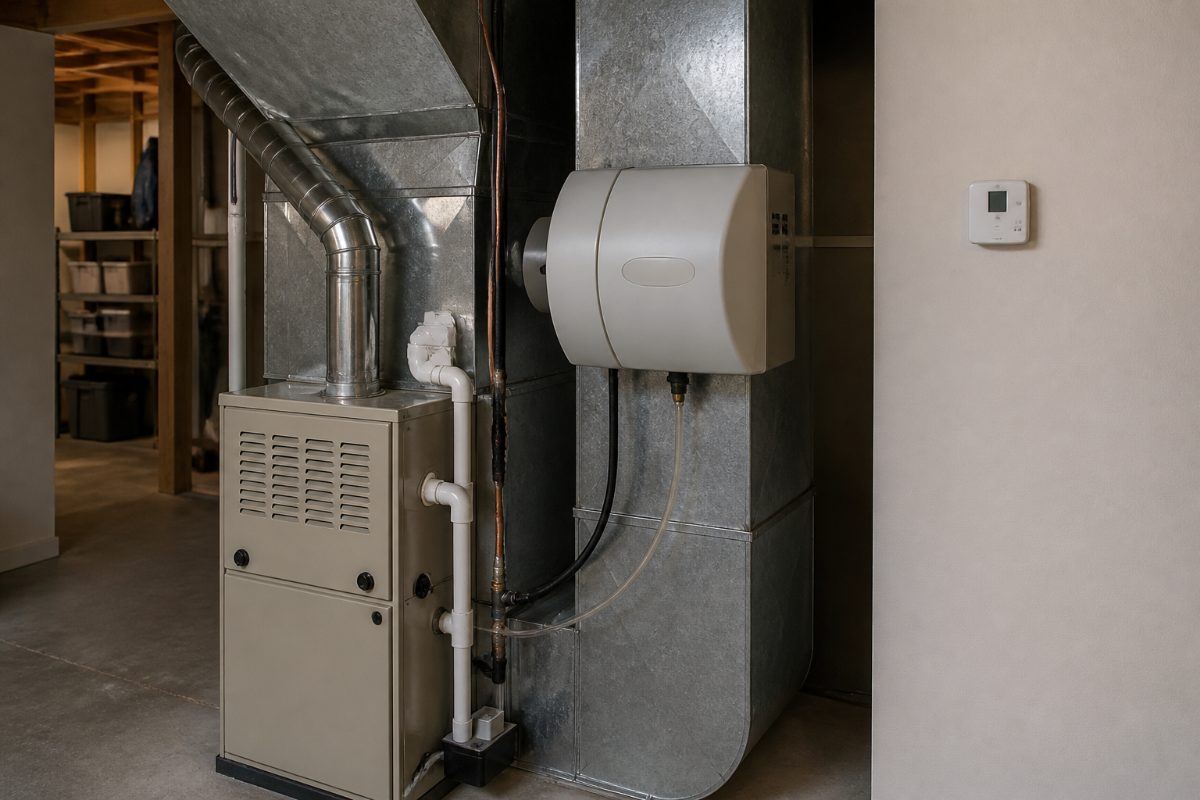
Before changing settings, identify the humidifier model and the control that operates it. A wall control, a control mounted on the unit, or a furnace-connected control may not use the same sequence. The model’s instructions are the best reference for what should happen during a heating call.
Whole-house humidifier not working: a practical first-check sequence
Work from the easiest observations to the issues that require service. This order helps distinguish a setting or maintenance problem from a failed component without opening electrical or plumbing parts.
- Confirm the symptom. Note whether the home feels dry, whether static has increased, or whether wood furnishings show signs associated with dry indoor air. Bryant lists these as possible indications that a humidifier may not be operating correctly, but they do not identify a specific failed part.
- Observe a normal furnace heating cycle. Check whether the humidifier appears to operate during an actual call for heat, rather than only when the furnace fan is running. If the humidifier control is configured to run with a furnace call, fan-only circulation may not meet that condition.
- Review the humidity control. Confirm that the control is set to request moisture and is not switched off. Use the manufacturer’s instructions to understand the control’s symbols, settings, and operating mode; avoid guessing at model-specific settings.
- Look for visible maintenance clues. Bryant recommends looking for mineral buildup, residue, uneven moisture output, white scaling, odors, leaks, and restricted drain flow. These observations can point toward cleaning or component maintenance.
- Compare the result after maintenance. American Standard advises waiting about one hour after maintenance, then checking the water supply again and adjusting as needed. If the unit still does not produce moisture, stop at accessible checks and arrange diagnosis rather than trying to repair a valve or electrical connection.
This sequence separates three different questions: is there a humidity demand, can the unit receive and distribute water, and can air pick up moisture from the unit? A “yes” to the furnace question alone answers none of those by itself.
Check the water panel, scale, and drain
Mineral buildup can reduce humidifier performance even when the furnace is heating. Bryant says white scaling, reduced output, or odors can indicate mineral deposits or stagnant water, and notes that many systems use a water panel that should be replaced seasonally.
With the unit’s instructions in hand, inspect only the components the manufacturer identifies as accessible for homeowner maintenance. Look for a panel with visible deposits, residue on the distribution area, or a drain that appears restricted. Bryant’s maintenance framework is “Clean, Replace and Calibrate”: clean accessible water-distribution parts, replace consumables such as a water panel or steam canister as directed, and adjust the humidity control for current conditions.
Use only a manufacturer-approved cleaning solution or a mild solution that the manufacturer permits. Bryant recommends rinsing cleaned components thoroughly and says an HVAC professional can handle cleaning if the homeowner is uncomfortable doing it. Do not treat every humidifier as if it has the same panel, canister, drain, or cleaning procedure.
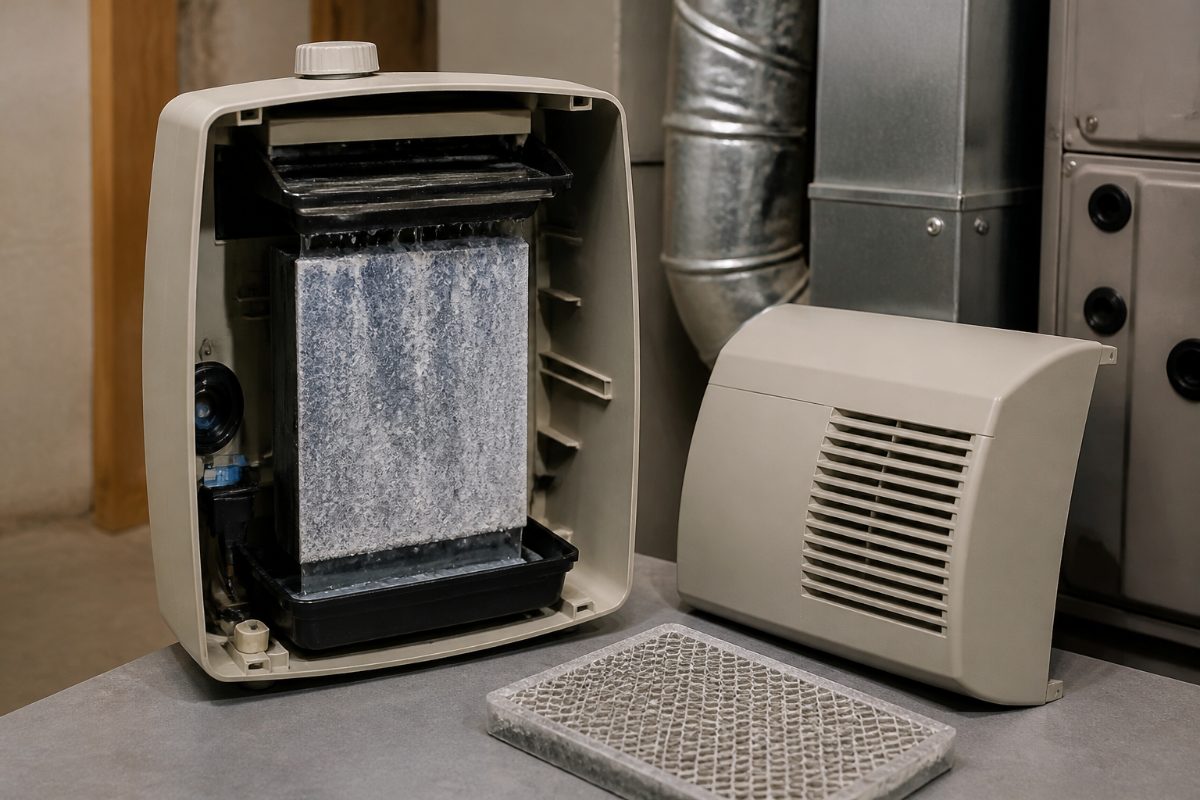
Aprilaire’s reference guide explains one reason a drain may be present: in drain-equipped models, water that is not evaporated passes to the drain, while minerals produced during evaporation may be trapped by the water panel, held in a scale-control insert, or flushed away. A visible drain is therefore part of the system’s normal water handling, not automatically evidence of a leak. A blockage or restricted flow, however, is a maintenance clue Bryant specifically calls out.
A common mistake is to replace a water panel and assume the whole humidifier has been serviced. The control still needs to be set appropriately, and accessible distribution parts and the drain may also need attention. Bryant’s three-part framework makes clear that cleaning, replacing consumables, and calibrating the control are separate tasks.
Could a water valve or control be the problem?
If the control appears to request humidity but the humidifier shows no sign of water delivery, the fault may be beyond routine cleaning. A solenoid valve is one possible component in water delivery; an HVAC-industry article notes that malfunctioning solenoid valves are a common homeowner frustration with whole-house humidifiers. That observation does not prove that a particular valve has failed.
Aprilaire’s reference guide describes metered water flow through an orifice in the applicable humidifier design. That means water use is not necessarily a simple all-or-nothing flow, and a small amount of water going to a drain can be normal on drain-equipped models. Do not judge operation by looking for a large stream or by assuming every unit should behave like another model.
Homeowners can record what they observe: whether the control requests humidity, whether the furnace is on a heating call, and whether there are visible signs of water, deposits, or a leak. Avoid opening electrical compartments, disconnecting wiring, or dismantling a valve. American Standard says repairs should be left to professionals; if routine maintenance does not resolve the issue, a technician can test the system and identify whether the control, water delivery, or another component needs repair.
When the humidifier runs but the house still feels dry
A humidifier can appear to operate without bringing the home to a comfortable moisture level. Carrier says a 30% to 50% indoor relative-humidity range is a target for people primarily concerned with comfort and furnishings. Relative humidity is the amount of moisture in the air compared with the maximum the air can hold at its temperature; it is not the same thing as how long the furnace runs.
Start by distinguishing a lack of output from a home that loses moisture quickly. PV Heating, Cooling & Plumbing explains that an open-combustion furnace located inside conditioned living space removes air from that space when it operates, which leads to more outdoor-air infiltration. The same source notes that cooking and showering add moisture, while very hot furnace air may not retain enough humidity to offset dry conditions in some homes.
Use a simple comparison over several heating cycles: record the humidifier control setting, whether the furnace is making a heat call, and whether the indoor humidity reading changes. If the control calls for moisture but the reading remains low, look for the maintenance clues described above before concluding that the furnace itself is the cause. If the humidifier seems to work but dryness persists after regular cleaning, American Standard recommends professional evaluation.
Do not respond to dryness by turning the control up without watching the windows. Bryant advises lowering the humidity setting if condensation forms on windows. That visible condensation is a practical sign that the setting may be too high for the home’s current conditions, even if the room still feels dry.
Choose the right next step for your situation
The best next move depends on whether this is a first-time startup, a maintenance issue, or a system that has stopped producing moisture despite a control request. Keep the checks limited to settings and accessible maintenance tasks.
| What you notice | Reasonable next step | Why it helps |
|---|---|---|
| The furnace heats, but the humidifier control is off or unclear | Identify the control and follow the model instructions for its operating mode. | A heating call and a humidifier demand are separate conditions on systems configured to run the humidifier with heat. |
| White scale, residue, odor, or uneven output | Inspect accessible components and follow the approved cleaning and replacement schedule. | Bryant associates these signs with mineral deposits, stagnant water, or reduced performance. |
| Visible drain restriction or water around the unit | Stop short of dismantling plumbing parts; arrange service if the obstruction or leak is not part of an approved homeowner task. | Drain flow is part of water handling, while a leak or restricted flow can require diagnosis. |
| Humidifier appears to run, but the home stays dry | Compare control demand and indoor humidity across heating cycles; consider air infiltration and maintenance condition. | The home’s moisture balance can be affected by both humidifier output and air entering from outdoors. |
| Maintenance is complete but there is still no operation | Ask an HVAC professional to test the control and humidifier components. | Electrical, valve, and equipment repairs are not routine cleaning tasks. |
If you are new to the system, focus on identifying the model, control, and visible maintenance parts before changing anything. If you already maintain it regularly, note what changed: a new control setting, a newly replaced panel, or an output drop after the last cleaning can help narrow the service diagnosis.
How to avoid repeat humidifier problems
Use the maintenance interval and replacement instructions for the specific model rather than applying a one-size-fits-all calendar. Bryant says many humidifiers have a water panel replaced seasonally and recommends inspecting for scale, residue, leaks, and restricted drain flow as part of maintenance.
Keep the control calibrated or adjusted for current conditions, not just at the setting that seemed comfortable in another season. Bryant’s guidance is to lower the setting if window condensation develops. A control setting that ignores window conditions can produce a different result from the one intended.
Also understand the furnace-control relationship. PV Heating, Cooling & Plumbing recommends operating a humidifier only when the furnace is calling for heat when ducts are in unconditioned spaces, because adding moisture while ducts are cold increases mold-growth risk. This is a system-design consideration, not a universal setting instruction for every humidifier; follow the installed equipment’s control instructions.

Carrier describes whole-house units as integrated with the HVAC system, while Aprilaire’s guide shows that installation location and model design affect how air and moisture move. If the humidifier repeatedly fails after cleaning, or if the installed control behavior does not match the equipment instructions, professional testing is more useful than repeated adjustments by trial and error.
Frequently Asked Questions
Should a whole-house humidifier run whenever the furnace fan is on?
Not necessarily. PV Heating, Cooling & Plumbing describes systems set to run the humidifier only when the furnace calls for heat, so fan-only circulation may not trigger it. Check the installed humidifier’s control instructions to determine its intended operating sequence.
How can I tell whether my humidifier water panel needs attention?
Look for mineral deposits, residue, uneven moisture output, or white scale. Bryant says many systems use a water panel that is replaced seasonally, but the correct interval and part depend on the model’s instructions.
Is water going down the humidifier drain a sign of a problem?
Not by itself. Aprilaire explains that excess water goes to the drain in drain-equipped models, while Bryant identifies a clogged or restricted drain as a maintenance concern. Compare what you see with the instructions for your specific unit.
What indoor humidity should I aim for?
Carrier gives 30% to 50% relative humidity as a target for comfort and furnishings. Bryant advises lowering the humidifier setting if condensation appears on windows, so use both the humidity reading and visible window conditions when adjusting the control.
When should I call an HVAC professional?
Arrange professional diagnosis if the control appears to call for humidity but the unit still does not operate after approved cleaning and maintenance. Repairs involving electrical connections, a water valve, or other system components should be left to a professional.
Key points to remember
- A running furnace does not prove that the humidifier has a humidity demand or water supply.
- Check the model-specific control, then inspect accessible parts for mineral buildup, panel wear, leaks, and restricted drain flow.
- Follow the humidifier maker’s cleaning and replacement instructions; do not dismantle electrical or water-delivery components.
- If output stays low after routine maintenance, or window condensation appears, use the equipment guidance and arrange professional help when needed.
References
- Humidifier Troubleshooting | American Standard®
- You May Not Need a Humidifier | PV Heating, Cooling & Plumbing
- Whole House Humidifier Maintenance Guide | Bryant
- Guide to Furnace Humidifiers: Types, Pros, Cons | HVAC Humidifiers
- Aprilaire Humidifier Application - Reference Guide
Information in this post was checked as of October 2026. Policies and prices may change, so please verify important details with official sources.


Comments
Post a Comment