Is Rock Salt Safe for a Concrete Driveway?
Key Takeaways
- Rock salt can be used on concrete, but it is not risk-free: repeated wetting, freezing, and thawing can contribute to surface damage.
- Use sodium chloride sparingly, shovel first, and reserve it for ice rather than spreading it over several inches of snow.
- Rock salt is generally best suited to concrete that is more than a year old and pavement temperatures around 15°F or warmer.
- For newer concrete, use traction material such as sand and follow the concrete installer’s care instructions instead of relying on deicer.
Table of Contents
- Is rock salt safe for a concrete driveway?
- Why does rock salt damage concrete?
- When does rock salt work—and when should you skip it?
- How should you apply rock salt to a concrete driveway?
- What can you use instead of rock salt?
- How can you protect nearby plants and water?
- What should new-concrete owners and experienced homeowners do?
- Common rock-salt mistakes to avoid
- Frequently Asked Questions
- Key points to remember
Rock salt can be used on a concrete driveway, but “safe” depends on the concrete’s age, the temperature, and how much salt you apply. Sodium chloride is among the less damaging deicers for concrete, yet overuse and repeated freeze-thaw cycles can still wear the surface; careful shoveling and a light application reduce the risk.
Is rock salt safe for a concrete driveway?
Rock salt is sodium chloride, or NaCl, sold as a deicer to melt ice on pavement. The Concrete Masonry & Hardscapes Association (CMHA) says rock salt is the least damaging of the deicing chemicals it discusses for concrete materials and recommends using it whenever possible. That is a comparison with other deicers, not a guarantee that salt cannot damage a driveway.
Damage often involves more than the chemical alone. When water enters concrete, freezes, and thaws repeatedly, the surface can deteriorate; the University of Maryland Extension says overuse of some deicers can accelerate these cycles. The practical takeaway is to treat rock salt as a limited tool for icy spots, not as a coating to spread across the whole driveway after every snowfall.
| Driveway condition | Practical choice | Reason |
|---|---|---|
| Concrete less than a year old | Prioritize shoveling and traction; avoid routine deicer use. | New concrete is more vulnerable to deicer-related damage, according to Roof & Router’s ice-melt guide. |
| Older concrete with a thin ice layer | Use a small amount of rock salt if the pavement is around 15°F or warmer. | Sodium chloride is a commonly available option in that temperature range. |
| Very cold pavement or deep snow | Remove snow first; do not expect rock salt to work well below its effective range. | Connecticut’s Department of Energy and Environmental Protection lists sodium chloride as effective down to 15°F. |
Why does rock salt damage concrete?
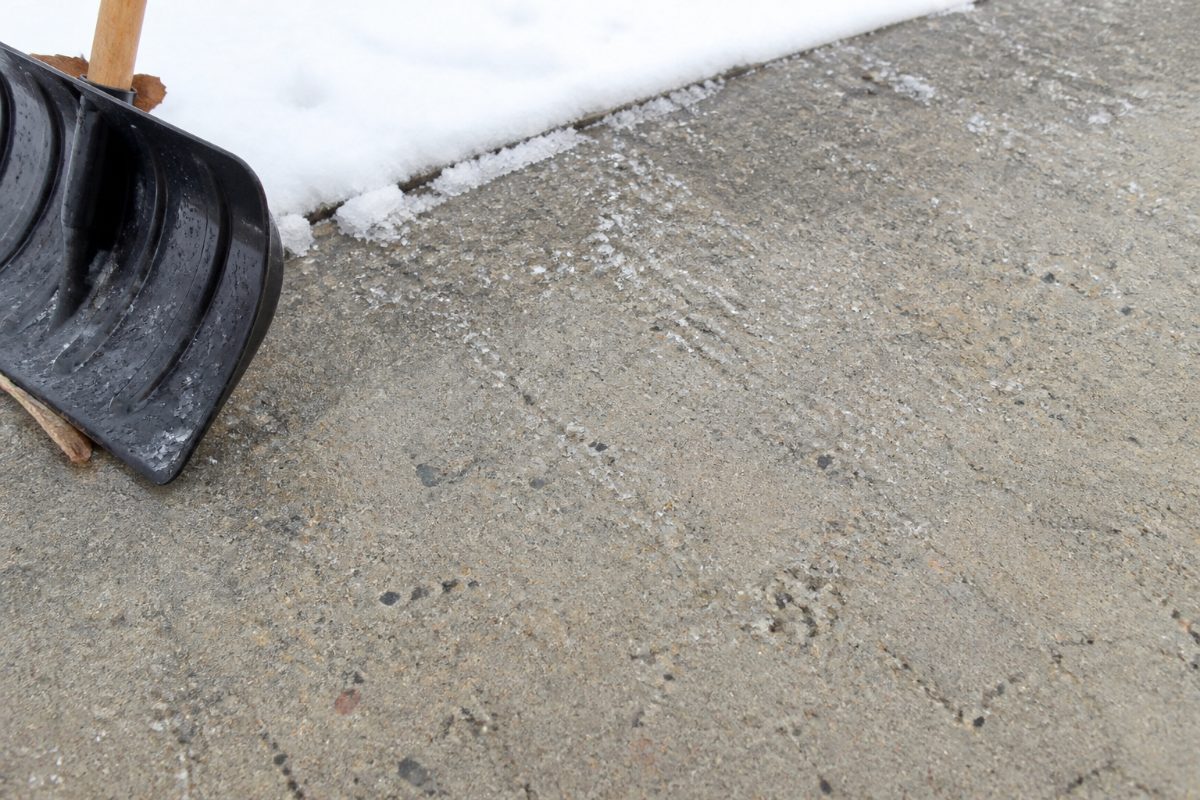
Salt melts ice by forming salty water, or brine, whose freezing point is lower than that of plain water. The brine can move across the pavement and into small surface openings. If the area repeatedly becomes wet and then freezes, the concrete experiences additional freeze-thaw stress.
Deicer exposure can also make the freeze-thaw problem worse by keeping the surface wet or encouraging melting and refreezing. The University of Maryland Extension warns that overuse of some deicers can accelerate damaging freeze-thaw cycles. This is why a driveway that looks fine after one use may still be a poor candidate for routine, heavy salting over many winters.
Concrete age matters. Roof & Router’s guide identifies concrete more than a year old as a better candidate for rock salt and says new concrete is most at risk. If your driveway was recently poured or replaced, use the installer’s care guidance; do not assume that a product labeled “ice melt” is suitable for fresh concrete.
When does rock salt work—and when should you skip it?
Rock salt works best within its temperature range. Connecticut’s Department of Energy and Environmental Protection says sodium chloride is effective down to 15°F. Below that temperature, spreading more rock salt is not a reliable fix; it can leave extra salt behind without producing the melt you want.
Snow depth matters, too. The Taneytown homeowner salt-management guide advises against applying salt on top of several inches of snow because it is ineffective there. Clear the snow first, then use deicer only where a layer of ice remains. That sequence exposes the ice to the product and avoids wasting salt across loose snow.
- Use rock salt: On older concrete, for a thin, persistent ice layer, when pavement conditions are within the product’s working range.
- Skip or limit it: On newly placed concrete, below the stated working temperature, or when the surface is covered by deep snow.
- Use traction instead: When the main need is footing rather than melting. Sand adds grip but does not melt ice, according to New Berlin’s low-salt guidance.
If you are deciding whether to spread deicer before or after a storm, the timing affects how much ice forms and how much product you need. The related guide When to Apply Ice Melt: Before or After Snow? covers that separate timing question.
How should you apply rock salt to a concrete driveway?
Start with physical snow removal, then apply only enough deicer to address the remaining ice. CMHA says deicing chemicals should not replace snow removal and recommends following the product’s dosage. Salt does not melt faster simply because a thicker layer is applied.
- Shovel or push snow away. Clear the driveway before treating it, especially when several inches have accumulated.
- Read the package label. Confirm that sodium chloride is the active ingredient and read its temperature range and application directions.
- Target icy areas. Treat the remaining ice rather than broadcasting salt over clear pavement or the entire snow-covered driveway.
- Use a restrained amount. Add only what is needed to loosen the ice. If crystals remain after melting, sweep or scoop them up for reuse where appropriate; the Taneytown guide recommends recovering leftover deicer.
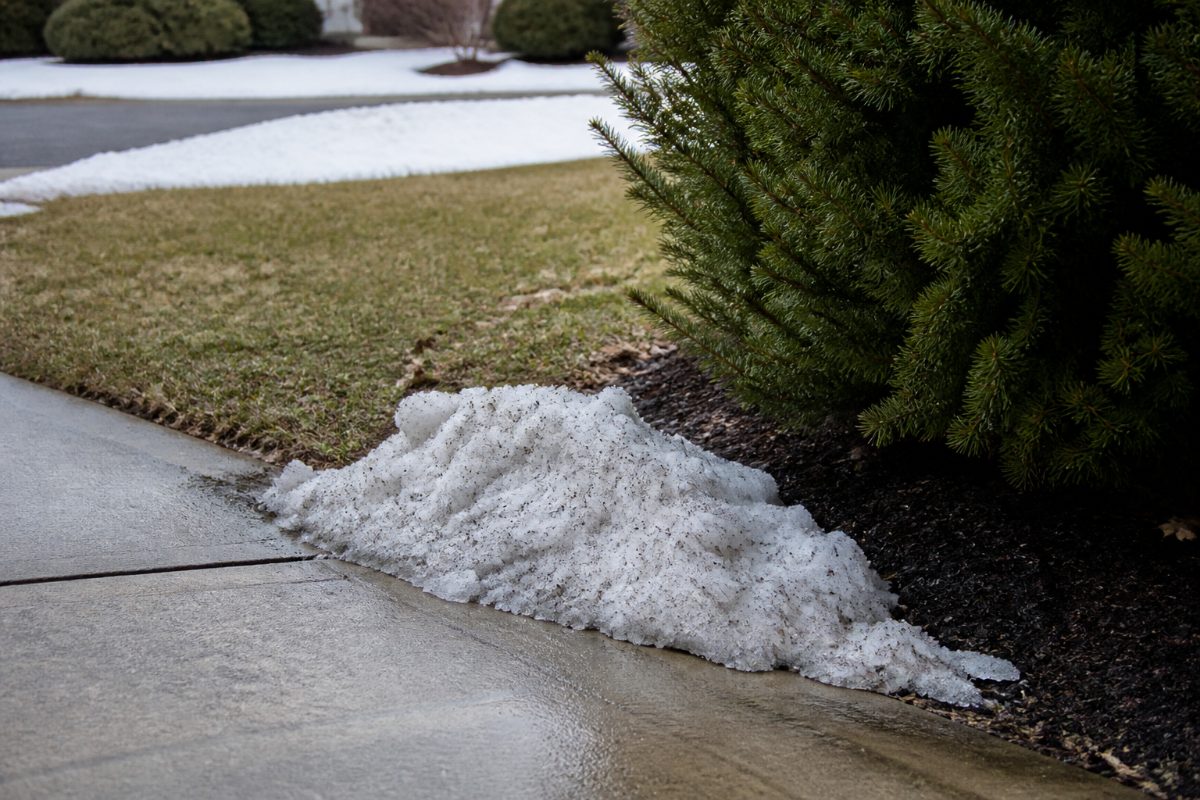
- Keep runoff in mind. Avoid pushing salty slush toward planting beds, lawns, or drainage paths leading to water.
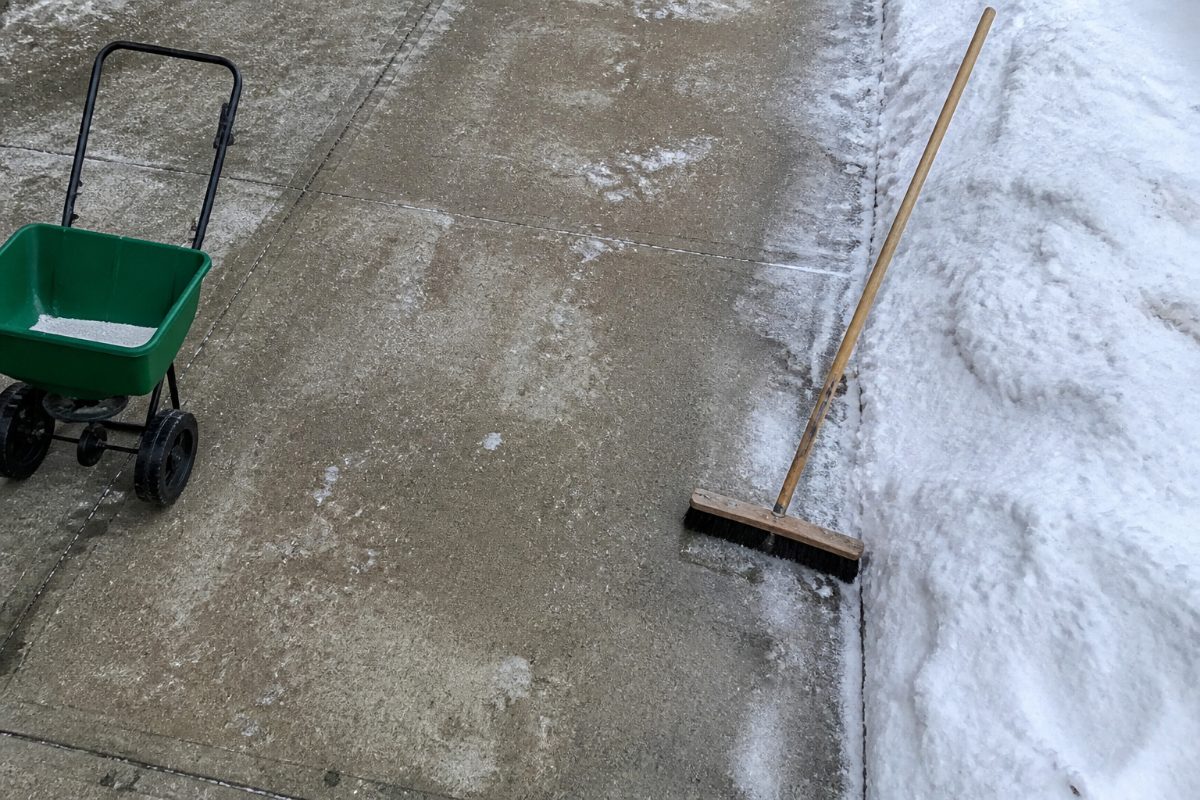
A common mistake is to judge success by how quickly the driveway turns wet. More product will not make sodium chloride effective below its working temperature, and excess salt increases the amount left to wash off the pavement. A light, targeted application is easier to control than repeated handfuls across the full surface.
What can you use instead of rock salt?
The right alternative depends on whether you need melting, traction, or less exposure to deicer. No substitute is harmless in every setting: some products can still affect plants, water, or concrete, and their working temperatures differ.
| Material | What it does | Concrete and use considerations |
|---|---|---|
| Sand | Adds traction; it does not melt ice. | Useful when footing is the priority. Sweep it up after conditions improve to limit residue. |
| Calcium magnesium acetate (CMA) | Salt-free deicer in Connecticut DEEP’s comparison. | Connecticut DEEP lists it as effective down to 20°F and safer for vegetation and concrete surfaces, while noting potential effects on freshwater organisms. Other cited guidance gives a lower working limit of 22–25°F, so use the product label. |
| Calcium chloride | A deicer that works at colder temperatures than rock salt in the cited guidance. | CMHA says to consider careful use when a quicker-acting deicer is necessary. It still requires restrained application and can affect vegetation. |
| Kitty litter | Provides traction rather than dependable ice melting. | Taneytown’s guide notes it absorbs moisture, needs cleanup, and can be messy over a large area. |
CMHA advises against magnesium chloride and CMA for concrete pavers because they can chemically degrade concrete materials; it says CMA’s potential for damage increases with the amount of magnesium in the formulation. Connecticut DEEP describes CMA as safer for concrete surfaces than chloride salts. These recommendations address different product formulations and concrete contexts, so do not treat “salt-free” or “safer” as meaning damage-proof. Check the label and choose a product specifically suited to your pavement.
How can you protect nearby plants and water?
Rock salt can leave the driveway with melting snow and enter soil or waterways. The University of Minnesota Extension says one teaspoon of salt can pollute five gallons of water. Sodium chloride can also harm plants: salt spray may burn turf and evergreen needles, while salt in soil can dehydrate roots and sodium can compact clay soil.
Use these steps to reduce unwanted spread:
- Shovel salty snow away from planting beds instead of piling it around shrubs or trees.
- Keep deicer use narrow and targeted; do not spread it onto lawn edges just because they border the driveway.
- Collect leftover crystals after the ice melts and store deicer in a dry, impervious container to prevent exposure and leakage, as Taneytown’s guide recommends.
- Watch for stunted spring growth, brown evergreen needles, or leaf-edge browning. The University of Maryland Extension identifies these as possible signs of salt injury.
What should new-concrete owners and experienced homeowners do?
If the driveway is new, treat it as the higher-risk case. Roof & Router’s guide recommends rock salt for concrete more than a year old, so for newer pavement, rely first on shoveling and traction and follow the concrete installer’s instructions. Do not substitute another chemical deicer without checking whether it is suitable for the concrete.
If the driveway is established and has been exposed to winter weather before, rock salt may be a practical choice when temperatures are at least 15°F and ice remains after clearing snow. Keep an eye on the surface over time: scaling, flaking, or a roughened finish are reasons to stop routine deicer use and reassess the product and application pattern. A penetrating silane or siloxane sealer can reduce salt absorption, according to Roof & Router’s guide, but it does not make overapplication safe.
For a household prioritizing traction over melting, choose sand and accept that it must be swept up. For a household needing to melt a stubborn ice patch in colder conditions, compare a labeled alternative such as calcium chloride or CMA, but account for the concrete and vegetation tradeoffs rather than choosing by a “pet-safe” or “eco-friendly” phrase alone.
Common rock-salt mistakes to avoid
Most avoidable problems come from using salt in the wrong place, at the wrong temperature, or in excess. These corrections keep the treatment focused and protect the driveway and its surroundings.
- Applying it over deep snow: Shovel first; salt on several inches of snow is ineffective according to Taneytown’s homeowner guide.
- Adding more below 15°F: Sodium chloride’s cited effective limit is 15°F. Use a suitable alternative or focus on traction instead.
- Assuming every ice melt is concrete-safe: CMHA cautions that some deicers can chemically degrade concrete materials, and recommendations differ by product.
- Leaving leftover product behind: Sweep or scoop remaining crystals once the ice has melted, and store them dry for later use.
- Ignoring new concrete: The first winter after installation deserves extra caution; avoid routine salt use until the installer’s guidance supports it.
Frequently Asked Questions
Will rock salt ruin a concrete driveway?
Not necessarily, but it can contribute to deterioration, especially on newer concrete or when used heavily through repeated freeze-thaw cycles. CMHA identifies rock salt as the least damaging deicer among those it discusses, not as completely harmless.
What temperature is too cold for rock salt?
Connecticut DEEP lists sodium chloride as effective down to 15°F. Below that, adding more rock salt is unlikely to solve the problem; use traction material or a product labeled for colder conditions.
Can I use rock salt on a brand-new concrete driveway?
New concrete is the higher-risk case. Roof & Router’s guide recommends rock salt on concrete more than a year old, so use shoveling and traction first on newer concrete and follow the installer’s care instructions.
Is sand better than rock salt for concrete?
Sand is a better choice when you need grip rather than melting. It does not melt ice, so remove it after conditions improve to keep grit from accumulating on the driveway.
Does a concrete sealer make rock salt safe?
A silane or siloxane penetrating sealer can reduce salt soaking into concrete, according to Roof & Router’s guide. It does not eliminate the need to shovel first and apply deicer sparingly.
Key points to remember
Rock salt is a reasonable deicer for many established concrete driveways, but it is not damage-proof. Shovel first, use it only on remaining ice, keep application light, and avoid relying on sodium chloride below 15°F. Give new concrete extra protection, and choose sand when traction—not melting—is the goal.
References
- Rock salt vs. calcium chloride: which ice melt should you use? | Roof & Router
- Guide to Salt Management for Homeowners:
- For safety reasons, we need to keep driveways and ...
- The Effects of Deicing Chemicals on Interlocking Concrete Pavers - CMHA
- What can I do
- Melting Ice Safely | University of Maryland Extension
Information in this post was checked as of October 2026. Policies and prices may change, so please verify important details with official sources.


Comments
Post a Comment