How to Clear Leaves From Window Well Drains Before Fall Storms

Key Takeaways
- Remove leaves and loose debris from the window well before a storm, then uncover and inspect the drain opening.
- Use a small rake or shop vacuum for loose material, as Window Well Supply recommends for clearing window well debris.
- Do not assume every well drains the same way: identify whether yours has a visible drain, gravel, or another arrangement before probing or pouring water into it.
- If water is already entering the basement, or the drain appears blocked below the surface, stop routine cleaning and address the drainage problem safely.
Table of Contents
- Why clear leaves from window well drains before a storm?
- What to gather before cleaning a window well
- How to clear leaves from a window well drain step by step
- How to tell whether the drain is actually clear
- What not to do when cleaning a window well
- How often should you inspect a window well in fall?
- What to do if water still collects after cleaning
- Advice for first-time homeowners and repeat maintainers
- Common mistakes that make the problem harder
- Frequently Asked Questions
- Key points to remember
To clear leaves from window well drains before fall storms, remove the cover if it is designed to come off, lift out leaves and sediment, and uncover the drain opening without forcing tools into it. Finish by checking that the opening is visible and the well is free of loose debris; if you cannot identify the drain or water is backing up, avoid treating the well as a simple leaf-cleaning job.
Why clear leaves from window well drains before a storm?
A window well is the recessed area outside a below-grade basement window. Its drain is meant to give water collected in that area a way to move away, but leaves and other debris can cover the opening or interfere with drainage.
Federal Highway Administration guidance on storm-drain design explains that sediment, debris, and plant material can obstruct drainage facilities over time. The setting is different from a residential window well, but the basic maintenance lesson applies: material that collects around an inlet is worth removing before runoff reaches it.
Cleaning ahead of a storm is more useful than waiting until the well is full. Once wet leaves compact against a drain opening, they can be harder to lift out, and the water level can make it difficult to see what is underneath.
- Before the storm: You can inspect the opening and remove dry or loose debris with better visibility.
- After a storm: Look for newly collected leaves, standing water, sediment, or signs that water reached the window area.
- During active flooding: Do not lean into a water-filled well or handle water that may be contaminated. NC State Extension cautions that floodwater can contain bacterial, viral, and parasitic contaminants.
Clearing leaves does not repair a damaged drain or correct a larger drainage problem. It is a routine maintenance step that keeps the entrance to the drain from being hidden under loose material.
What to gather before cleaning a window well
For ordinary loose leaves, Window Well Supply suggests using a small rake or shop vacuum to remove debris from a window well. Choose a tool that lets you work from stable ground and reach the material without leaning over the window or putting your face close to the well.
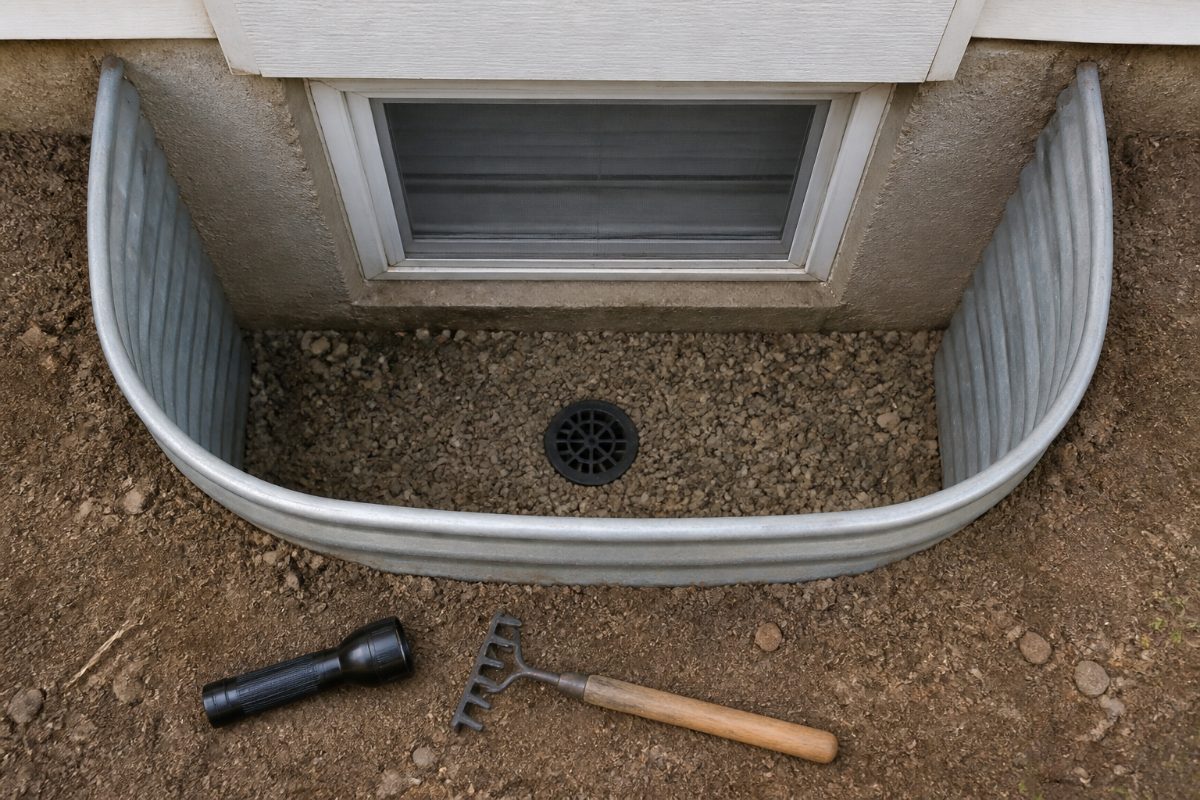
Keep the job simple: a small rake or hand tool, a bucket or yard-waste container, and a flashlight are enough for a basic inspection. A shop vacuum can help with dry, loose debris, but do not use it to remove standing water or material that may be wet, muddy, or contaminated.
| Item | Useful for | Use with care |
|---|---|---|
| Small rake or hand tool | Pulling out loose leaves and sticks | Keep the tool away from the window, drain piping, and any fragile cover parts. |
| Shop vacuum | Collecting dry, loose debris | Do not use it for standing water unless the equipment is specifically designed for wet pickup and you know how to operate it safely. |
| Flashlight | Seeing the drain opening and corners | Use it from outside the well rather than reaching into a dark or water-filled space. |
| Gloves and yard-waste container | Handling and collecting leaves | Avoid direct contact with dirty standing water or unknown material. |
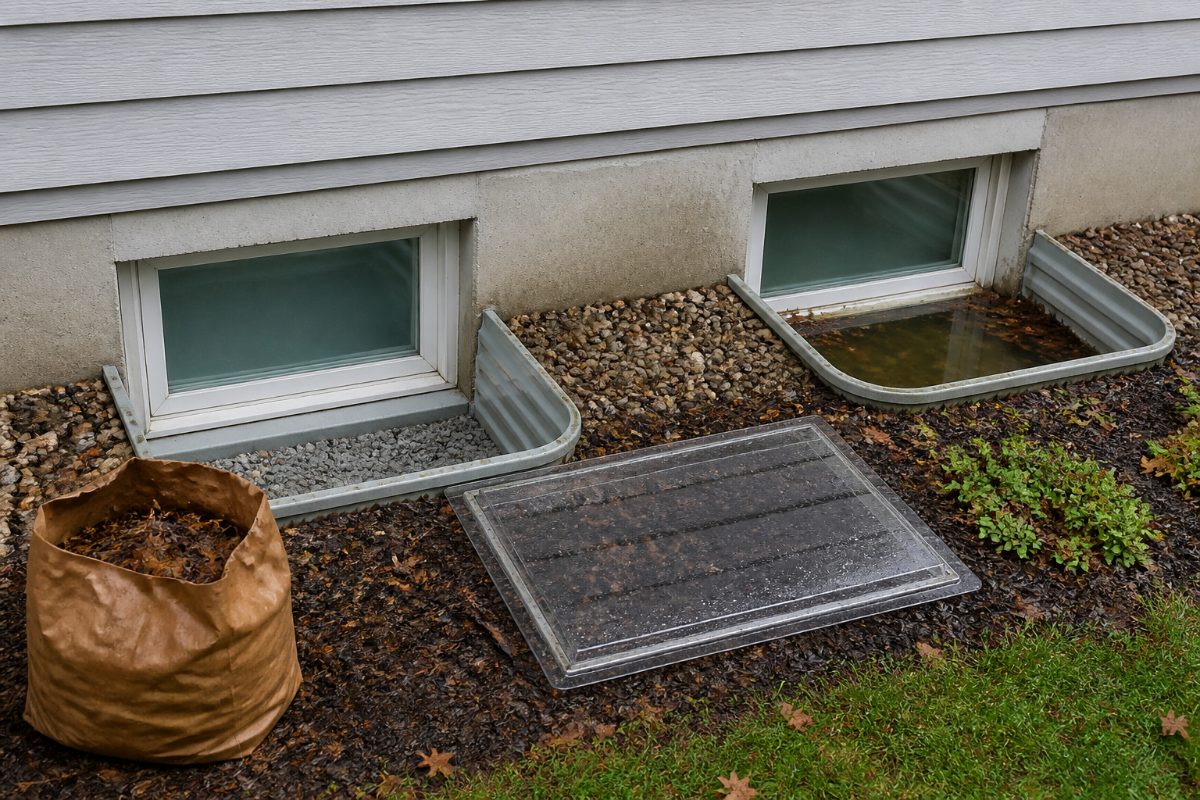
If the well has a cover, check how it is attached before trying to remove it. Some covers are secured or positioned in a way that makes lifting them awkward; do not force one or work beneath a loose cover.
How to clear leaves from a window well drain step by step
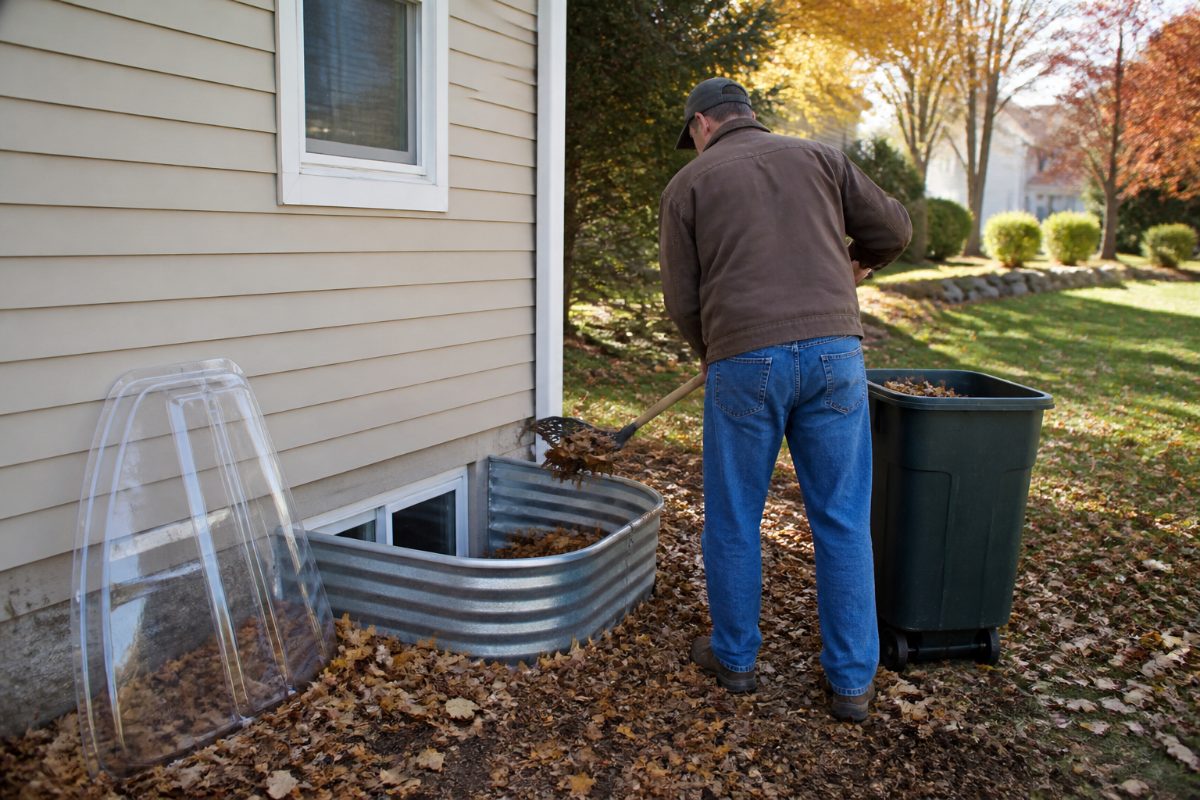
Work from the top down: make the well accessible, remove loose debris, locate the drain, and inspect the area before closing the cover. This order prevents leaves from falling back over the opening while you are still cleaning.
- Choose a dry, calm time. Do the work before rain begins, when leaves are easier to handle and the drain opening is easier to see. Avoid cleaning a well that is filling with water.
- Check the cover. If it is removable, release it according to its design and set it on a stable surface. If it is fixed, clean only the parts you can reach safely without forcing tools through it.
- Remove the largest debris first. Lift out sticks, clumps of leaves, and other visible material with a small rake or by hand while wearing gloves. Put debris in a container instead of pushing it toward the drain.
- Collect remaining loose leaves. Use a small rake or, for dry loose debris, a shop vacuum as suggested by Window Well Supply. Keep suction and tool tips away from any visible pipe or drain fitting.
- Expose the drain opening. Clear leaves and loose sediment from around the opening so you can see its shape and condition. Do not drive a tool into the opening or try to dislodge an unseen blockage.
- Look over the well. Check for remaining debris, standing water, visible damage, or a drain opening that is still covered or obstructed. Note what you see before replacing the cover.
- Replace the cover securely. Return a removable cover to its intended position, and make sure it is not left where wind or foot traffic could displace it.
Keep the removed leaves out of the drain and do not sweep them into a nearby street inlet. Illinois Extension describes leaves as a source of water-quality concerns and notes that communities may have fall leaf pickup programs. Use your local yard-waste collection or disposal method where available.
How to tell whether the drain is actually clear
A visible opening is a useful first check, but it does not prove that the full drain path is open. Residential window wells can have different drainage arrangements, and a drain may continue below the surface where you cannot inspect it visually.
Start with what you can verify without dismantling anything: the drain opening is not covered by leaves, the well is not holding water at the time of inspection, and no loose debris remains against the window. If water is present, note whether it is receding or staying at the same level rather than assuming a quick surface check proves the drain works.
Do not pour a large amount of water into the well as a test. Without knowing where the drain leads or how it is arranged, adding water can create a problem rather than reveal one. If you use a small amount of water to observe the surface, stop if the level rises or water moves toward the window; do not use this as a substitute for diagnosing a concealed blockage.
The Federal Highway Administration’s HEC-22 drainage guidance notes that plant material, sediment, and debris can accumulate in drainage facilities and obstruct flow. That supports a practical distinction: removing visible leaves helps prevent an inlet obstruction, but it cannot confirm that a buried line, outlet, or other part of a drainage system is functioning.
- Likely routine cleanup: Loose leaves are visible, the opening is accessible, and you can remove debris without forcing tools.
- Needs closer attention: Water remains in the well, the opening is hidden under sediment, or the same debris returns quickly.
- Stop DIY probing: The opening appears damaged, the drain cannot be identified, or cleaning would require digging or taking apart a connected system.
What not to do when cleaning a window well
The goal is to remove debris from the well, not to push it farther into a pipe or damage a part you cannot see. Avoid forceful probing, blindly feeding a long tool into the drain, or using pressurized equipment to blast material out of an unknown drainage route.
Do not climb into the well to reach the bottom. A window well is narrow, may have a slippery surface, and can be difficult to exit; use tools from a stable position outside it. Keep children and pets away from the work area while a cover is removed.
Do not treat standing water as clean just because it came from rain. NC State Extension warns that floodwater may contain contaminants, including sewage-related and animal-waste contamination. If water has entered the basement or appears dirty, avoid direct contact and focus on keeping people away from the affected area.
Also avoid placing a mesh screen or other barrier over the drain unless it is part of the existing design and you know it will not block water flow. The U.S. Virgin Islands Environmental Protection Handbook notes that leaf screens on gutters or downspouts need regular cleaning to remain effective. That guidance concerns rooftop runoff systems, not window wells, but it illustrates why a screen can become another place where leaves collect rather than a maintenance-free fix.
How often should you inspect a window well in fall?
There is no inspection interval in the cited window-well guidance that fits every property. Instead, tie checks to conditions: inspect before forecast fall storms, after a major leaf fall, and after a storm that leaves debris or water in the well.
A simple schedule makes the task easier to remember without pretending that every yard sheds leaves at the same rate. A well beneath a tree may collect material sooner than one with little nearby vegetation, so use what you see in your own yard to decide when another check is needed.
| When to check | What to look for | What to do |
|---|---|---|
| Before a storm | Leaves on the cover, debris in the well, and a visible drain opening | Remove loose material and make sure the cover is back in place. |
| After leaves fall nearby | New buildup or a screen or cover collecting leaves | Clear debris before it compacts or hides the drain. |
| After a storm | Standing water, sediment, shifted cover, or debris at the drain | Remove accessible loose material when conditions are safe; record unresolved signs. |
| When the basement shows signs of water | Water near the window, dampness, or active entry | Stop routine cleaning and address the source of water rather than only clearing leaves. |
Keeping roof runoff and yard drainage in mind can also help you spot a broader problem. If leaves repeatedly collect in the well after storms, consider whether surrounding runoff is carrying debris toward it; do not assume the window-well drain is the only part of the drainage path involved.
What to do if water still collects after cleaning
If the opening is visibly clear but water continues to collect, the problem may be beyond the leaves you can reach. A hidden obstruction, a drainage arrangement you cannot see, or water arriving faster than it can leave are possibilities to investigate rather than diagnoses to assume.
Document the conditions while they are visible: take a photo of the well, note whether the drain opening is exposed, and record whether water is present before or after rain. This gives you a clearer starting point if you need a qualified drainage professional to inspect the system.
Do not remove soil around the window or dig toward a buried line based on guesswork. Digging can disturb the area around the foundation or damage something underground. If the drain is concealed, damaged, or remains blocked after loose debris is removed, stop at the accessible surface cleaning and arrange a proper assessment.
If water is entering the basement, treat the situation as a water-intrusion issue, not merely a leaf-cleanup task. NC State Extension emphasizes personal safety around floodwater because it can contain harmful contaminants. Keep people away from contaminated water and do not handle electrical equipment in a wet area.
For a broader look at where roof runoff goes, the related guide How to Check Gutters and Downspouts for Drainage Problems can help you inspect the exterior drainage path without confusing gutter maintenance with a window-well drain repair.
Advice for first-time homeowners and repeat maintainers
If you are new to the house, first identify the well’s cover, the visible drain opening, and any area where water appears to leave. Take a clear photo after cleaning so you have a baseline for comparing the well after a storm; do not infer the route of a buried drain from its surface appearance alone.
If you have cleaned the wells before, focus on changes: a drain opening that is newly hidden, a cover that no longer sits in its intended position, sediment that returns, or water that remains longer than you have observed previously. A change in conditions is more useful than repeating the same quick cleanup without checking whether it solved the visible issue.
For a home with several window wells, use a short checklist for each one rather than assuming they share the same design. Record the location and what you observed—such as “opening visible” or “water present”—so the next inspection starts with useful information.
- First-time homeowner: Identify each well’s visible parts, photograph the clean condition, and avoid probing an unfamiliar opening.
- Experienced homeowner: Compare current conditions with prior observations and investigate recurring water or sediment.
- Anyone facing active water entry: Prioritize safety and the water source; leaf removal alone is not a remedy for ongoing basement intrusion.
Common mistakes that make the problem harder
The most common mistake is pushing leaves toward the drain instead of lifting them out. A second is assuming that a clear-looking opening means the buried drainage route is clear; surface cleaning only verifies what you can see.
Another mistake is waiting until the well is full of water to inspect it. Wet debris is harder to distinguish from sediment, and the water can conceal the opening. If you discover standing water, do not lean into the well or use a household vacuum that is not designed for wet pickup.
Finally, do not add a screen, filter, or cover modification simply because leaves are a recurring issue. Leaf screens in other drainage applications require regular cleaning, as the U.S. Virgin Islands Environmental Protection Handbook notes. Any barrier around a window well should be compatible with the existing system and must not interfere with the intended flow path.
Frequently Asked Questions
Can I use a shop vacuum to clean a window well drain?
Window Well Supply recommends a shop vacuum for removing debris from the well, especially loose material. Use it for dry debris only unless the vacuum is specifically designed for wet pickup, and do not insert it into an unknown drain opening.
Should I pour water into the drain to test it?
A small surface check cannot confirm that a concealed drain line or outlet is clear. Avoid adding a large amount of water, and stop if the water level rises or moves toward the window.
What if leaves are gone but water remains in the well?
A clear surface opening does not establish that the full drainage path is working. Record what you see, avoid digging or probing blindly, and arrange an appropriate inspection if water continues to collect.
Is standing water in a window well safe to touch?
Do not assume it is clean. NC State Extension warns that floodwater can contain bacterial, viral, and parasitic contaminants, so avoid direct contact with dirty or flood-related water.
How often should I remove leaves from a window well?
Check before fall storms, after nearby leaves have fallen, and after storms that leave debris or standing water. The right timing depends on how much material reaches each well, so use visible buildup as your cue.
Key points to remember
Before a fall storm, remove loose leaves from the well, expose the drain opening, and replace the cover securely. A small rake or a shop vacuum for dry debris can handle basic cleanup, but neither tool can confirm that a buried drain is clear.
Keep leaves out of the opening, avoid forceful probing and unsafe contact with standing water, and treat recurring water as a possible drainage issue rather than a cleaning task. Check changing conditions before storms and after debris-heavy weather; if water enters the basement or the drain remains blocked, stop at surface cleaning and address the underlying problem.
References
- Handling Flooding and Storm Damage in the Landscape - Gardening | NC State Extension
- From trees to trouble: how leaves harm water quality | Good Growing | Illinois Extension | Illinois
- US VIRGIN ISLANDS ENVIRONMENTAL PROTECTION ...
- Urban Drainage Design (HEC-22) 4th edition
- Don't Let Winter Flood Your Basement: The Crucial Importance of Fall & Winter Window Well Maintenance - Window
Information in this post was checked as of October 2026. Policies and prices may change, so please verify important details with official sources.


Comments
Post a Comment