How to Check an Outdoor GFCI Outlet Before Holiday Lights
Key Takeaways
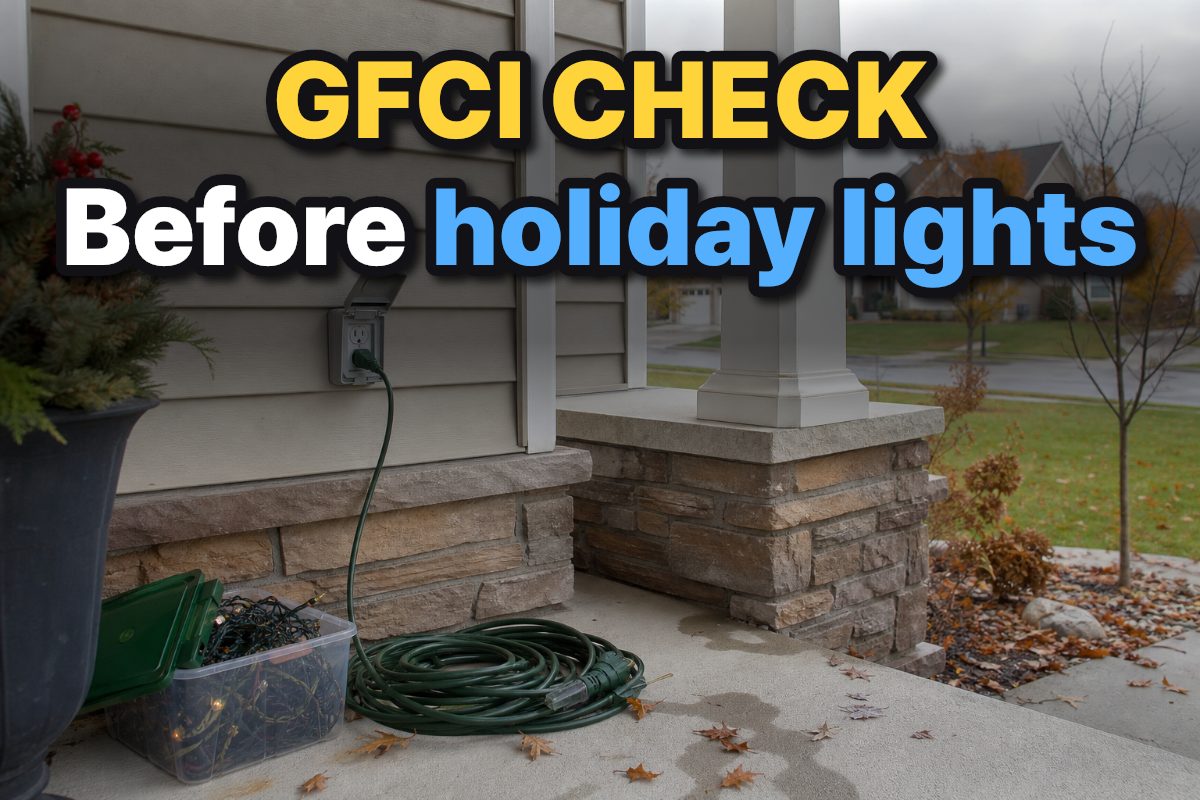
- With the holiday lights unplugged, inspect the outdoor outlet, cover, cords, and light strings before testing.
- Press the GFCI outlet’s TEST button and confirm power to a connected indicator light stops; then press RESET and confirm power returns.
- If the outlet will not trip or reset, or it shows visible damage or moisture, leave it unused and arrange service.
- If power trips after you connect decorations, disconnect them and narrow down the problem without repeatedly resetting the outlet.
Table of Contents
- What to inspect before testing an outdoor GFCI outlet
- How to test an outdoor GFCI outlet before plugging in lights
- How to tell whether the outlet passed the TEST and RESET check
- What to check on holiday lights and extension cords
- What to do if the GFCI trips after you connect holiday lights
- When to stop and get electrical service
- Choose the right check for your situation
- Common mistakes that make a GFCI check less useful
- Frequently Asked Questions
- Key points before decorating
An outdoor GFCI outlet should pass a simple two-button check before holiday lights go up: TEST should interrupt power, and RESET should restore it. A GFCI, or ground-fault circuit interrupter, is a device intended to provide protection by cutting power when it detects a ground fault. Mississippi State University Extension recommends using GFCI protection for outdoor lights and checking holiday-light sockets, bulbs, and cords for damage before each season.
What to inspect before testing an outdoor GFCI outlet
Start with the outlet and everything that will connect to it, not with the decorations switched on. The outlet should look intact and dry, and the lights and extension cords should be labeled for outdoor use and free of visible damage.
Look at the receptacle face and its cover from the outside. Note cracks, loose or broken parts, signs of moisture, or a cover that is visibly damaged. Do not remove the cover or open the outlet to investigate; a visual check is enough to decide whether it is sensible to continue with a button test.
- Outlet: Check for visible cracks, broken parts, or moisture around the receptacle.
- Cover: Look for damage that could leave the outlet exposed. Do not force a damaged cover shut.
- Lights: Check the label for outdoor-use suitability. Inspect sockets, bulbs, and cords for breaks, frayed wires, or loose connections.
- Extension cord: Confirm that its label identifies it for outdoor use and inspect its length for damage.
Mississippi State University Extension advises checking both new and previously used holiday lights before every season. A familiar string is not automatically ready for another year: a cracked jacket, loose connection, or damaged socket changes the decision from “plug it in” to “set it aside.”
If you see moisture inside the outlet, damage to the receptacle, or exposed wiring, do not press the buttons or plug in decorations. Keep that outlet out of use until it has been assessed and serviced. The same applies if the outlet is dry but its cover is broken or no longer protects it from exposure.
How to test an outdoor GFCI outlet before plugging in lights
Test the outlet while the holiday lights are disconnected. Press TEST first, confirm that power stops, and then press RESET to restore power; this is the sequence described in the holiday-light guidance from Twin Cities Homeowner Guide.
- Unplug decorations and cords. Keep the outlet empty of the holiday setup so a fault in the lights does not confuse the basic outlet check.
- Confirm the area is dry and the outlet looks intact. If you noticed moisture or visible damage during inspection, stop rather than testing it.
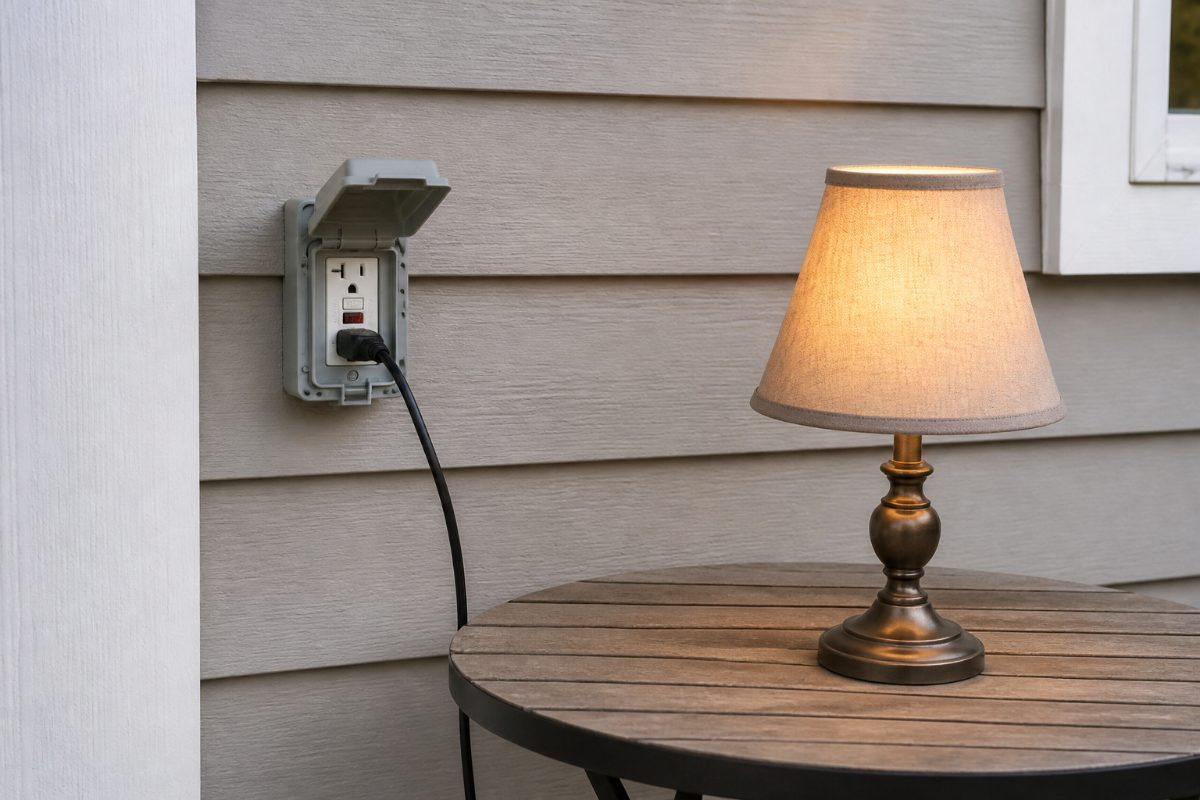
- Use a known-working plug-in light as an indicator, if appropriate. With the outlet and plug dry, a light that is on gives you a visible way to tell whether power has stopped. Do not use a damaged light or cord as a test device.
- Press TEST. The connected indicator light should go out as the GFCI trips and cuts power. If there is no clear sign that power stopped, do not assume the outlet passed.
- Press RESET. The indicator light should come back on when power is restored. Remove the indicator and proceed to the decoration checks only if the test and reset responses are clear.
The point of this sequence is to check two separate responses. TEST checks that the device interrupts power; RESET checks that it can restore power afterward. A button that moves without a clear change in power is not a successful functional check.
If the outlet will not trip when you press TEST, or it will not reset afterward, stop using it for holiday lights and arrange service. Twin Cities Homeowner Guide gives that failure pattern as a reason for service. Do not treat a working lamp before the test as proof that GFCI protection works: ordinary power at the receptacle and a successful trip are different checks.
How to tell whether the outlet passed the TEST and RESET check
A clear pass has two observable steps: power stops after TEST and returns after RESET. A failed or uncertain response means the outlet is not ready to serve as the tested GFCI point for the light setup.
| What you observe | What it tells you | Next step |
|---|---|---|
| The indicator light goes out after TEST and returns after RESET. | The outlet completed the basic trip-and-restore check. | Continue with the visual inspection of lights and cords before decorating. |
| Power does not appear to stop after TEST. | The test did not show the expected interruption. | Do not rely on this outlet for the setup; arrange service. |
| Power stops, but RESET does not restore it. | The outlet did not complete the trip-and-restore check. | Leave the outlet unused and arrange service. |
| The response is unclear or inconsistent. | You cannot confirm that the protection worked. | Do not count an uncertain result as a pass. |
This check does not replace inspection of the decoration itself. Mississippi State University Extension recommends checking sockets, bulbs, and cords for breaks, frayed wires, and loose connections whether the lights are new or old. A good outlet test cannot make a damaged light string safe to use.
One common mistake is to press RESET first and stop because the light turns on. That only shows that power is available; it does not show that TEST can interrupt it. For a useful pre-season check, observe both the loss of power and its return.
What to check on holiday lights and extension cords
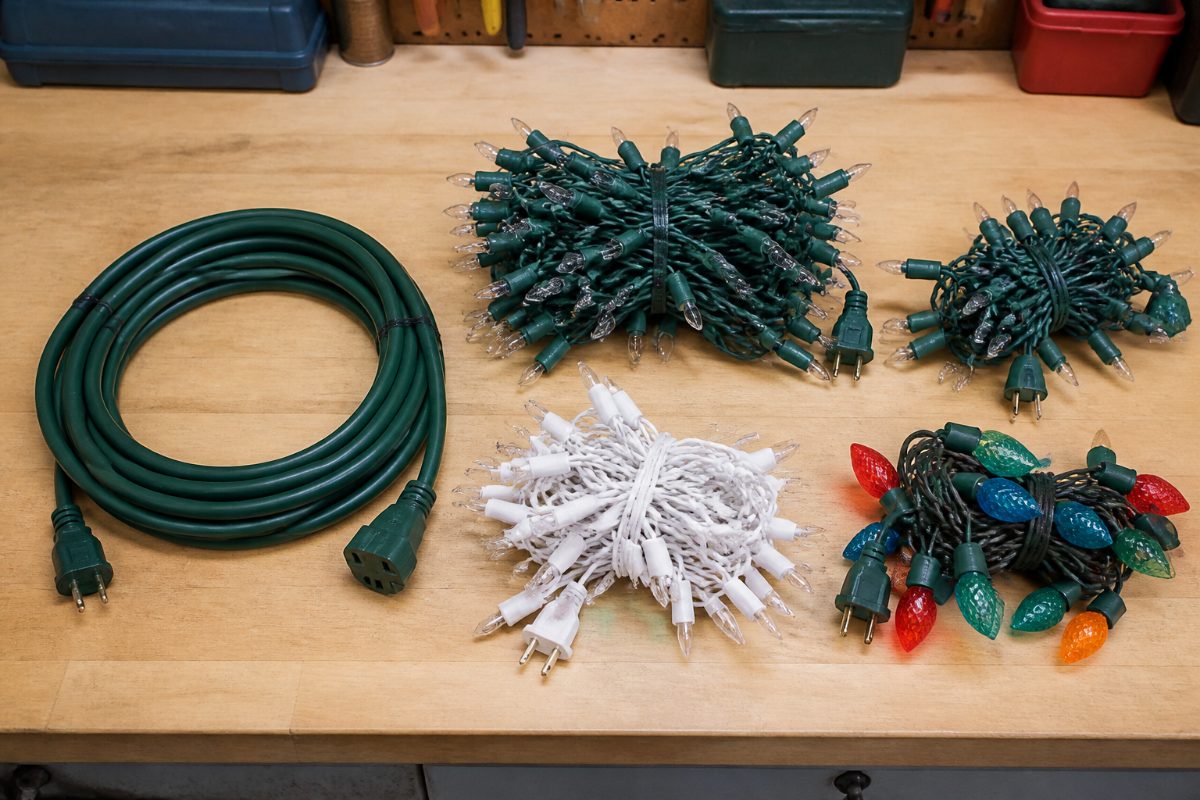
Before connecting the display, match each item to its intended setting: outdoor lights and outdoor-rated extension cords belong outside, while damaged or indoor-only products should stay out of the outdoor setup. Safe Electricity advises plugging outdoor lights into GFCI-protected outlets and using a portable GFCI when needed.
Read the product label rather than judging a cord by its thickness or appearance. Mississippi State University Extension specifically advises checking that outdoor lights are designed for outdoor use. It also recommends lights with an approved laboratory rating and, where available, fused plugs.
- Inspect each string end to end. Look for cracked insulation, fraying, broken sockets, missing or loose bulbs, and loose connections.
- Check the extension cord label. Use one marked for outdoor use, and do not use a cord with damaged insulation or a loose plug.
- Keep the layout within the product’s directions. Follow the cord and light manufacturer’s connection instructions rather than assuming every string can be connected to another.
- Secure lights to stable objects. Mississippi State University Extension advises securing outdoor lights to trees, walls, fence posts, or other stable objects to reduce wind damage. If using staples on a hard object, it recommends insulated staples.
These checks address different risks. The GFCI test is about whether the protection interrupts power; the product inspection is about whether the lights and cords are intact and suitable for outdoor use. Passing one does not cancel the other.
What to do if the GFCI trips after you connect holiday lights
If power cuts off after the decorations are connected, unplug the holiday setup and inspect the lights and cords before trying to narrow down the cause. Do not keep pressing RESET while the same connected arrangement remains in place.
- Unplug the decoration setup. Separate the lights and extension cords from the outlet so you are not testing the whole arrangement as one bundle.
- Look for visible damage or moisture. Check each light string and cord for fraying, breaks, loose connections, damaged sockets, or bulbs. Set aside anything damaged.
- Recheck the GFCI on its own. If the outlet and surrounding area are dry and intact, use the TEST-then-RESET sequence again. If it will not pass that check, stop and arrange service.
- Reconnect only items that passed inspection. Add the light strings and cords in a controlled way, following their labels and instructions. If the GFCI trips again, disconnect the last arrangement rather than continuing to reset it.
- Stop if the problem returns or the cause is unclear. Keep the outlet and setup out of use until the issue can be assessed.
This process helps separate an outlet problem from a problem in the connected decorations. If the GFCI passes by itself but trips when a particular cord or string is reintroduced, that item becomes a useful place to focus the inspection. It does not prove the exact fault, so do not use an item that is damaged or repeatedly associated with a trip.
A trip is not a nuisance to work around by bypassing the protection. Safe Electricity recommends GFCI-protected outlets for outdoor lights and says a portable GFCI can be used when needed. If the setup still trips, the next step is to stop using the suspect arrangement and have the problem evaluated, not to defeat the GFCI.
When to stop and get electrical service
Arrange service if TEST does not cut power, RESET does not restore it, or the outlet has visible damage or moisture. Also stop using the setup if the GFCI trips repeatedly after you remove visibly damaged lights and cords and reconnect only inspected items.
Do not open the outlet, replace its wiring, or treat a plug-in device as a substitute for diagnosing a failed receptacle. Twin Cities Homeowner Guide describes a portable GFCI as a temporary option when outdoor or garage outlets are not GFCI-protected, while identifying a properly protected outlet as the longer-term answer. Safe Electricity also recommends a portable GFCI when needed for outdoor lights.
If you are not sure whether the outlet has GFCI protection, look for TEST and RESET buttons on the receptacle. Their absence alone does not establish how the circuit is protected, so do not guess from the faceplate. A qualified electrician can assess the outlet and the protection serving it; meanwhile, use only a suitable GFCI-protected connection for outdoor lighting.
A portable GFCI does not repair a damaged outlet or a failing light string. Treat it as a protection option for a setup that otherwise passes inspection, not as permission to ignore moisture, damaged insulation, a failed button test, or repeated trips.
Choose the right check for your situation
For a first-time holiday display, follow the full sequence: inspect the outlet, test TEST and RESET, inspect every light and cord, and then connect the setup. For a familiar display, the same pre-season checks still apply; Mississippi State University Extension specifically recommends inspecting new and old lights before every season.
| Your situation | Practical next move | Why |
|---|---|---|
| You are using the outdoor outlet for the first time. | Find the TEST and RESET buttons, check the outlet’s condition, and complete the trip-and-restore test before connecting lights. | A first use is a good time to establish whether the outlet shows the expected response before the decoration setup is involved. |
| You used the same light strings last year. | Repeat the visual inspection of sockets, bulbs, and cords, then test the outlet. | Prior use does not reveal whether insulation, connections, or sockets have since been damaged. |
| The outlet has no visible TEST and RESET buttons. | Do not assume it is GFCI-protected or unprotected based only on appearance; use an appropriate protected connection and have the installation assessed. | The visible receptacle face alone may not tell you how protection is provided. |
| The GFCI trips with the lights connected. | Disconnect the setup, inspect each item, and stop if the trip returns or you cannot isolate a safe arrangement. | Separating the items makes it easier to identify whether a particular cord or light string is involved. |
After the electrical checks, plan how the lights will be used. Mississippi State University Extension advises turning lights off when leaving home or going to bed. It also recommends using no more than three strings of lights for each extension cord and checking that the cord is rated for multiple-cord use. Follow the product instructions where they are more restrictive.
Common mistakes that make a GFCI check less useful
Testing only after the lights are connected makes it harder to tell whether a response comes from the outlet or the decoration setup. Test the outlet with the lights disconnected first, then inspect and connect the lights only after the outlet passes.
- Skipping the RESET step: TEST should interrupt power, but RESET should restore it. Observe both parts of the check.
- Using a damaged string to confirm power: Choose a known-working indicator only if it is intact and suitable for the conditions; otherwise, the test itself introduces another questionable item.
- Assuming “it worked last year” means it is ready: Check older lights and cords every season for damage, as Mississippi State University Extension advises.
- Ignoring a trip because the lights come back on: A successful reset does not explain why the GFCI tripped. Disconnect the setup and inspect it instead of repeatedly restoring power to the same arrangement.
- Using an indoor-only cord or light string outside: Read the label. Outdoor use is a product suitability question, not something appearance can confirm.
When the outlet passes but the connected display does not, keep the two checks separate in your notes: record that the outlet passed the button test, then identify which inspected light strings and cords were connected when power stopped. That simple sequence gives a service professional a clearer starting point if the problem persists.
Frequently Asked Questions
Should I press TEST or RESET first on an outdoor GFCI?
Press TEST first and confirm that power stops, then press RESET and confirm power returns. Twin Cities Homeowner Guide describes this order for testing a GFCI before the holiday-light season.
Can I use holiday lights if the GFCI will not reset?
No. A GFCI that will not reset has not completed the trip-and-restore check. Leave the outlet unused for the decoration setup and arrange service.
What if the outlet has no TEST and RESET buttons?
Do not decide how the circuit is protected from the receptacle face alone. Use an appropriate GFCI-protected connection for outdoor lights and have the installation assessed if you cannot confirm its protection.
Why does the GFCI trip only after I plug in the lights?
The connected lights or cords may be involved, but a trip by itself does not identify the exact cause. Unplug the setup, inspect each item for damage, and stop if the trip returns or you cannot establish a safe arrangement.
Do older holiday lights need the same inspection as new lights?
Yes. Mississippi State University Extension recommends checking both new and old lights before every season, including sockets, bulbs, and cords for breaks, frayed wires, and loose connections.
Key points before decorating
Before hanging the lights, make the next action straightforward: inspect the dry, intact outlet; test with TEST and RESET while the decorations are unplugged; and set aside any damaged or indoor-only light strings and cords. If the outlet fails the button check or the setup trips again after inspection, keep it out of use and arrange service rather than trying to work around the protection.
References
- December - Holiday Safety Tips | Mississippi State University Extension Service
- Holiday Lights Safety: A Twin Cities Homeowner Guide
- Holiday Lights: Your Guide to Decorating Safely - Safe Electricity
Information in this post was checked as of October 2026. Policies and prices may change, so please verify important details with official sources.


Comments
Post a Comment