How Often to Replace a Furnace Humidifier Water Panel
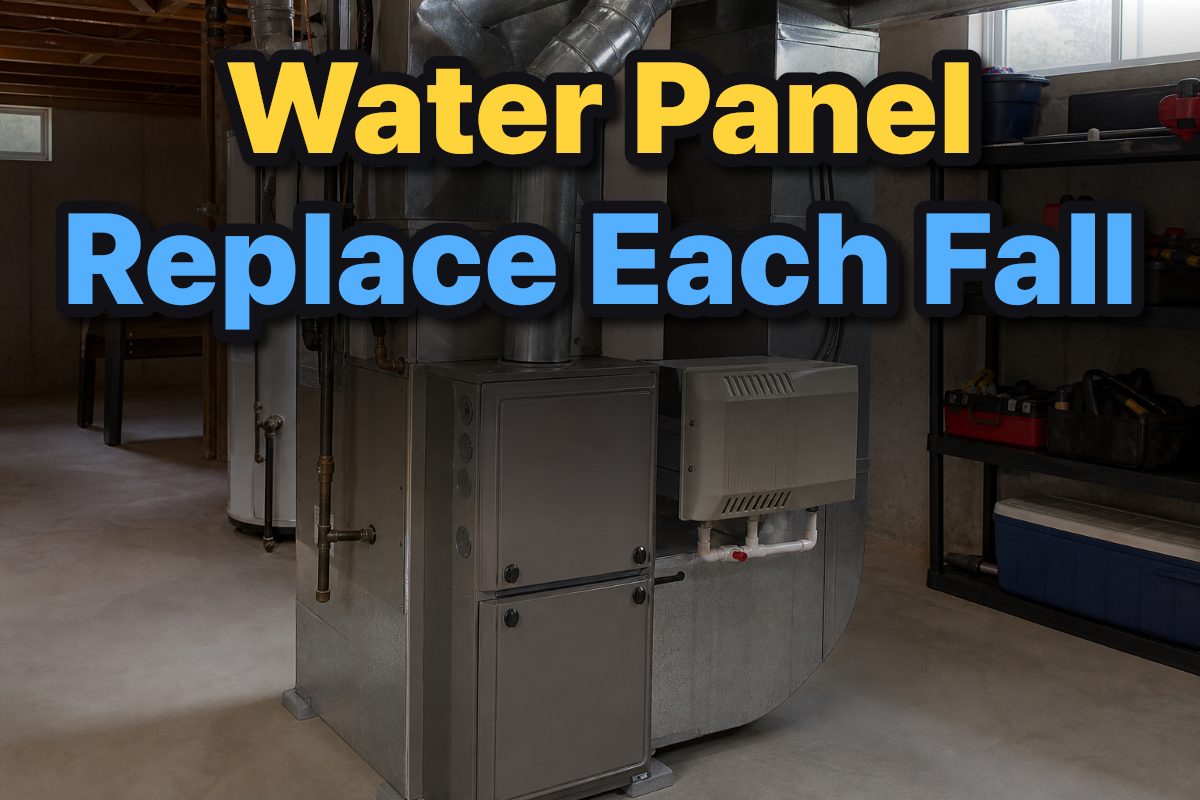
Key Takeaways
- Replace a furnace humidifier water panel at the start of each heating season, usually once a year.
- Hard water, frequent operation, or visible mineral buildup can call for a more frequent replacement.
- Use the panel specified for your humidifier model; a steam humidifier can use a different replaceable part.
- Turn off the furnace before servicing, and shut off the humidifier during warm months when it is not in use.
Table of Contents
- How often should you replace a furnace humidifier water panel?
- Why does a water panel need regular replacement?
- What signs mean the panel may need changing sooner?
- How do water hardness and run time change the schedule?
- When is the best time to change the panel?
- Is a water panel the same as a humidifier filter?
- What should you do if a new panel does not fix the problem?
- Which replacement schedule fits your household?
- Frequently Asked Questions
- Key takeaways
For most furnace humidifiers, replace the water panel once a year, at the beginning of the heating season. Bryant recommends a new panel at the start of each heating season, while noting that hard water or operating conditions can make more frequent changes necessary. If your system runs heavily or the panel is crusted with mineral deposits, inspect it sooner and follow the instructions for your specific model.
A furnace humidifier water panel is the water-absorbing evaporator pad that air passes over to pick up moisture. It is not interchangeable with every humidifier filter or steam canister, so identify the humidifier type before buying a replacement.
How often should you replace a furnace humidifier water panel?
Plan on replacing the water panel once each year, preferably when you prepare the humidifier for the heating season. Bryant’s whole-house humidifier guidance recommends replacement at the beginning of each heating season; Precision Temperature also reports that most manufacturers recommend at least one change per year.
That annual change is a practical baseline, not a promise that every panel lasts the same amount of time. Bryant says hard water may require more frequent replacement, and GreenLeaf Air recommends inspecting the panel every three to six months when a system runs frequently or the home has hard water. Inspection helps you catch buildup before it restricts the panel’s ability to distribute water and support moisture output.
| Household or system condition | Useful starting schedule | What to look for |
|---|---|---|
| Typical seasonal use | Replace at the start of each heating season | Confirm the old panel is not heavily coated or damaged. |
| Hard water | Inspect more often; replace sooner if buildup is substantial | Look for mineral deposits that cover the panel surface or interfere with water distribution. |
| Frequent humidifier operation | Inspect every three to six months | Compare the panel’s condition and the humidifier’s moisture output. |
| Model instructions give a different interval | Follow the model-specific schedule | Check whether the part is a water panel, filter, or steam canister. |
Use the table as a maintenance cue rather than a substitute for the product instructions. A clean-looking panel does not cancel the annual seasonal replacement recommendation, and a visibly scaled panel does not need to be kept in service until fall if the humidifier is still running.
Why does a water panel need regular replacement?
The panel gives water a broad surface for furnace air to pass across. In a bypass humidifier, furnace air moves across the wet panel; mineral deposits and dirt can reduce moisture output or contribute to clogs, according to the maintenance guidance from APHW and GreenLeaf Air.
Minerals remain behind as water moves through the humidifier. With hard water or frequent use, deposits can accumulate sooner, which is why Bryant identifies water quality and operating conditions as reasons to replace a panel more often than once per season. A fresh panel also gives you a clear starting point for assessing the system’s performance through the heating season.
Replacing the panel is one part of maintenance, not the whole job. Bryant describes whole-house humidifier care as “Clean, Replace and Calibrate”: clean the humidifier, replace the water panel, and check the humidity control. Keeping these tasks together makes it easier to distinguish a worn panel from a setting or distribution problem.
What signs mean the panel may need changing sooner?
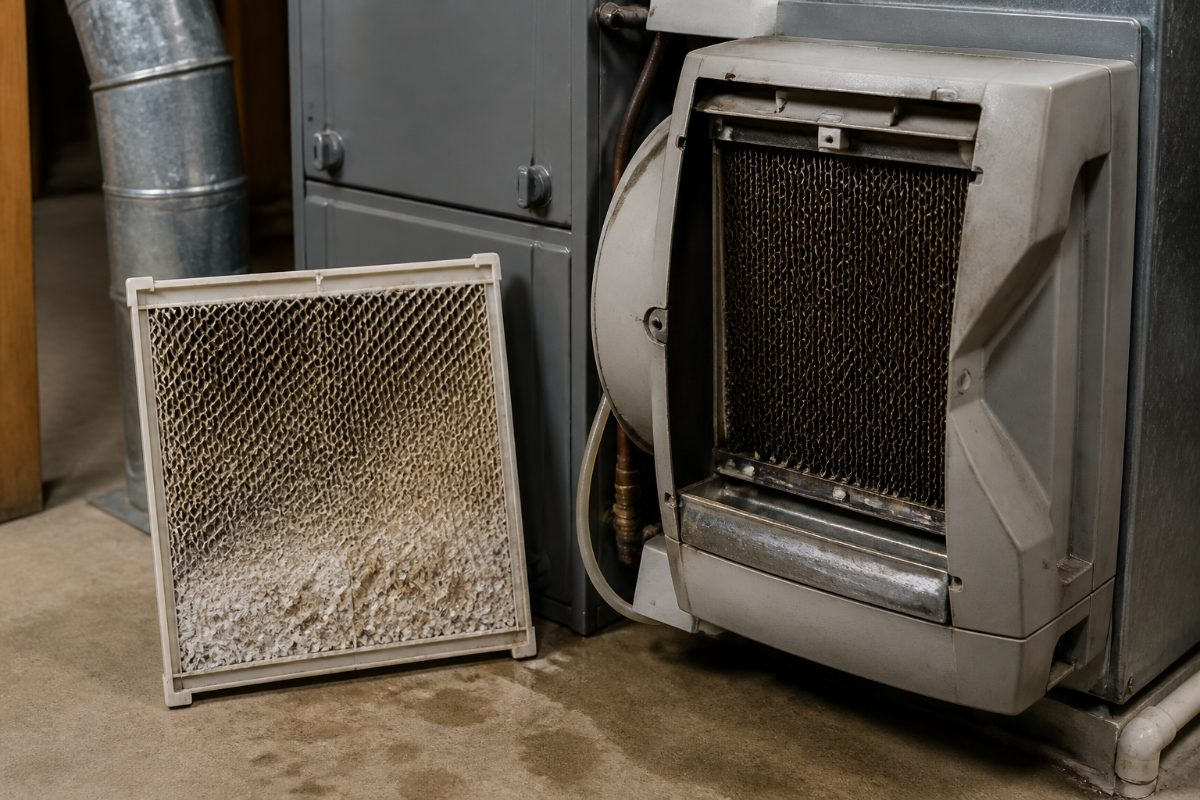
Do not wait only for a calendar reminder if the humidifier’s output has fallen or the panel is visibly clogged. GreenLeaf Air lists reduced moisture output, persistent dry-air symptoms, and increased static as reasons to inspect the panel and the humidifier’s settings. Those signs can point to other issues too, so treat them as prompts to inspect rather than proof that the panel alone is at fault.
- Mineral buildup or dirt: A visibly coated or dirty panel can interfere with water distribution. Compare its condition with a new panel of the correct type.
- Lower moisture output: If the home no longer reaches the intended humidity, inspect the panel and verify the humidistat setting before assuming the humidifier has failed.
- Dry-air symptoms or more static: GreenLeaf Air identifies these as possible signs of low humidity or an underperforming humidifier. Check humidity with a hygrometer if you have one, then inspect the panel.
- Water around the humidifier: A leak may relate to a clogged panel, blocked drain line, or poor installation. GreenLeaf Air advises checking tubing, panel seating, and overflow rather than replacing the panel without inspecting the surrounding components.
One common mistake is to blame every leak on an old panel. A fresh panel cannot clear a blocked drain line or correct a poorly seated component, so inspect the water path as well. If the panel is clean but moisture output remains low, the humidistat setting or another part of the humidifier may need attention.
How do water hardness and run time change the schedule?
Hard water and frequent operation are the two clearest reasons in the cited maintenance guidance to inspect a panel more often than once per heating season. GreenLeaf Air suggests an inspection every three to six months for these conditions, while Bryant says hard water may require more frequent replacement. Neither source sets one universal early-change date for every home.
Use a condition-based approach: start with a new panel in fall, then inspect it during the season if the system runs often or mineral buildup is common. The point of the inspection is to decide whether the panel remains open and functional, not to replace parts on a rigid monthly schedule regardless of condition.
| What you notice | Next step | Why |
|---|---|---|
| Little mineral buildup and normal output | Keep the annual replacement date and inspect at the next seasonal service. | The available guidance sets a seasonal baseline for ordinary use. |
| Heavy scaling, dirt, or restricted-looking water distribution | Replace with the correct model-specific panel and inspect the distribution area. | Buildup can reduce moisture output or contribute to clogging. |
| Frequent operation or hard water | Schedule interim inspections, using the three-to-six-month interval as a prompt. | More use and mineral content can shorten the useful service interval. |
| New panel but continuing low output | Check the humidity control and inspect for other flow or drain problems. | A panel is only one factor in humidifier performance. |
Households that are unsure whether their water is hard can begin with the panel itself: visible mineral crust is a direct reason to inspect the water path and consider an earlier change. Avoid treating symptoms such as static alone as a diagnosis; first verify that the humidifier is on, the humidity control is set appropriately, and the panel is installed correctly.
When is the best time to change the panel?
Change it during fall preparation, before restarting the humidifier for the heating season. APHW recommends replacing the water panel with a new one when reversing the summer shutdown process. Bryant likewise places water-panel replacement at the beginning of each heating season.
Summer shutdown matters because a furnace humidifier should be off during warm months when the furnace is not running. APHW advises turning off the humidistat and the water supply valve, and says to consider removing the panel so it can dry completely. The reason is practical: running the humidifier without airflow across the panel can promote mold buildup and shorten the unit’s life.
- Before seasonal startup: Locate the humidifier’s model information and determine which replacement part it uses.
- Turn off the furnace before servicing: AireServ specifically advises shutting off the furnace before working on the humidifier filter.
- Remove and inspect the old panel: Look for mineral deposits, dirt, damage, and evidence that water has not been distributing evenly.
- Install the correct replacement: Follow the product’s installation directions so the panel sits properly and water can reach it as intended.
- Restore operation and check the surrounding area: Look for leaks and confirm that water is not overflowing or escaping around the unit.
These steps are a maintenance outline, not a model-specific installation manual. Humidifier designs differ, so use the product instructions for panel orientation, access, and reassembly. If the unit leaks after a change, turn the humidifier off and inspect the seating, tubing, and drain area rather than repeatedly running it in the same condition.
Is a water panel the same as a humidifier filter?
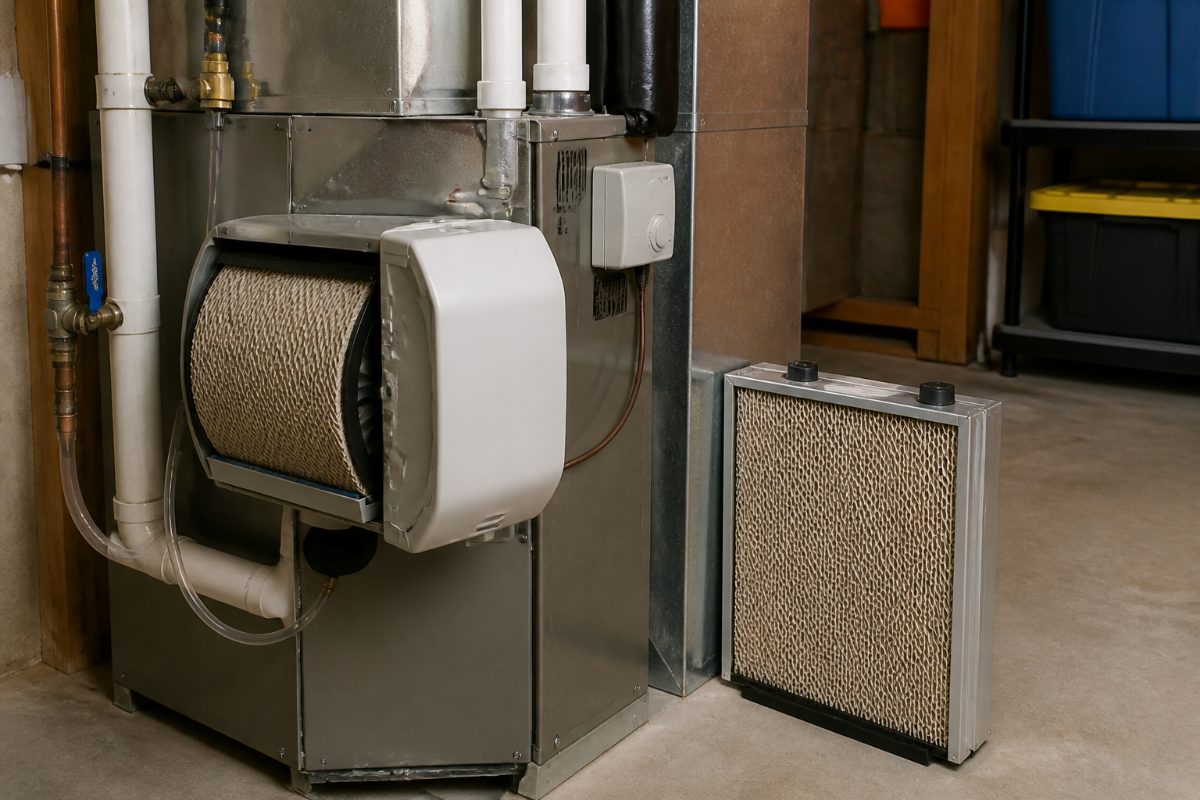
Not always. “Water panel,” “evaporator pad,” and “humidifier filter” can be used for parts in evaporative humidifiers, but a steam humidifier may use a replaceable steam canister instead. Bryant specifically distinguishes its evaporative humidifier water panel from the steam canister used in its Preferred Series steam humidifier.
Published replacement intervals can also differ because sources may use “filter” broadly. AireServ advises checking and replacing a humidifier filter every one to three months during use, while Bryant recommends replacing an evaporative water panel at the start of each heating season, with earlier replacement when water quality or operation calls for it. Do not apply the one-to-three-month filter interval automatically to every water panel; identify the component and follow the instructions for that humidifier.
Before ordering, match the replacement part to the humidifier’s manufacturer and model. A part that looks similar may not fit the frame or distribute water correctly. If the unit uses a steam canister, the water-panel schedule does not apply; Bryant says to follow the steam product documentation for replacement timing and instructions.
What should you do if a new panel does not fix the problem?
A new panel should not be treated as a cure-all for every humidifier complaint. GreenLeaf Air notes that a leak may come from a blocked drain line or poor installation, and that low moisture output can relate to settings or internal scale as well as the panel.
- For low humidity: Check the humidistat or humidity control, then confirm the panel is the correct part and seated as directed. Bryant recommends calibrating or adjusting the control based on outdoor conditions.
- For a leak: Look for a displaced panel, tubing problem, blocked drain, or overflow. Do not assume a new panel will resolve a drainage fault.
- For continued mineral deposits: Inspect the distribution tray, orifice, water strainer, and feed tube. Bryant recommends annual inspection of the strainer and feed tube and clearing or replacing them if water flow is restricted.
- For an older unit with a major repair: APHW says furnace humidifiers typically last five to ten years with proper maintenance and that replacement may make more sense than a significant repair when a unit is near the older end of that range.
That lifespan range refers to the humidifier, not the water panel. Replacing a panel annually does not mean the whole humidifier should be replaced every year, and a recent panel change does not rule out a separate component problem. For an aging unit, compare the scale of the repair with the condition of the humidifier rather than buying multiple panels to address a fault elsewhere.
Which replacement schedule fits your household?
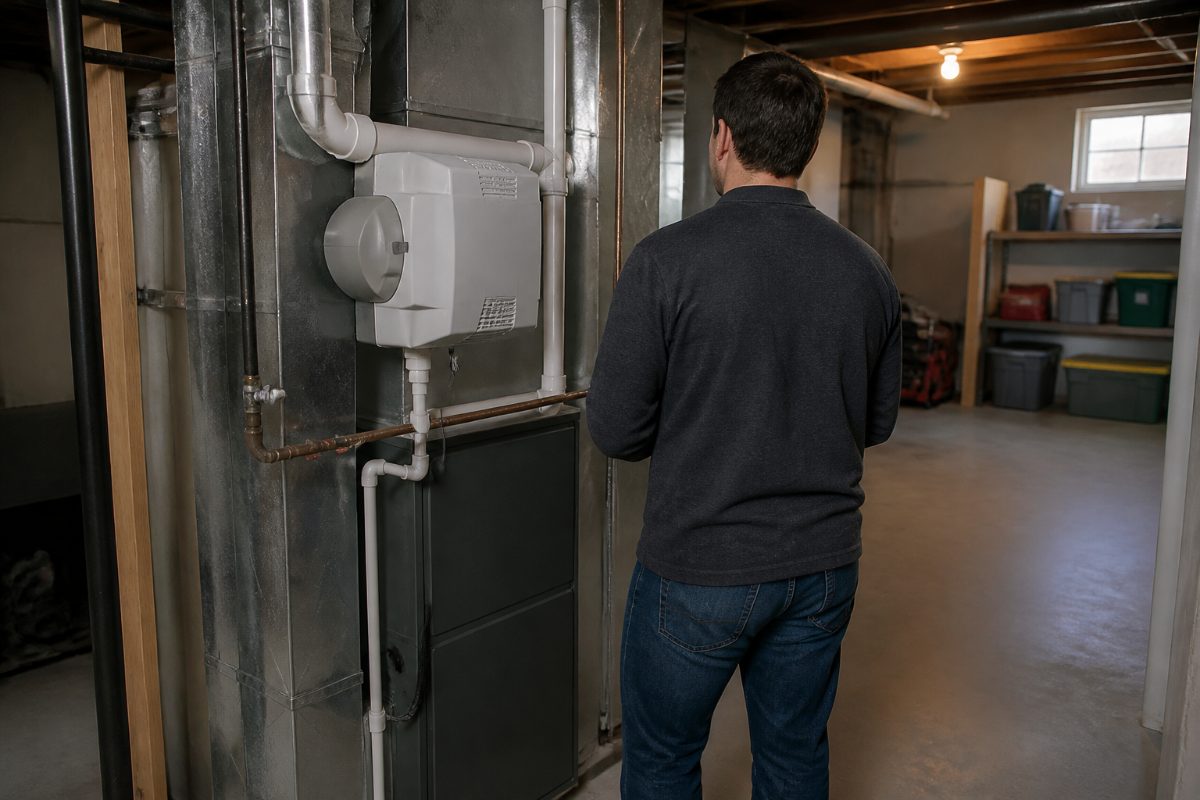
Choose the schedule that reflects how the system is used, then keep the annual fall change as the baseline. A household with ordinary seasonal use can plan one replacement before startup; homes with hard water or longer run time should add interim inspections and let the panel’s condition guide an earlier change.
| Your situation | Practical plan |
|---|---|
| You are starting a humidifier for the first time | Find the model information, confirm whether the unit is evaporative or steam, and install the specified part before seasonal use. |
| You already replace the panel each fall | Keep that routine, and inspect sooner if output drops or mineral buildup appears. |
| Your home has hard water or the system runs frequently | Inspect every three to six months as GreenLeaf Air suggests; replace sooner if the panel is scaled or performance declines. |
| You are seeing a leak or persistent low humidity | Inspect the panel and also check water distribution, the drain path, and the humidistat setting. |
| Your unit uses steam rather than an evaporative panel | Identify the steam canister and use the model’s documentation for its service interval. |
A simple maintenance note can prevent confusion next fall: record the replacement date, the part name, and the humidifier model. If you inspect midseason, note whether the panel showed heavy scale and whether the humidifier was running frequently. Those observations help you make the next replacement decision based on your system rather than a generic label.
Frequently Asked Questions
Can a furnace humidifier water panel last more than one year?
Some panels may remain usable, but Bryant recommends replacing an evaporative water panel at the beginning of each heating season. Hard water and operating conditions can call for earlier replacement, so annual seasonal service is a more dependable baseline than waiting for a panel to fail visibly.
Should I replace the panel every time I clean the humidifier?
Cleaning and replacement are related but separate tasks. Bryant’s maintenance framework includes both, and its guidance calls for a new evaporative panel at the start of each heating season; follow the instructions for your model if its schedule differs.
Does a dirty water panel cause a humidifier leak?
A clogged panel can be one possible cause, but GreenLeaf Air also identifies a blocked drain line or poor installation as possible reasons for water around the unit. Inspect the panel, tubing, seating, and drain path instead of assuming a replacement panel alone will stop the leak.
Is the panel replacement interval the same for steam humidifiers?
No. Some steam humidifiers use a replaceable steam canister rather than an evaporative water panel. Bryant directs owners to the steam product documentation for canister replacement timing and instructions.
What should I do with the panel when the humidifier is off for summer?
APHW recommends turning off the humidistat and the water supply valve during warm months when the furnace is not running. It also suggests removing the panel and letting it dry completely; install a new panel before restarting the humidifier for the next heating season.
Key takeaways
- Replace an evaporative furnace humidifier water panel once each year, at the start of the heating season.
- Inspect sooner when the system runs frequently, water is hard, mineral buildup is visible, or moisture output drops.
- Confirm whether the unit uses a water panel, filter, or steam canister before ordering a replacement.
- When a new panel does not solve low output or a leak, inspect the humidistat, water distribution, and drain path too.
As of October 15, 2026, the cited guidance supports an annual seasonal replacement as the baseline, with earlier changes driven by water quality, use, and the humidifier model. Bryant’s maintenance instructions are especially useful for distinguishing evaporative panels from steam canisters and for keeping cleaning, replacement, and humidity-control checks in one routine.
References
- Furnace Humidifier Maintenance: A Homeowner'S Guide
- How Often Should I Change My Furnace Humidifier Filter?
- Humidifier Water Panel Replacement: Stop Dry Air & Clogs
- Whole House Humidifier Maintenance Guide | Bryant
- Best Time to Change a Humidifier Water Panel - Precision Temperature
- How Often Should I Change My Furnace Humidifier Filter?
Information in this post was checked as of October 2026. Policies and prices may change, so please verify important details with official sources.


Comments
Post a Comment