How Much Ice Melt to Use on a Driveway
Key Takeaways
- There is no universal amount of ice melt for every driveway; use the rate on the product label and measure the area you plan to treat.
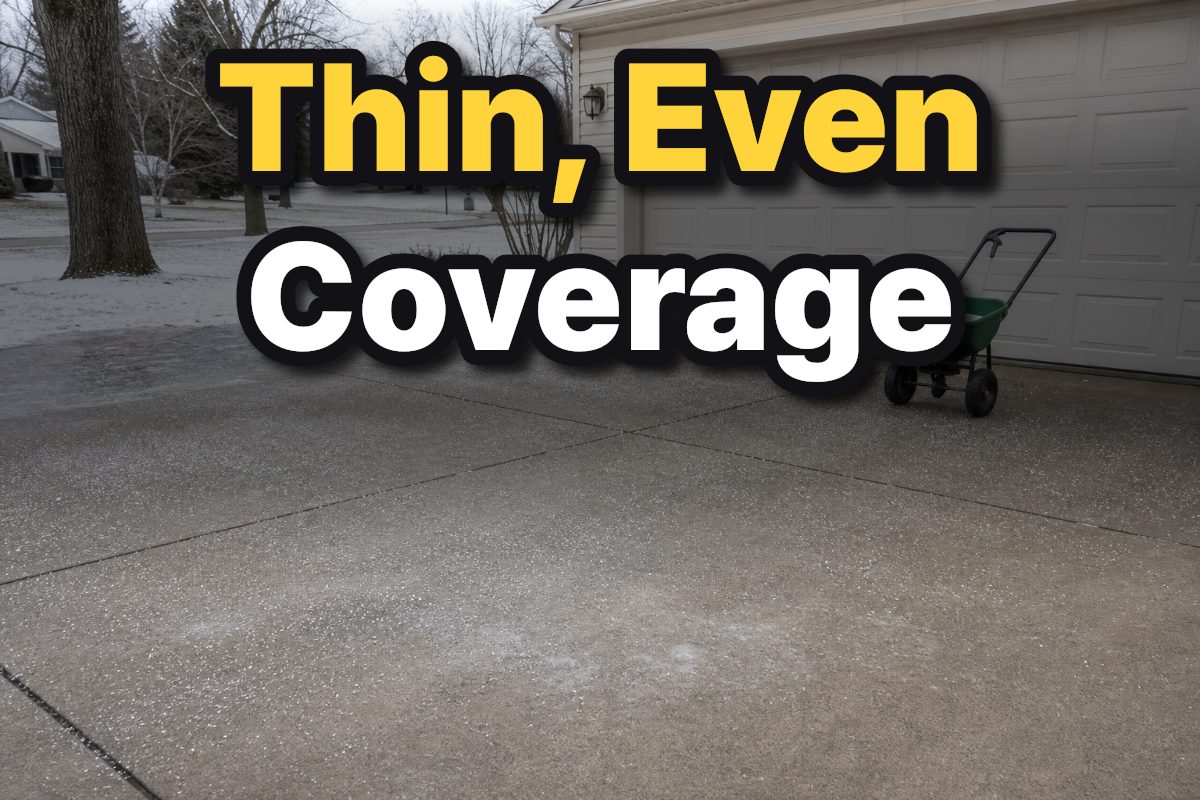
- Spread deicer in a thin, even layer. University of Maryland Extension says a lighter application can work when it still covers the pavement evenly.
- Preventing a thin ice film is easier than melting thick ice, so apply before ice forms when conditions and product directions allow.
- Choose by pavement temperature and surface material, not just by the product name: some chlorides can damage concrete, plants, brick, or stone.
Table of Contents
- How much ice melt should you use on a driveway?
- How to calculate the amount for your driveway
- Why a thin, even application works better
- When to apply ice melt: before ice or after it forms?
- Choose an amount based on the product and pavement temperature
- How much should you use on new concrete, plants, or a sloped drive?
- Common ice-melt mistakes and how to avoid them
- Which approach fits your situation?
- Frequently Asked Questions
- Key points for a safer application
For the right amount of ice melt on a driveway, start with the application rate printed on the bag, then use it to calculate the quantity for the area you actually need to treat. Spread that amount thinly and evenly rather than making a deep layer; more product does not automatically mean faster or safer melting.
How much ice melt should you use on a driveway?
Use the manufacturer’s labeled application rate for the product and the driveway area being treated. There is no single reliable “handfuls per driveway” amount: products use different compounds, and the University of Maryland Extension advises following the product directions while applying no more than needed for thin, even coverage.
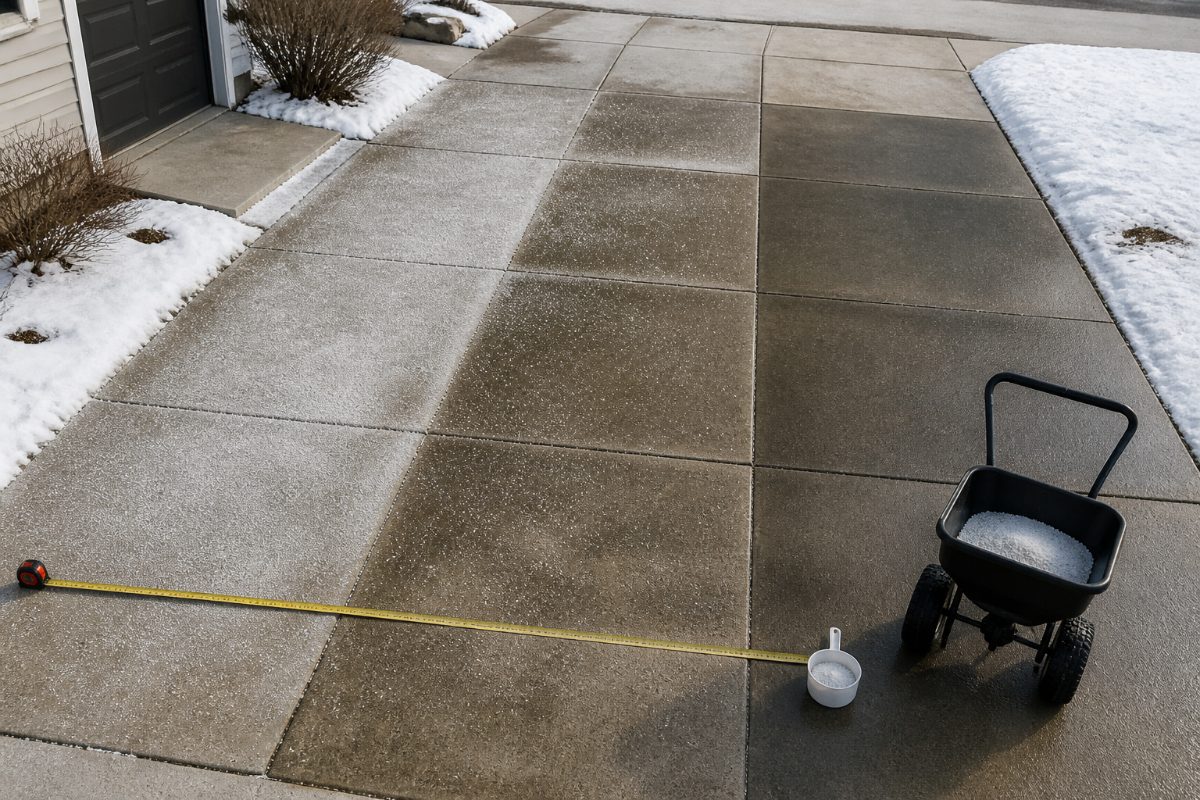
Find the treated area by measuring the driveway’s length and width and multiplying them. If you are treating only a shaded section, a tire path, or the approach to a garage, calculate that portion instead of spreading product across the entire driveway. This keeps the amount tied to the surface that needs treatment.
| What to measure or read | How it guides the amount |
|---|---|
| Driveway area | Measure only the pavement you intend to treat; divide an irregular driveway into simple sections and total their areas. |
| Product application rate | Use the label’s rate for the product and conditions. Apply that rate to the measured area. |
| Coverage after spreading | A thin, even distribution is the goal. If the pavement is still bare in broad patches, redistribute the material rather than piling it into a few spots. |
| Surface and weather conditions | Check that the product is suited to the pavement and temperature before deciding to apply it. |
For example, if only a sloped section has glaze ice, the calculation should use that section’s area, not the full driveway. A spreader can make it easier to distribute granules consistently; Minnesota Pollution Control Agency’s Smart Salting manual recommends using an application-rate chart and calibrating equipment each year.
How to calculate the amount for your driveway
Convert the label rate into a quantity for your measured area. If a label gives a rate per square foot, multiply the rate by the treated square footage; if it gives a rate for a larger area, scale the amount proportionally. Keep the label’s units intact so you do not accidentally mix pounds, ounces, or area units.
- Choose the section. Decide whether the whole driveway needs treatment or only specific icy areas.
- Measure the pavement. For a rectangular section, multiply length by width. For an uneven layout, split it into rectangles, calculate each one, and add the areas.
- Read the product label. Find the application rate and any directions for temperature, pavement type, or timing.
- Scale the rate. Use the label’s rate for the measured area, not an estimate based on the size of the bag or a scoop.
- Spread and assess. Apply a thin, even layer. If the product has collected in ridges or piles, spread it out instead of adding more.
A rate chart is more useful than a fixed scoop size because the same scoop covers different areas depending on the granule size and product. MPCA’s Smart Salting manual recommends using a rate chart and calibrating application equipment annually, a practical approach for a homeowner who treats the driveway repeatedly through a season.
Why a thin, even application works better
Ice melt works at the pavement surface, where the ice bonds to the drive. Midwest Salt’s Liquid Ice Melt Quick Reference Guide distinguishes air temperature from pavement surface temperature and identifies the pavement surface temperature as the key surface condition for deicing. That is why an air-temperature reading alone may not tell you whether a product is suited to the ice underfoot.
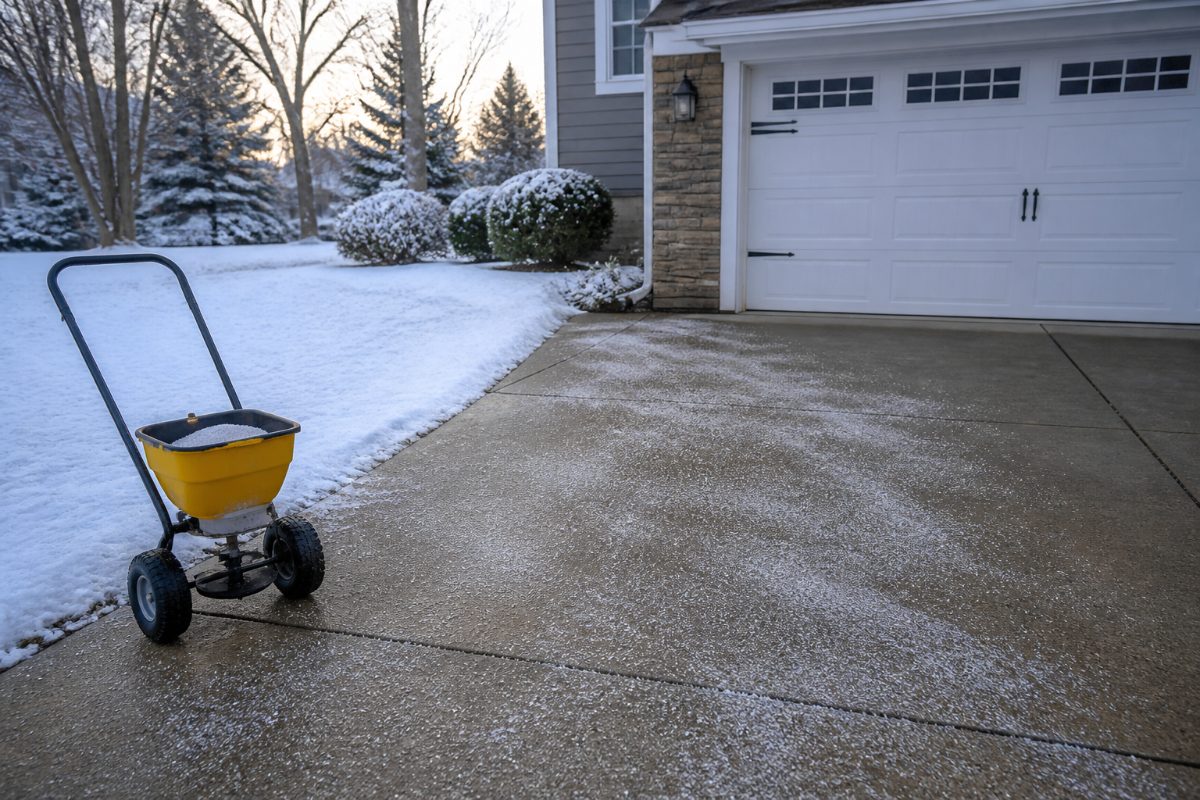
University of Maryland Extension says deicers are most effective when spread thinly and evenly before ice forms. Preventing ice from bonding is easier than trying to melt a thick layer after it has formed. A concentrated pile can leave much of the pavement untreated while placing excess product in one spot.
Apply carefully across the surface, following the label. If you use a handheld spreader, make a controlled pass over the target area and inspect the distribution from a safe position. For a small patch, distribute the product across the patch instead of dropping a large clump in its center.
When to apply ice melt: before ice or after it forms?
For prevention, apply a product before ice forms when its directions allow it and freezing conditions are expected. University of Maryland Extension says pre-ice application is more effective than trying to melt a thick layer later. That does not mean every driveway needs a full-area treatment before every winter event: use the label rate and focus on the surface that needs protection.
Once thick ice has formed, avoid responding by simply doubling the amount. The University of Maryland Extension notes that a small amount of water can help initiate melting when treating thick ice in very cold weather. It also describes mixing deicer with wet sand and/or ashes to aid melting and provide sure footing. Follow the product label and do not improvise a mixture that conflicts with its directions.
Sand is a traction aid, not a substitute for the deicer’s melting action. If the main problem is slippery footing and melting is slow, adding a traction material can address the immediate grip problem while the ice treatment works. After the surface loosens, remove snow and slush so they do not remain as a wet layer that can refreeze.
Choose an amount based on the product and pavement temperature
Different compounds have different operating ranges, speeds, and surface impacts. The University of Maryland Extension’s comparison lists magnesium chloride as working to −13°F, calcium chloride to −22°F, sodium chloride to 18°F, and potassium chloride to 25°F. The same table rates their speeds from very fast to slow and flags possible damage to concrete, metal, or plants.
| Product listed by University of Maryland Extension | Minimum working temperature | Listed speed | Surface and plant notes |
|---|---|---|---|
| Magnesium chloride | −13°F | Very fast | No concrete or metal damage in the table; moderate plant harm. |
| Calcium chloride | −22°F | Fast | Can damage concrete and metal; can harm plants. |
| Sodium chloride, or salt | 18°F | Moderate | Can damage concrete and metal; can harm plants. |
| Potassium chloride | 25°F | Slow | Listed as OK on old concrete; moderate plant harm. |
These are product-category comparisons, not a reason to exceed a package rate. UNH Extension also cautions that over-application of any ice melt can be harmful. For a real application, use the specific product label, because the compound name and temperature range do not supply a driveway dosage by themselves.
Be especially cautious with new concrete. University of Maryland Extension says sodium chloride and calcium chloride are particularly damaging to newly poured concrete and advises against applying those chemicals to brick or stone. If the driveway has one of those surfaces, do not assume that a lower dose makes an unsuitable product appropriate; select a compatible approach based on the label and surface guidance.
How much should you use on new concrete, plants, or a sloped drive?
New concrete: Avoid treating the extension’s warning as a challenge to find a smaller dose of rock salt or calcium chloride. The source specifically identifies those products as particularly damaging to newly poured concrete. Read the product directions and choose a method that does not conflict with the surface warning.
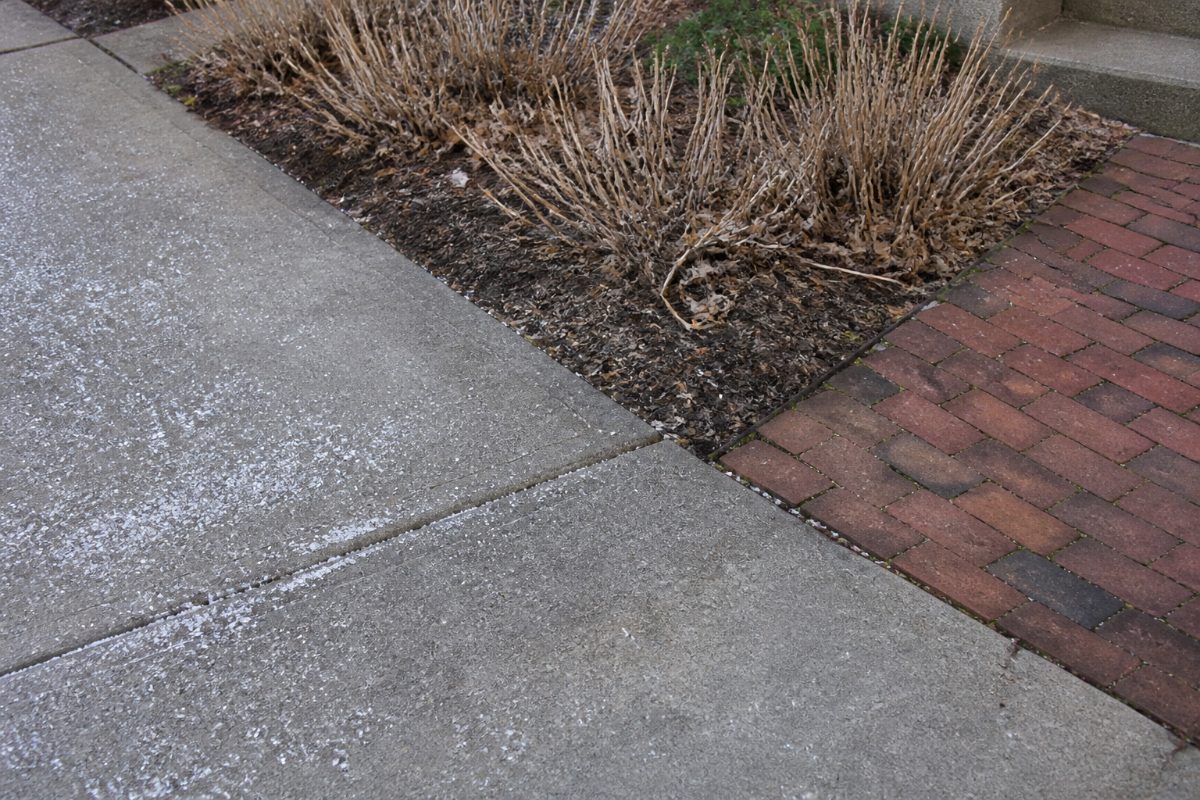
Brick or stone: University of Maryland Extension says sodium and calcium chloride should not be applied to brick or stone surfaces. Keep the product off those areas and use a compatible alternative or a traction material when appropriate.
Nearby plants: Keep the application focused on the pavement, not borders or planting beds. The Extension comparison lists plant harm for several products, and UNH Extension notes that over-application can injure grass and plants. Do not treat extra product as harmless runoff.
Sloped or frequently shaded driveway: Treat only the area that needs it, and prioritize a thin, even layer rather than a heavy coating. If a product melts slowly at the pavement temperature, adding a thicker layer is not a reliable fix; use the label’s temperature guidance and consider traction from wet sand where suitable.
Common ice-melt mistakes and how to avoid them
- Using the same scoop for every product. Granules and application rates differ. Use the label rate and measured area rather than a remembered scoop count.
- Applying a thick pile to thick ice. University of Maryland Extension says prevention is easier than melting thick ice. Spread the deicer evenly and use its guidance for thick ice rather than assuming more product solves the problem.
- Choosing by air temperature alone. Pavement temperature is the relevant surface condition for ice bonding, according to Midwest Salt’s guide. Use the product’s stated working temperature and the actual surface conditions as your decision points.
- Ignoring the driveway material. Calcium chloride and sodium chloride can damage certain surfaces, and the Extension advises against them on brick and stone. Identify the surface before opening the bag.
- Using fertilizer to melt ice. University of Maryland Extension says Maryland’s Lawn Fertilizer Law prohibits fertilizer use for melting ice and snow because fertilizer nutrients can harm local waterways. Fertilizer is not a substitute deicer.
- Spreading product everywhere “just in case.” Over-application can harm plants and surfaces. Measure the treated area, follow the rate, and keep application focused.
Which approach fits your situation?
| Your situation | Practical approach |
|---|---|
| You are applying ice melt for the first time. | Measure the target area, read the label rate and temperature guidance, then use a small, controlled application that covers the pavement evenly. |
| You treat the driveway regularly. | Keep the product’s rate information with your spreader and use a rate chart. MPCA recommends calibrating application equipment each year so the spreader’s output is not simply guessed. |
| You want to limit product near landscaping. | Treat the pavement area that needs it rather than broadcasting over the whole property. Avoid piles and use the product label’s rate. |
| The ice is thick and the weather is very cold. | Do not compensate automatically with a heavy dose. Follow the label’s temperature limits; University of Maryland Extension describes a small amount of water to initiate melting and wet sand and/or ashes to aid melting and footing. |
| Your driveway is brick, stone, or newly poured concrete. | Check surface compatibility before applying a chloride product. The Extension specifically warns against sodium and calcium chloride on brick or stone and identifies both as particularly damaging to newly poured concrete. |
Frequently Asked Questions
Can I use too much ice melt on a driveway?
Yes. University of Maryland Extension advises applying only enough for thin, even coverage, and UNH Extension warns that over-application can harm plants and surfaces. Extra material is not a reliable way to make an incompatible product or unsuitable temperature range work.
Should I spread ice melt before snow or after ice forms?
For preventing ice from bonding, University of Maryland Extension says deicers are most effective when applied before ice forms. If thick ice is already present, follow the product’s directions instead of assuming a heavier application will melt it faster.
Is rock salt safe for every driveway?
No. The University of Maryland Extension table lists sodium chloride as working down to 18°F and notes potential concrete and metal damage and plant harm. The Extension also says sodium chloride should not be applied to brick or stone and can be particularly damaging to newly poured concrete.
Should I use air temperature to choose an ice melt?
Use the product’s temperature guidance, but do not treat air temperature as the whole picture. Midwest Salt’s guide distinguishes air temperature from pavement surface temperature and identifies pavement surface temperature as the key condition where ice bonds to pavement.
What can I use when ice melt is slow?
First confirm that the product is within its stated working temperature and has been spread as directed. University of Maryland Extension describes wet sand and/or ashes mixed with deicer as a way to aid melting and provide sure footing; use only an approach compatible with the product and surface.
Key points for a safer application
- Measure the area and calculate the amount from the product’s own label rate.
- Spread a thin, even layer; do not substitute piles or extra scoops for coverage.
- Use pavement temperature and surface compatibility when choosing a product.
- Protect plants and vulnerable surfaces by limiting application to the pavement that needs treatment.
- For repeated use, a rate chart and annually calibrated spreader make the amount more consistent.
There is no one-size-fits-all ice-melt quantity for every driveway. The dependable method is to match the label rate to the measured treatment area, then adjust the product choice—not the dose blindly—to the pavement, ice, and temperature.
References
- Melting Ice Safely | University of Maryland Extension
- Breaking the Ice | Extension
- THIRD EDITION
- [PDF] Smart Salting for Parking Lots and Sidewalks Manual
Information in this post was checked as of October 2026. Policies and prices may change, so please verify important details with official sources.


Comments
Post a Comment