CO Alarm Placement Near Bedrooms and Furnaces
Key Takeaways
- Place CO alarms on every level of the home and outside sleeping areas so an alarm can be heard near bedrooms.
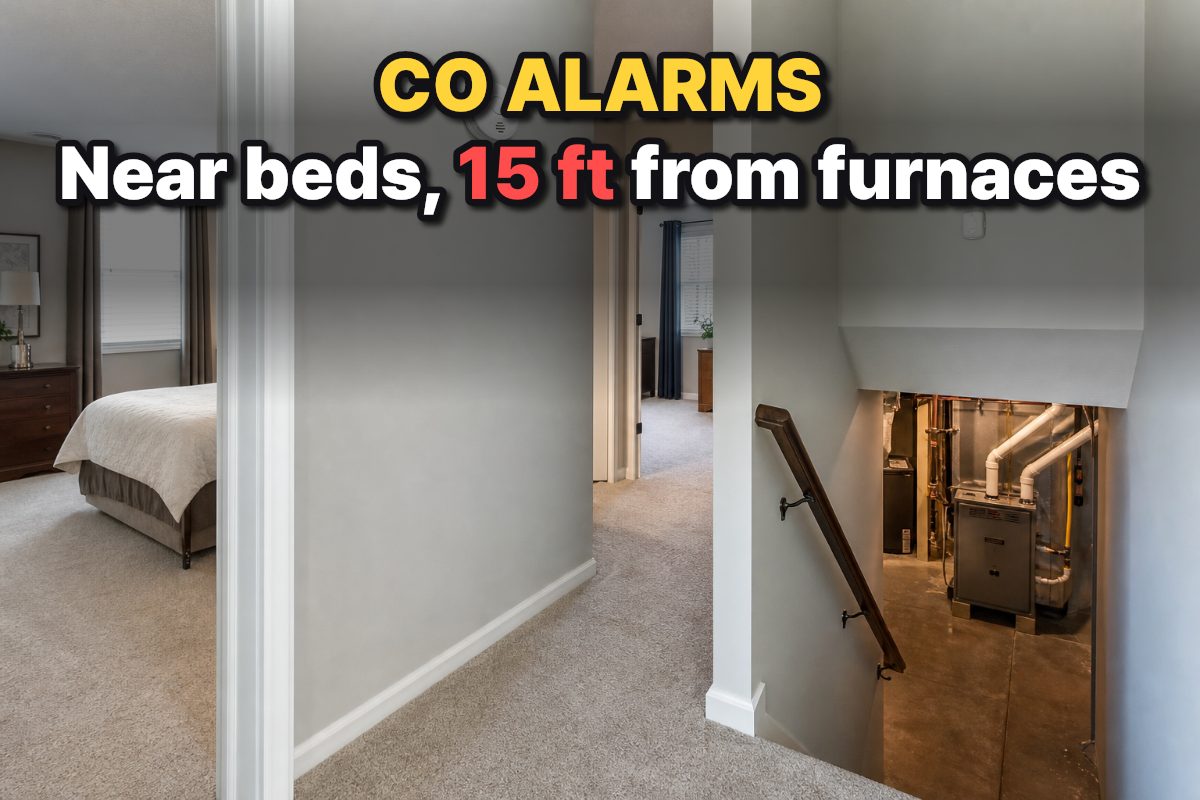
- Keep an alarm near a furnace area, but not directly beside a gas-burning appliance; the City of Madison recommends at least 15 feet of separation.
- Mounting height guidance differs: Madison says wall or ceiling height does not matter, while manufacturers may specify a particular location.
- Use the alarm’s installation instructions to resolve placement details, especially in homes with separated bedrooms or multiple fuel-burning appliances.
Table of Contents
- Where should CO alarms go near bedrooms and furnaces?
- How close should an alarm be to a bedroom?
- Where should a CO alarm go near a furnace?
- Does a CO alarm need to be mounted high or low?
- How many alarms does a home need?
- What placement mistakes should you avoid?
- A quick placement plan for different homes
- Frequently Asked Questions
- Key placement points
Where should CO alarms go near bedrooms and furnaces?
CO alarm placement should cover every level of the home, sleeping areas, and locations with fuel-burning appliances. For a bedroom, put an alarm outside and near the sleeping area; for a furnace, put one in the appliance area but keep it at least 15 feet from a gas-burning appliance when following the City of Madison Fire Department’s guidance.
Carbon monoxide (CO) is a gas that cannot be detected by sight or smell, so an alarm’s location matters: it needs to be placed where it can detect CO and alert people in the home. The recommendations are not identical across every source. Follow the instructions for your specific alarm and check local requirements if you are installing equipment in a rental or a home subject to local rules.
How close should an alarm be to a bedroom?
Install an alarm outside and near sleeping areas, where it can alert people while they are asleep. Carrier recommends placing alarms within 10 feet of every sleeping area, while the City of Madison’s guidance says to place them outside and near sleeping areas.
Think of “near” as a placement goal, not a reason to put the unit inside a closet or behind a door. The alarm needs an unobstructed location where its sound can reach the sleeping area. If a home has bedrooms in separate parts of a floor, the layout may call for more than one alarm; Madison notes that its example floor plans call for two alarms when bedroom doors are more than 30 feet apart.
- One bedroom: Place an alarm outside the bedroom, in the adjacent hall or nearby common area.
- Bedrooms grouped together: A shared hall location may serve the sleeping area if the alarm instructions allow it and the sound can be heard in each room.
- Bedrooms far apart: Check each sleeping-area location separately rather than assuming one hallway alarm will cover the entire floor.
Where should a CO alarm go near a furnace?
Place an alarm in the area of a major fuel-burning appliance, such as a furnace or water heater, but do not mount it directly next to the equipment. The City of Madison recommends at least 15 feet between an alarm and a gas-burning appliance; Carrier gives the same minimum distance for furnaces.
This distinction is easy to miss: “near the furnace area” does not mean “on the furnace” or immediately beside it. The goal is to protect the part of the home where a fuel-burning appliance is located while respecting the separation distance in the guidance. If the furnace is in a basement, place an alarm on that level and maintain coverage on the home’s other levels too.
- Identify the furnace, water heater, fireplace, or other major fuel-burning appliance.
- Choose a location in the same general area that is at least 15 feet away from the gas-burning appliance, following Madison and Carrier guidance.
- Check that the alarm is not blocked by stored items, furniture, or a closed cabinet.
- Compare the location with the alarm manufacturer’s instructions before fastening or plugging in the unit.
Do not treat the 15-foot figure as permission to leave a level without an alarm. Coverage by floor and separation from the appliance are two different placement considerations.
Does a CO alarm need to be mounted high or low?
There is no single mounting height that applies to every CO alarm. The City of Madison says an alarm can be mounted on a wall or ceiling because CO’s weight is very close to that of normal atmosphere, so mounting height does not matter in its guidance.
Carrier says height requirements can vary by model and describes knee-to-chest height as a common recommendation. These instructions differ in emphasis, so use the specific alarm manual as the final guide for its mounting position. Do not move a ceiling-mounted or wall-mounted model to a different height simply because you assume CO always rises or always sinks.
| Placement question | Practical reading of the guidance |
|---|---|
| Wall or ceiling? | Madison allows either; check the alarm manual for the model-specific location. |
| High or low? | Madison says height does not matter; Carrier notes that some models have height guidance. |
| Near a furnace? | Use the furnace area for coverage, but keep the alarm at least 15 feet away from gas-burning equipment under Madison and Carrier guidance. |
How many alarms does a home need?
Plan for at least one CO alarm on each level, including the basement, and add coverage near sleeping areas. NerdWallet summarizes common placement guidance as one alarm on each home level and outside bedrooms; Kidde also recommends an alarm on each level, ideally on levels with fuel-burning appliances and outside sleeping areas.
A single alarm near the furnace does not replace alarms near bedrooms or on other floors. In a multistory home, map each level independently. Then mark sleeping areas and major fuel-burning appliances on the same sketch; this makes gaps visible before installation.
- Single-level home: Cover the floor and place an alarm outside the sleeping area; account for the furnace or other fuel-burning equipment.
- Multistory home: Plan an alarm for each level, including the basement, then add bedroom-area coverage as needed.
- Spread-out bedrooms: Compare bedroom locations with the alarm maker’s coverage and Madison’s example noting two alarms when bedroom doors are more than 30 feet apart.
- Attached garage or extra fuel-burning equipment: Consider those locations when mapping coverage; NerdWallet identifies areas near garages as a placement consideration.
What placement mistakes should you avoid?
A common mistake is placing the only alarm in the basement beside the furnace. A 2013 study on CO-poisoning risk behaviors reported that many surveyed people placed alarms in basements or attics near furnaces, while fewer placed them in bedrooms, common areas, or garages. A furnace-area alarm alone may therefore leave sleeping areas or other floors without nearby coverage.
Other mistakes come from treating one rule as universal. Sources differ on mounting height and the distance recommended from sleeping areas, so avoid copying a generic diagram without checking your model’s instructions and the room layout.
- Too close to a gas appliance: Keep the recommended separation; Madison and Carrier specify at least 15 feet.
- Only one alarm for a multi-level home: Add coverage on each level rather than relying on the furnace location.
- Obstructed placement: Kidde advises choosing a location free of obstructions and away from adverse environmental conditions.
- Assuming all alarms mount the same way: Check the product instructions for the specific model, especially where height or room placement is unclear.
A quick placement plan for different homes
For a first-time installation, draw a simple floor plan before choosing mounting points. Mark bedrooms, stairs, the furnace, and other major fuel-burning appliances, then compare each proposed spot with the spacing and model instructions.
- Start with floors: Mark one alarm location on every level, including the basement.
- Add sleeping-area coverage: Mark a location outside and near each bedroom area. For rooms far apart, evaluate whether one alarm can reasonably cover them or whether another is needed.
- Add appliance-area coverage: Mark a spot near the furnace or other major fuel-burning appliance, maintaining at least 15 feet from gas-burning equipment under Madison and Carrier guidance.
- Check the device manual: Confirm the permitted mounting position and any model-specific distance or height directions.
- Review the finished map: Make sure each floor, sleeping area, and relevant appliance area has been considered before installation.
If you already have alarms, use the same map as an audit. A unit near the furnace may be useful, but it should not be counted as bedroom-area coverage unless its location and the manufacturer’s guidance support that placement.
Frequently Asked Questions
Should a CO alarm be inside or outside a bedroom?
Place an alarm outside and near sleeping areas, as recommended by the City of Madison. Carrier recommends placing alarms within 10 feet of every sleeping area; check your model’s instructions when deciding on the exact spot.
Can I put a CO alarm right next to my furnace?
No. Madison and Carrier recommend keeping CO alarms at least 15 feet from gas-burning appliances such as furnaces. Place an alarm in the furnace area while maintaining that separation.
Does carbon monoxide rise, so the alarm must be on the ceiling?
Madison says CO’s weight is very close to that of normal atmosphere and that mounting height does not matter in its guidance. Carrier notes that height recommendations can vary by alarm model, so follow the instructions for your unit.
Do I need a CO alarm in the basement?
Yes, include the basement when planning alarms for every level of the home. If a furnace is there, maintain the recommended separation from the appliance and still provide coverage near bedrooms and on other floors.
Key placement points
Put CO alarms on every level, outside and near sleeping areas, and in areas with major fuel-burning appliances. Keep alarms at least 15 feet from gas-burning appliances under City of Madison and Carrier guidance, and use the unit’s instructions to settle mounting-height and model-specific details.
Placement recommendations can differ by source and alarm model. This guidance reflects the sources reviewed as of September 28, 2026; check the current instructions supplied with your alarm and local requirements before installation.
References
- Where to Place a Carbon Monoxide (CO) Alarm - NerdWallet
- Where To Place Your Carbon Monoxide Alarms | Fire | City of Madison, WI
- Storm-Related Carbon Monoxide Poisoning: An Investigation of Target Audience Knowledge and Risk Behaviors - PM
- Where to Place Carbon Monoxide Detector | Best Placement Guide
- Placement of Carbon Monoxide Alarms | Kidde
Information in this post was checked as of 2026-09-28. Policies and prices may change, so please verify important details with official sources.


Comments
Post a Comment