Best Indoor Humidity in Winter to Prevent Window Condensation
Key Takeaways
- A useful starting target for preventing winter window condensation is 30–40% relative humidity (RH), but colder outdoor temperatures call for lower indoor humidity.
- Check a digital hygrometer in more than one room, then compare the reading with the outdoor-temperature guide below.
- Condensation on the room-side glass usually points to moisture in the indoor air meeting a cold surface; moisture between panes can indicate a failed window seal.
- Reduce avoidable moisture from showers, cooking, and indoor laundry before relying on a humidifier to correct dry air.
Table of Contents
- What indoor humidity level prevents window condensation?
- Why does condensation form on windows in winter?
- How do you measure and adjust humidity at home?
- What should you do when windows are wet?
- How low is too low for winter humidity?
- Which humidity target fits your situation?
- Frequently Asked Questions
- Quick winter checklist
The best indoor humidity level in winter to prevent window condensation is usually 30–40% RH, with a lower target during severe cold. The right number is not fixed: as the outdoor temperature drops, window glass gets colder, so indoor air needs a lower moisture level to avoid reaching its dew point at the glass.
What indoor humidity level prevents window condensation?
Start by aiming for 30–40% RH in winter, then lower the target if condensation appears or outdoor temperatures fall sharply. The U.S. Environmental Protection Agency’s general year-round guidance is 30–50% RH, as summarized by Innovative Dehumidifiers, but the upper end may be too high for cold windows.
That difference is not a contradiction. A general humidity range addresses overall indoor conditions; preventing condensation on a cold window can require a lower reading. Use the table as a practical starting point, not as a guarantee that every window will stay dry: glass temperature, window construction, and room conditions affect where droplets form.
| Outdoor temperature | Suggested indoor RH ceiling |
|---|---|
| 20°F to 40°F | 40% |
| 10°F to 20°F | 35% |
| 0°F to 10°F | 30% |
| -10°F to 0°F | 25% |
| Below -10°F | 20%; some guidance suggests 15% below -20°F |
The cold-weather targets reflect humidity guidance for reducing window condensation, including the winter advice discussed by ARS. For readings below -10°F, sources differ on how low to go; start with the 20% ceiling and pay attention to both window moisture and signs of overly dry indoor air.
Why does condensation form on windows in winter?
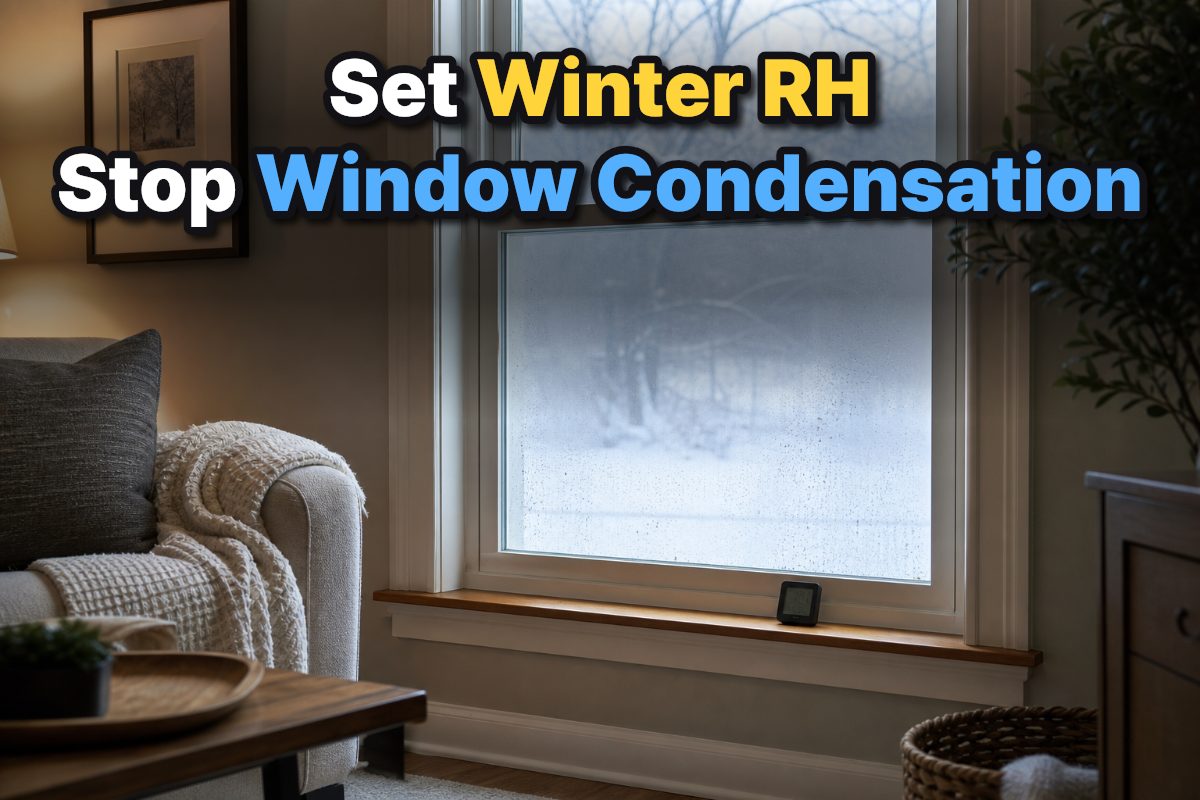
Condensation forms when warm, moisture-containing indoor air touches a surface cold enough to cool the air below its dew point. The dew point is the temperature at which water vapor in the air begins to turn into liquid water; in winter, window glass is often among the coldest surfaces in a room.
Relative humidity, or RH, is the amount of water vapor in the air compared with the maximum it can hold at that temperature. Because warm air can hold more moisture than cold air, air next to cold glass cools quickly and can release some of its moisture as droplets. Pella and JELD-WEN describe this indoor-air-and-cold-glass pattern as a common cause of winter condensation.
Everyday activities add moisture: showers, cooking, washing dishes, indoor laundry drying, houseplants, and breathing all contribute. Tightly sealed homes can retain more of that moisture because less indoor air is exchanged with drier outdoor air. That efficiency can help reduce heating losses, but it also makes humidity control more noticeable.
How do you measure and adjust humidity at home?
A digital hygrometer measures indoor RH and gives you a reading to compare with the cold-weather targets. Check more than one location—such as a bedroom, bathroom, and basement—and take readings at different times, because moisture levels can vary around the house.
- Place the hygrometer in a lived-in room. Keep it away from a humidifier, a direct heat source, or a spot where it would measure a local pocket of moisture rather than the room’s general air.
- Record the RH and outdoor temperature. Compare the readings with the table, especially when the weather turns colder.
- Look for a pattern. Note whether droplets appear after showers, cooking, or overnight, and which windows or rooms are affected.
- Reduce moisture at its source. Avoid drying laundry indoors when possible, and use available kitchen or bathroom ventilation during moisture-producing activities.
- Recheck before changing humidifier settings. If a humidifier is running, lower its output or pause it when the reading is above the relevant target and condensation is present.
These steps help distinguish a whole-house humidity issue from a problem limited to one room or window. A hygrometer reading is more useful than guessing based on how dry the air feels, particularly when a humidifier is in use.
What should you do when windows are wet?
First, identify where the moisture is: on the room-side glass, on the outdoor surface, or between window panes. For indoor droplets, reduce indoor moisture and keep checking RH as outdoor temperatures change; Pella’s window-condensation guidance also treats indoor humidity as a key factor to investigate.
- Wipe away standing water. This removes moisture that could sit on the sill or frame. Drying the glass does not solve the source, so pair it with a humidity check.
- Check the room’s humidity. If it is above the suggested ceiling for the outdoor temperature, reduce added moisture or humidifier output.
- Compare rooms and windows. If one room reads much higher or only one window is affected, consider local moisture sources and differences in how cold the glass becomes.
- Inspect between panes. Fog or moisture trapped between panes is different from droplets on the room-side surface. JELD-WEN describes condensation between panes as a sign of a possible seal failure; it is not usually fixed by lowering room humidity.
A common mistake is to assume that any indoor condensation proves a window is defective. Room-side condensation often reflects humid indoor air contacting cold glass; a window can simply be the first surface where excess moisture becomes visible.
How low is too low for winter humidity?
Lowering RH can help stop window droplets, but very dry indoor air can be uncomfortable. The supplied winter guidance flags readings below about 25–30% RH as a range where dry skin, cracked lips, nose irritation, static electricity, and drying or cracking of wood may become concerns.
Use the lowest target that addresses the condensation rather than lowering humidity without checking the result. If RH is already low and people in the home notice dryness, do not keep reducing it automatically; check whether moisture is coming from a specific activity or whether condensation is limited to a particular window.
Likewise, a humidifier is not a universal winter fix. Adding moisture can ease dry-air discomfort, but running it too aggressively can push RH high enough to increase window condensation and moisture-related damage. Recheck a hygrometer after changing the setting instead of relying only on the humidifier’s dial.
Which humidity target fits your situation?
Choose a starting point based on both the weather and what you observe—not simply on a year-round target. The EPA range summarized by Innovative Dehumidifiers is useful context, while the winter temperature steps provide a more specific condensation-control guide.
| Your situation | Practical next step |
|---|---|
| You are new to tracking humidity | Use a digital hygrometer in a bedroom and a room where condensation appears; note RH and outdoor temperature. |
| You already use a humidifier | Set a lower output during cold spells and recheck the room reading rather than keeping one setting all winter. |
| Condensation appears during a cold snap | Compare RH with the table, reduce indoor moisture sources, and observe whether the glass dries. |
| Only one window is affected | Check that room’s humidity and the location of the water before assuming every room needs a lower target. |
| Moisture appears between panes | Treat it as a possible seal issue rather than ordinary room-side condensation. |
Modern, tightly sealed homes can hold onto moisture from routine activities, so a home that feels comfortable may still need a lower winter RH when outdoor temperatures plunge. Managing humidity can also support energy-conscious comfort: the goal is not to ventilate away all indoor warmth, but to control added moisture and avoid keeping the air more humid than cold windows can tolerate.
Frequently Asked Questions
What is the ideal indoor humidity in winter to prevent window condensation?
A practical starting range is 30–40% RH. When outdoor temperatures fall below 20°F, use a lower ceiling from the temperature guide and adjust further if condensation continues.
Why do my windows get condensation in winter?
Warm indoor air cools when it meets cold glass. If the air at the glass cools below its dew point, water vapor becomes liquid droplets on the window.
Does condensation on the inside of a window mean the window is bad?
Not necessarily. Room-side condensation commonly points to indoor moisture meeting cold glass, while moisture between panes can indicate a failed seal.
What household activities raise indoor humidity?
Showers, baths, cooking, dishwashing, and drying laundry indoors add moisture. Houseplants and people also contribute to indoor humidity.
How can I tell if my home is too humid?
Measure RH with a digital hygrometer in several rooms and compare the readings with outdoor temperature. Persistent window droplets are another practical signal to check indoor moisture, but they do not identify the cause by themselves.
Quick winter checklist
- Start near 30–40% RH, then lower the target as outdoor temperatures drop.
- Use a digital hygrometer and compare more than one room.
- Cut avoidable moisture from indoor laundry, showers, and cooking.
- Wipe standing water and check whether condensation is on the room side or between panes.
- Balance condensation control with signs of excessively dry air.
Humidity recommendations are general starting points, and window conditions differ from home to home. Recheck readings during cold spells; if indoor RH is controlled but moisture between panes persists, the issue may be the window seal rather than the room’s humidity.
References
- How to Deal with Window Condensation | Pella
- jeld-wen.com
- The Best Humidity Level for Your Home This Winter
- Ideal Indoor Humidity Level: What the EPA Recommends | IDS
Information in this post was checked as of 2026-09-27. Policies and prices may change, so please verify important details with official sources.


Comments
Post a Comment